Introduction
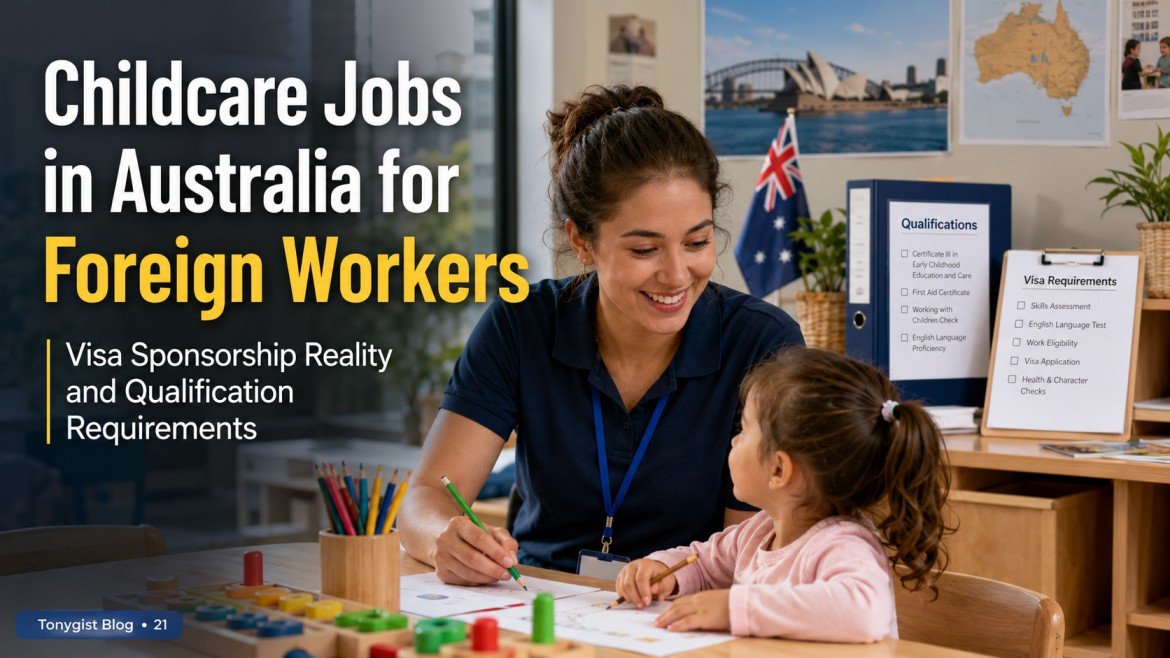
Australia’s early childhood education and care sector has faced a well-documented and sustained workforce shortage, and this has led many foreign workers to research childcare jobs in Australia as a potential pathway abroad. The demand is genuine, but the path from “Australia needs childcare workers” to “I have a sponsored childcare job in Australia” involves specific qualification requirements, working with children checks, and a visa system that does not treat every childcare role the same way.
This guide explains exactly how Australian childcare employment connects to visa sponsorship, what qualifications you actually need before you can work in this field, how the skills assessment and registration process works, and what realistic pay and working conditions look like. It is written to give you an accurate picture rather than the inflated promises that circulate around this topic, since childcare work in Australia involves working with vulnerable children, and the regulatory framework around it is, appropriately, quite serious.
Australian immigration policy, skilled occupation lists, and qualification recognition requirements all change periodically. Always verify current details directly through the Department of Home Affairs and the Australian Children’s Education and Care Quality Authority (ACECQA) before making decisions.
Table of Contents
- Why Australia Has a Genuine Childcare Workforce Shortage
- Understanding the Different Levels of Childcare Roles in Australia
- Qualification Requirements for Each Role Level
- Getting Your Overseas Qualification Recognised in Australia
- Working with Children Checks: A Mandatory Requirement
- Which Childcare Roles Appear on Skilled Occupation Lists
- Visa Pathways Relevant to Childcare Workers
- The Skills Assessment Process for Early Childhood Educators
- Realistic Pay Across Different Childcare Roles
- What Genuine Employer Sponsorship Looks Like
- Key Things to Know
- Common Mistakes to Avoid
- Practical Tips
- Frequently Asked Questions
- Conclusion
Why Australia Has a Genuine Childcare Workforce Shortage
Australia’s early childhood education and care sector has expanded significantly over the past decade, driven by government subsidies that have increased demand for childcare places, alongside ongoing difficulty attracting and retaining qualified staff. Industry reports and government workforce assessments have consistently identified early childhood education roles as facing sustained shortages, particularly for qualified educators and centre directors, rather than entry-level assistant roles.
This shortage is real and has been reflected in the inclusion of certain early childhood occupations on Australian skilled occupation lists at various points. However, as with most labour shortage and visa sponsorship topics, the existence of a genuine shortage does not mean every childcare role or every employer can sponsor a foreign worker, and understanding the specific distinctions within this sector matters enormously.
Understanding the Different Levels of Childcare Roles in Australia
Childcare work in Australia is structured into distinct qualification tiers, and which tier you’re targeting significantly affects both your visa options and realistic pay.
Childcare Assistants and Trainees
Entry-level roles, sometimes called childcare assistants or trainees, generally require at most a Certificate III in Early Childhood Education and Care, and in some cases workers can begin in these roles while still completing this qualification under supervision.
Diploma-Qualified Educators
Educators holding a Diploma of Early Childhood Education and Care can generally take on more responsibility within a centre, including counting toward higher educator-to-child ratios required by Australian regulations, and this qualification level is more commonly associated with genuine skill shortage recognition.
Early Childhood Teachers
Early childhood teachers hold a bachelor’s degree (or equivalent) specifically in early childhood education, and this is the most qualified tier within the sector, generally carrying the strongest case for skilled visa sponsorship due to both the degree-level qualification and the specific regulatory requirements for qualified teachers within Australian childcare centres.
Centre Directors and Coordinators
Centre directors and educational leaders typically combine substantial early childhood qualifications with management experience, and these roles, due to their salary level and responsibility, are also more realistically positioned for sponsorship consideration than entry-level assistant roles.
Qualification Requirements for Each Role Level
Understanding Australia’s specific qualification framework, the Australian Qualifications Framework (AQF), helps you understand where your existing overseas qualifications and experience might fit.
Certificate III level qualifications are the minimum standard for most direct childcare roles in Australia and are generally completed through Registered Training Organisations (RTOs) within the Australian vocational education system.
Diploma level qualifications represent a more advanced vocational standard, generally requiring more extensive coursework and practical placement experience, and educators with this qualification can take on responsibilities that Certificate III holders cannot under Australian childcare ratio regulations.
Bachelor’s degree qualifications in early childhood education or a related field with appropriate specialisation are required for early childhood teacher roles, and this is generally the qualification level most clearly aligned with Australia’s points-based skilled migration system, given that most professional, degree-requiring occupations are more favourably treated under skilled visa categories than vocational-level roles.
Getting Your Overseas Qualification Recognised in Australia
If you already hold childcare or early childhood education qualifications from another country, you generally cannot simply transfer them directly into the Australian system without some form of assessment or recognition process.
Vocational Qualifications (Certificate and Diploma Level)
For Certificate III and Diploma-level equivalent overseas qualifications, recognition is generally assessed through Australian Registered Training Organisations or through formal skills recognition processes, sometimes involving a gap analysis that identifies specific units of competency you may need to complete to align with Australian standards.
Degree-Level Qualifications (Early Childhood Teacher)
For overseas bachelor’s degrees in early childhood education, recognition for teaching registration purposes is generally handled by the relevant state or territory teacher registration authority, since early childhood teachers in Australia must be registered in a similar way to school teachers, and these authorities assess whether your overseas degree and teaching practicum experience are comparable to Australian initial teacher education standards.
Why This Process Takes Genuine Time
Qualification recognition in this sector is not a quick formality. Depending on how closely your training aligns with Australian standards, you may be asked to complete bridging units, provide additional documentation about your practicum or supervised teaching experience, or in some cases undertake further study to address identified gaps. Budget realistic time for this process rather than assuming your existing credentials will be accepted without review.
Working with Children Checks: A Mandatory Requirement
Regardless of your visa status or qualification level, every state and territory in Australia requires anyone working with children, including in early childhood education and care settings, to hold a valid Working with Children Check (WWCC) or equivalent state-specific clearance.
How This Applies to Foreign Workers Specifically
As a foreign worker, you will generally need to apply for this check once you arrive in Australia (or in some cases, as part of your visa or employment onboarding process), and the specific requirements, including what international police checks or background documentation you need to provide, vary by state and territory.
Why This Cannot Be Skipped or Expedited Improperly
This is a child safety requirement, not an administrative formality that can be bypassed. Any employer or recruiter suggesting you can begin working with children before this clearance is finalised, or that the process can be skipped entirely, should be treated as a serious warning sign, since this would represent both a regulatory violation and a genuine child safety concern.
Which Childcare Roles Appear on Skilled Occupation Lists
Australia’s skilled migration system relies on occupation lists that determine which roles are eligible for various visa subclasses, and early childhood occupations have appeared on these lists at different points, though not uniformly across all role levels.
Early childhood (pre-primary school) teachers have more consistently appeared on relevant skilled occupation lists, reflecting both the genuine shortage and the degree-level qualification that aligns with how Australia’s skilled migration points system is structured.
Childcare centre managers and coordinators have also appeared on certain occupation lists at various points, reflecting demand for experienced leadership within the sector.
Entry-level childcare assistant and Certificate III-level roles are much less likely to appear on skilled occupation lists in a way that supports a standalone skilled visa application, since these roles generally fall below the qualification threshold these lists are designed around.
Because these lists are reviewed and adjusted periodically by the Australian government, you should verify the current status of any specific occupation directly through the Department of Home Affairs’ official skilled occupation list resources rather than relying on previous years’ information.
Visa Pathways Relevant to Childcare Workers
Employer-Sponsored Visas
For early childhood teachers and centre directors specifically, employer-sponsored skilled visa pathways are the most realistic option, provided the employer is willing and able to demonstrate genuine need and the role meets the relevant skill and salary requirements under current program settings.
Skilled Independent and State-Nominated Visas
For early childhood teachers with a positive skills assessment, points-based skilled independent visas or state and territory-nominated visas may become relevant options, depending on current program settings, your points test result, and whether your specific occupation is included in relevant state nomination lists at the time of your application.
Why Entry-Level Roles Have Limited Visa Pathways
Because Certificate III and most Diploma-level childcare roles generally do not appear on the occupation lists that support skilled visa categories, foreign workers without a teaching-level qualification typically have fewer realistic standalone visa pathways tied specifically to entry-level childcare work, and may need to consider other visa categories (such as those tied to partner visas, working holiday arrangements where eligible, or study pathways) if entry-level childcare work is their primary interest.
The Skills Assessment Process for Early Childhood Educators
For early childhood teachers pursuing skilled migration specifically, a formal skills assessment is generally a required step before a relevant visa application can proceed.
What the Assessment Involves
The assessment generally reviews your qualifications, your practicum or supervised teaching experience, and sometimes your subsequent professional experience, comparing them against the standard expected of an Australian-trained early childhood teacher. The specific assessing authority and process details should be confirmed through current Department of Home Affairs guidance for your specific occupation, since assessing bodies and requirements are reviewed periodically.
Processing Time Considerations
This assessment process can take a meaningful amount of time, particularly if additional documentation or clarification is required from your training institution. Building this into your overall timeline, rather than assuming it will be resolved quickly, is a more realistic approach to planning your relocation.
Realistic Pay Across Different Childcare Roles
The following figures represent general ranges based on typical patterns in the Australian childcare sector and should be verified against current job listings and award rates, since these figures change over time and vary by state, employer, and experience level.
Childcare assistants and Certificate III-qualified workers typically earn in a more modest range, often reflecting close alignment with relevant award minimum rates for the sector.
Diploma-qualified educators typically earn somewhat more than Certificate III holders, reflecting their additional qualification and the higher ratio responsibilities they can hold within a centre.
Early childhood teachers, given their degree-level qualification and registration requirements, typically earn noticeably more than vocational-qualified educators, often in a range broadly comparable to early-career primary school teacher salaries, though this varies by state and specific employer.
Centre directors and senior leadership roles typically earn the most within the sector, reflecting both their qualifications and their management responsibilities.
Always check current Fair Work Commission award rates for the Children’s Services sector and current job listings for the most accurate and location-specific figures, since these are reviewed periodically and vary by state.
What Genuine Employer Sponsorship Looks Like
A legitimate Australian childcare employer considering sponsorship will generally be a registered, licensed childcare provider that you can independently verify, will be transparent about which specific visa pathway they intend to use and at what stage that process currently stands, and will not ask you to pay any fee to secure the position or to “process” your sponsorship.
You can verify that a specific childcare service is legitimately registered and operating by checking the Australian Children’s Education and Care Quality Authority’s National Registers, which list approved education and care services along with their quality assessment ratings, giving you a genuine, independent way to confirm a prospective employer’s standing before you commit any time or money to pursuing a role there.
Key Things to Know
Childcare roles in Australia exist across distinct qualification tiers, and your realistic visa options depend heavily on which tier you’re targeting.
Early childhood teachers, with degree-level qualifications, generally have a stronger and more consistent case for skilled visa pathways than entry-level Certificate III roles.
Overseas qualifications generally require a formal recognition or assessment process rather than transferring automatically into the Australian system.
A Working with Children Check is mandatory in every state and territory and cannot be bypassed or expedited improperly.
Skilled occupation list inclusion for childcare-related roles changes periodically and must be verified through current Department of Home Affairs resources.
Common Mistakes to Avoid
Assuming entry-level childcare assistant roles have the same visa sponsorship potential as early childhood teacher positions, when these sit in genuinely different categories under Australian immigration policy.
Believing your overseas childcare qualification transfers automatically without any Australian-specific recognition or assessment process.
Treating the Working with Children Check as an optional or expedited formality, when it is a mandatory child safety requirement enforced by state and territory authorities.
Relying on outdated information about which childcare occupations currently appear on skilled occupation lists, when these lists are reviewed and adjusted periodically.
Paying any fee to a recruiter or employer specifically to secure a childcare job offer or “guarantee” visa sponsorship.
Practical Tips
Identify which specific qualification tier your existing training and experience most closely matches, and research the Australian-equivalent qualification and recognition pathway for that specific tier before assuming a particular visa category applies to you.
If you hold or are pursuing an early childhood teaching degree, research the specific skills assessment process and current occupation list status for early childhood teachers directly through the Department of Home Affairs before applying for any visa.
Verify any prospective employer’s registration and quality rating through ACECQA’s National Registers before investing significant time in pursuing a role there.
Research the specific state or territory Working with Children Check requirements for your intended location well before you expect to begin work, since processing times and exact requirements vary.
Check current Fair Work Commission award rates for the Children’s Services sector to understand realistic, legally binding minimum pay rates before evaluating any specific job offer.
Frequently Asked Questions
1. Can I get sponsored for an entry-level childcare assistant job in Australia?
This is generally difficult, since entry-level Certificate III roles typically do not appear on the skilled occupation lists that support standalone skilled visa pathways. Early childhood teacher and centre director roles, which require higher qualifications, have a more realistic and consistent case for sponsorship.
2. Do I need an Australian qualification to work in childcare there?
You generally need either an Australian qualification or a recognised equivalent through a formal assessment process. Overseas qualifications do not automatically transfer, and the specific recognition pathway depends on whether you’re at vocational (Certificate or Diploma) or degree level.
3. What is a Working with Children Check and is it mandatory?
It’s a mandatory background check required in every Australian state and territory for anyone working with children, including in childcare settings. It cannot be skipped, and any suggestion that it can be bypassed should be treated as a serious warning sign.
4. Are early childhood teacher roles on Australia’s skilled occupation list?
Early childhood teacher roles have appeared on relevant skilled occupation lists at various points, reflecting genuine demand, but this is reviewed periodically and should be verified through current Department of Home Affairs resources rather than assumed based on past information.
5. How do I verify a childcare employer in Australia is legitimate?
You can check whether a specific education and care service is registered and review its quality rating through the Australian Children’s Education and Care Quality Authority’s National Registers, which provides an independent way to confirm a provider’s legitimate standing.
6. What qualification do I need to become an early childhood teacher in Australia?
You generally need a bachelor’s degree or equivalent specifically in early childhood education, along with registration through the relevant state or territory teacher registration authority, which assesses whether your qualification and practicum experience meet Australian standards.
7. How long does qualification recognition take for overseas childcare qualifications?
This varies depending on how closely your training aligns with Australian standards and the specific assessing body’s current processing times. It can take a meaningful amount of time, particularly if additional documentation is required, so building this into your planning timeline realistically is important.
8. Is centre director a good role to target for visa sponsorship?
Centre director and senior leadership roles, due to their qualification requirements, salary level, and management responsibility, are generally more realistically positioned for sponsorship consideration than entry-level roles, though this still depends on the specific employer and current visa program settings.
9. Can I start working with children in Australia before my Working with Children Check is finalised?
No. This check is a mandatory legal requirement, and working with children before it is properly finalised would represent a serious regulatory and child safety violation, regardless of what an employer or recruiter might suggest.
10. Do childcare workers in Australia earn more in certain states?
Pay can vary by state due to differences in award interpretations, cost of living, and regional demand, though the underlying award structure for the Children’s Services sector applies nationally with some state-based variations. Checking current, state-specific job listings and Fair Work Commission award rates gives the most accurate picture.
Conclusion
Australia’s childcare sector has a genuine and well-documented workforce shortage, but the realistic visa sponsorship pathway depends heavily on which level of childcare role you’re targeting. Early childhood teachers and centre directors, with their higher qualifications and stronger alignment with skilled occupation lists, have a considerably clearer pathway than entry-level Certificate III roles, which generally fall outside the scope of standalone skilled visa categories.
Approaching this field requires understanding Australia’s specific qualification tiers, going through the proper recognition process for any overseas training you hold, completing the mandatory Working with Children Check without shortcuts, and verifying any prospective employer independently through ACECQA’s official registers. Done properly, with realistic expectations about timeline and which roles genuinely support sponsorship, childcare work in Australia can be a legitimate and rewarding path for qualified foreign workers.