Introduction
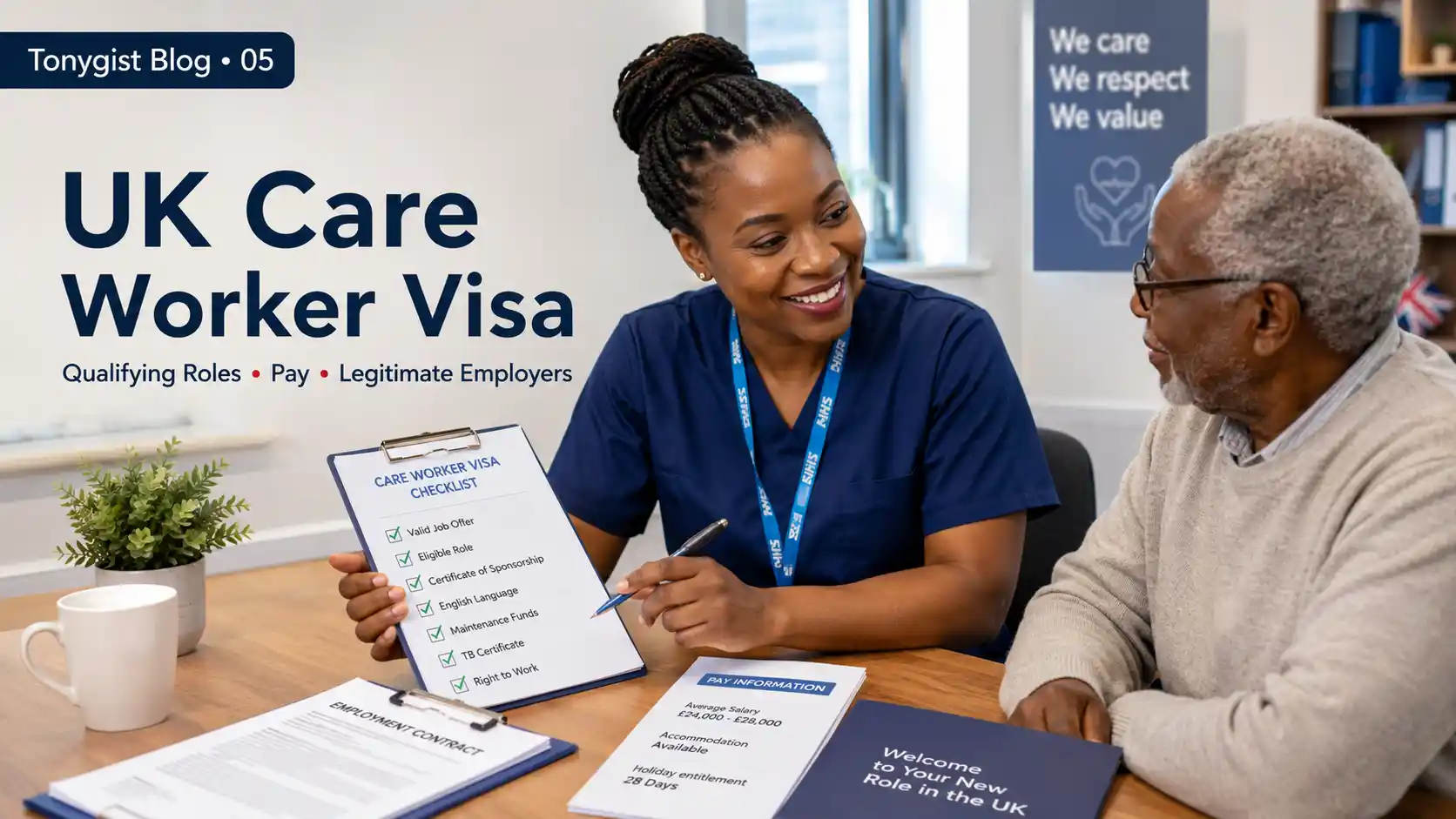
The UK care sector employs hundreds of thousands of people who support elderly, disabled, and vulnerable individuals in their daily lives. Care workers, senior care workers, and home support assistants are essential to a health and social care system that is under constant pressure from an aging population and a domestic workforce that cannot keep pace with demand.
For international applicants — particularly those from Nigeria and other African countries — the UK Health and Care Worker Visa has represented a route into the UK labour market. But the care sector has also become one of the most heavily targeted by fraudulent recruiters, exploitative employers, and outright criminal operations that prey on people who are genuinely hoping for a better life.
This guide exists to give you an accurate, honest, and detailed picture of how the UK Care Worker Visa actually works — which specific roles qualify, what the pay requirements are, how to verify that an employer is legitimate and licensed to sponsor you, what the working conditions in UK care really look like, and what your rights are once you arrive.
This is not a guide that will tell you how great every care employer is or make the process sound easier than it is. It is a guide that will help you understand the system clearly, protect yourself from the very real risks in this space, and make informed decisions based on accurate information.
All visa-related rules, salary thresholds, and employer requirements can change. Always verify the most current information through the official UK government website (gov.uk) before taking any action.
Table of Contents
- What Is the UK Health and Care Worker Visa?
- Which Care Roles Specifically Qualify for This Visa?
- The Salary Requirement: What Care Workers Must Be Paid
- What a Licensed Sponsor Must Provide
- How to Verify a UK Care Employer Using Official Registers
- What CQC Registration Means and Why It Matters
- The Certificate of Sponsorship Explained
- What the Application Process Looks Like
- Fraud and Exploitation in the Care Sector: Warning Signs
- Your Rights as a Health and Care Worker Visa Holder
- What Working in UK Care Actually Looks Like
- Dependants and Family Members Under This Visa
- Key Things to Know
- Common Mistakes to Avoid
- Practical Tips
- Frequently Asked Questions
- Conclusion
What Is the UK Health and Care Worker Visa?
The Health and Care Worker Visa is a sub-category of the UK Skilled Worker Visa that is specifically designed for qualified health and care professionals. It was introduced to help the UK fill critical gaps in its healthcare and social care workforce, which faces persistent shortages in both clinical and care roles.
The visa carries several advantages over the standard Skilled Worker Visa. These include reduced application fees, an exemption from the Immigration Health Surcharge (IHS) for the main applicant and their dependants (verify current exemption status — this has been subject to policy review), and a faster processing pathway for some applicants.
However, the Health and Care Worker Visa also has specific requirements that are stricter in certain ways than the general Skilled Worker Visa, particularly around which employers are eligible to sponsor and which roles qualify.
Who Administers the Visa
The visa is administered by UK Visas and Immigration (UKVI), a directorate of the Home Office. Employer sponsors are licensed through a separate Home Office process, and the care sector specifically has faced increased scrutiny from the Home Office following a significant expansion of care worker recruitment under the visa and a subsequent surge in fraud and exploitation cases.
Which Care Roles Specifically Qualify for This Visa?
This is the most important question to understand, and it requires precision. Not every job in a care home or care agency qualifies for the Health and Care Worker Visa under the care worker route.
The Two Main Eligible Care Worker Roles
The roles most relevant to Nigerian applicants in the care sector that appear in the eligible occupations list for the Health and Care Worker Visa are:
Care workers and home carers (SOC code 6145): This covers workers who support adults with personal care bathing, dressing, eating, mobility assistance in residential care homes, nursing homes, or in people’s own homes through domiciliary care services. The role involves direct, hands-on personal care rather than domestic cleaning, cooking, or companionship alone.
Senior care workers (SOC code 6146): Senior care workers have supervisory responsibilities alongside direct care work. They may lead shifts, supervise junior staff, handle medication administration, and liaise with healthcare professionals and families. The senior designation involves a genuine step up in responsibility and is reflected in the pay requirement.
What These Roles Involve in Practice
Care workers in the UK assist with:
- Personal hygiene (bathing, washing, toileting)
- Dressing and grooming
- Mobility and transfers (including use of hoists)
- Medication prompting or administration (depending on training level)
- Meal preparation and feeding support
- Supporting people with dementia, physical disabilities, or mental health conditions
- Completing care records and documentation
Domiciliary care workers do this work in people’s own homes, visiting multiple clients per day. Residential care workers operate from a fixed care home setting.
What Does NOT Qualify Under Care Worker Routes
Several roles in the broader care sector do not qualify under the Health and Care Worker Visa’s care worker route:
- Domestic cleaning roles in care homes
- Cooking and kitchen roles (unless also performing personal care duties)
- Administrative positions
- Receptionist or management roles without direct care duties
- Companionship-only support that does not involve regulated personal care activities
Some of these roles may qualify under different occupational codes within the broader Skilled Worker Visa framework, but they are not part of the Health and Care Worker Visa specifically.
Clinical Roles Under the Same Visa
The Health and Care Worker Visa also covers clinical healthcare roles including nurses, doctors, allied health professionals, and social workers. However, these roles have different registration and qualification requirements. This guide focuses specifically on the care worker roles.
The Salary Requirement: What Care Workers Must Be Paid
Pay is one of the most significant and most misunderstood aspects of the Health and Care Worker Visa for care workers.
The General Skilled Worker Visa Threshold
All Skilled Worker Visa holders including those on the Health and Care Worker route must be paid at least the applicable salary threshold for their occupation. Since 2024, these thresholds increased substantially. There is a general minimum threshold and a going rate for each specific occupation whichever is higher applies.
The going rate for care worker roles (SOC 6145) and senior care worker roles (SOC 6146) is set by the Home Office based on UK salary data. These rates must be met for a Certificate of Sponsorship to be issued.
The Historical Problem With Care Sector Pay
The care sector has, historically, been one of the lower-paying parts of the UK workforce. Many care workers particularly in smaller independent care homes have been paid at or near the National Living Wage. When the Skilled Worker Visa salary thresholds increased significantly from 2024, a serious tension emerged: many care employers were not paying rates that met the new thresholds.
This has had real consequences for the care sector’s ability to sponsor overseas workers and has been a subject of significant policy discussion. Some employers have adjusted pay structures to meet thresholds; others have found sponsorship untenable at current pay rates.
What This Means for You
Before accepting any job offer from a UK care employer that involves visa sponsorship, you must verify that the offered salary meets the current going rate for your specific role as set by the Home Office. An employer who cannot or will not meet the required rate cannot legally issue you a valid Certificate of Sponsorship.
Do not accept a verbal assurance alone. Ask for the written job offer including the specific annual or hourly salary, and then check it against the current published going rate on the gov.uk Appendix Skilled Occupations page.
Hours of Work and Minimum Salary
The going rate requirement applies to the hours you are contracted to work. An employer who offers minimum wage but limits your contracted hours to reduce the total annual salary may structure the offer in a way that does not meet the threshold. Understand both your hourly rate and your guaranteed contracted hours before assessing whether an offer meets the requirements.
What a Licensed Sponsor Must Provide
An employer who wants to hire an international care worker through the Health and Care Worker Visa must hold a valid Sponsor Licence from the Home Office. This is not optional — without a licence, the employer cannot legally issue a Certificate of Sponsorship.
What the Sponsor Licence Requires
To hold a Sponsor Licence in the care sector, employers must meet specific requirements including:
- Being registered with the Care Quality Commission (CQC) if providing regulated care activities in England or with equivalent bodies in Wales (CIW), Scotland (Care Inspectorate), or Northern Ireland (RQIA)
- Demonstrating that the roles being sponsored are genuine and meet the eligibility criteria
- Maintaining records on sponsored workers and reporting changes to the Home Office
- Not having been subject to licence revocation, suspension, or specific compliance actions
The Home Office has increased scrutiny of care sector sponsors following a significant expansion of the sector’s international recruitment and subsequent evidence of exploitation and fraud. Some organisations have had their licences suspended or revoked following compliance failures.
The Importance of This for You
An employer with a suspended or revoked licence cannot issue valid Certificates of Sponsorship. Workers who have already arrived in the UK sponsored by such an employer face serious consequences including the potential loss of their right to remain. This makes verifying licence status before you apply — and before you arrive essential.
How to Verify a UK Care Employer Using Official Registers
This section is one of the most practically important in this entire guide.
The Register of Licensed Sponsors
The UK Home Office maintains and publishes a Register of Licensed Sponsors. This is a downloadable file available on the gov.uk website that lists every organisation currently holding a valid Skilled Worker or Temporary Worker sponsor licence.
How to use it:
- Go to the official gov.uk website and search for the Register of Licensed Sponsors
- Download the current version of the register
- Search the file for the name of the employer who has made you a job offer
- If the employer’s name does not appear, they do not currently hold a valid licence
This is a public register you are entitled to use it. Any legitimate employer will not object to you checking their status. An employer who discourages you from checking the register is a red flag.
The register is updated regularly but not in real time. An employer may have recently obtained or lost their licence. If you want absolute certainty, you can ask the employer for their Sponsor Licence reference number and verify it directly.
Companies House
Companies House is the UK’s official registrar of companies. You can search for any UK registered company on the Companies House website to verify:
- That the company exists
- When it was incorporated
- Its registered address
- Its directors
- Whether it is active or has been dissolved
A legitimate care employer will have a verifiable company registration. An employer that cannot be found on Companies House, or that was incorporated very recently (sometimes weeks before making job offers internationally), warrants significant caution.
CQC Register
The Care Quality Commission (CQC) publishes a searchable register of all providers delivering regulated care activities in England. A legitimate residential care home or domiciliary care agency in England must be registered with the CQC.
You can search the CQC register on the CQC’s official website to:
- Verify that a care home or agency is registered
- See their most recent inspection ratings
- Read inspection reports that describe the quality of care and any concerns identified
An employer claiming to operate a care home in England that cannot be found on the CQC register is not legitimately providing regulated care in England. Do not proceed with any application to such an employer.
What CQC Registration Means and Why It Matters
CQC (Care Quality Commission) registration is not a bureaucratic formality — it has direct relevance to your working conditions, your safety, and your visa legitimacy.
The Five Key Questions CQC Assesses
The CQC assesses care providers against five key questions:
- Is the service safe?
- Is it effective?
- Is it caring?
- Is it responsive to people’s needs?
- Is it well-led?
Each of these areas is inspected, and providers are rated Outstanding, Good, Requires Improvement, or Inadequate in each domain.
What Inspection Ratings Tell You
A care home rated Outstanding or Good is operating to a standard that the CQC considers appropriate. A home rated Requires Improvement has problems that need to be addressed. An Inadequate rating means the CQC has found serious failings and has taken or is taking enforcement action.
Working for an Inadequate-rated provider puts you in a difficult professional and potentially legal position — you may be expected to operate in an environment where care standards are not met, and where your own professional conduct could be questioned.
Reading the most recent CQC inspection report for a potential employer before you accept an offer is a sensible and legitimate step that UK-based applicants routinely take.
The Certificate of Sponsorship Explained
The Certificate of Sponsorship (CoS) is not a physical certificate — it is a digital reference number that your employer assigns to you once they have decided to sponsor you. You use this reference number as part of your Health and Care Worker Visa application.
What the CoS Contains
The CoS records key information about your sponsored employment:
- The role you will be doing and the SOC code it falls under
- Your salary and contracted hours
- Your expected start date
- The employer’s details and licence reference
- Any conditions specific to your sponsorship
When You Receive a CoS
Your employer can only issue a CoS after they have a genuine job offer in place and after they have confirmed that the role and salary meet the sponsorship requirements. A CoS has an expiry date — you must apply for your visa before it expires.
Checking Your CoS
You can verify your CoS details through the UKVI’s checking service. Doing this before submitting your visa application allows you to confirm that the information recorded is accurate and that the reference number is valid.
What the Application Process Looks Like
Step One: Receive and Accept a Genuine Job Offer
Before anything else can happen, you need a genuine job offer from an employer that holds a valid sponsor licence and has a role that meets the eligibility criteria. This offer should be in writing, include your salary and hours, and come from an employer you have verified through the registers described above.
Step Two: Receive Your Certificate of Sponsorship
Once the employer confirms your offer and processes the sponsorship, they assign you a CoS reference number.
Step Three: Prepare Your Application
Your Health and Care Worker Visa application is submitted online through the UKVI portal. You will need:
- Your CoS reference number
- A valid passport
- Your financial evidence (proof you can support yourself when you arrive, unless your employer certifies they will cover this)
- English language evidence if required
- Any qualification documents required for your role
- Tuberculosis test results if you are applying from a country where this is required (verify current list — Nigeria has been included in TB testing requirements)
Step Four: Pay the Visa Fee and Biometrics
The Health and Care Worker Visa has a reduced application fee compared to the standard Skilled Worker Visa. You submit biometrics (fingerprints and photograph) at a Visa Application Centre (VAC) — there are VACs in Nigeria in Lagos and Abuja.
Step Five: Wait for a Decision
Processing times vary. Standard processing aims for a decision within three weeks after submitting your biometrics and application, though this can vary. Check current processing times on the UKVI website.
Step Six: Travel and Begin Work
If approved, your visa is issued as a vignette (a sticker in your passport) that allows you to enter the UK. Once you arrive, you collect your Biometric Residence Permit (BRP) from a designated Post Office.
Fraud and Exploitation in the Care Sector: Warning Signs
The UK care sector has seen a serious and documented surge in fraud targeting international applicants, particularly from Nigeria. The Home Office has taken enforcement action against multiple care providers and has tightened sponsorship requirements specifically because of exploitation in this sector.
How Scams and Exploitation Typically Work
Upfront fee scams: A fraudulent recruiter or employer charges applicants fees to “process” their visa, arrange a COS, or secure the job. In some cases, people have paid thousands of pounds and received nothing. Legitimate UK employers and their genuine recruitment partners do not charge workers for job placement or visa arrangement.
Inflated CoS fraud: Some unscrupulous employers issued Certificates of Sponsorship for roles that did not genuinely exist or were structured to inflate the salary figures, only for workers to arrive and find their working hours reduced, their pay different from what was stated, or their role different from what they were told.
Accommodation exploitation: Some sponsors have required workers to live in employer-provided accommodation at inflated rates deducted from wages, effectively reducing their take-home pay below viable levels.
Unlicensed operators: Individuals posing as care home owners or agency operators who do not actually hold CQC registration or sponsor licences have solicited money from applicants overseas with no legitimate offer behind it.
Warning Signs That Should Concern You
- Any request for upfront payment to arrange a job, visa, or CoS
- Employers you cannot find on the Register of Licensed Sponsors
- Care providers you cannot find on the CQC register (for England)
- Companies incorporated very recently on Companies House
- Job offers communicated entirely through WhatsApp or personal email addresses rather than professional company communications
- Salary figures that seem unusually high for entry-level care work (which may indicate the role does not exist as described)
- Pressure to accept quickly without time to verify the employer
- Employers who object to you checking the sponsor register or asking for their Company House registration number
What Exploitation Can Look Like After Arrival
Some workers arrive legally, begin work, and then experience exploitation:
- Being expected to work more hours than contracted without overtime pay
- Having excessive deductions taken from wages for accommodation, transport, or “uniform costs”
- Having their passport retained by the employer (this is illegal in the UK)
- Being threatened with deportation if they complain or seek help
- Being told to care for more service users than is safe or legal
None of this is acceptable, and all of it is illegal. If you experience any of this, the Gangmasters and Labour Abuse Authority (GLAA), the employment tribunal system, and local law enforcement are relevant resources.
Your Rights as a Health and Care Worker Visa Holder
Understanding your rights before you arrive not after puts you in a stronger position.
The Right to Change Employers
A Health and Care Worker Visa ties you to a specific employer initially, but you can change employers within the same visa category. If your employer is exploiting you, acting illegally, or simply not providing what was offered, you can seek a new sponsor and apply to change your visa conditions. You are not trapped.
The process for changing sponsors involves the new employer issuing a new CoS and you making a visa change application. This takes time, and maintaining continuity of lawful status during the transition requires care — seek advice from a reputable immigration adviser if you face this situation.
The Right to Not Have Your Passport Retained
Your employer has no right to hold your passport. If an employer asks to keep your passport — for any reason — refuse, and understand that this is illegal under UK law.
The Right to Minimum Wage and Written Pay Slips
You are entitled to be paid at least the National Living Wage (for workers 23 and over) or National Minimum Wage (for younger workers), and you must receive a written pay slip that clearly shows your pay and any deductions. Deductions must be lawful — they cannot reduce your pay below minimum wage levels.
The Right to Report Concerns
You have the right to raise concerns about your employer’s conduct — to the GLAA, to HMRC (if your pay is below minimum wage), to the Home Office (if your employer is violating sponsorship obligations), or to an employment tribunal. Doing so is protected by UK law — your employer cannot legally retaliate against you for raising concerns in good faith.
What Working in UK Care Actually Looks Like
Beyond the visa mechanics, understanding what day-to-day care work actually involves in the UK helps you make a genuine decision rather than an abstract one.
The Physical and Emotional Demands
Care work is physically demanding. Moving and handling service users, working long shifts, and maintaining energy and patience through challenging interactions all require physical resilience. The emotional dimension is significant too working with people at the end of their lives, supporting individuals with dementia, and dealing with distressing situations is part of the role.
Most care workers in the UK find the work meaningful and would not describe it as merely a job. But going in without understanding the genuine demands leads to poor experiences for workers and the people they care for.
Shift Patterns
Residential care operates 24 hours a day, 365 days a year. Shifts typically include days (7am–2pm or 8am–3pm), lates (2pm–10pm or 3pm–11pm), and nights (10pm–7am). Some care homes operate 12-hour shifts. Weekend and bank holiday working is standard and is usually paid at enhanced rates.
Domiciliary care (visiting clients in their homes) often involves early mornings, evenings, and sometimes overnight sits, with travel between clients during the day. Work may be spread across a large geographic area depending on the agency.
Training and Development in UK Care
Most UK care employers provide induction training covering topics like manual handling, medication administration, safeguarding, infection control, and dementia awareness. The Care Certificate is a widely used framework for induction in the care sector.
Beyond induction, many care employers offer NVQ Level 2 and Level 3 qualifications in Health and Social Care, which provide formal professional development and support career progression toward senior carer or care coordinator roles.
Dependants and Family Members Under This Visa
Who Can Join You
Spouses, civil partners, and dependent children under 18 can typically accompany you to the UK under the Health and Care Worker Visa as dependants. They are usually entitled to work and access education in the UK.
Application Costs for Dependants
Each dependant makes their own visa application with associated fees. The Immigration Health Surcharge (IHS) historically applied to dependants as well as the main applicant — verify the current position regarding IHS and the Health and Care Worker Visa on gov.uk, as this has been subject to policy change.
Financial Requirements for Bringing Dependants
Bringing dependants means you need to demonstrate that you can financially support them. If you have been in the UK for a qualifying period, savings requirements may be waived — but check current specific requirements carefully.
Key Things to Know
- The Health and Care Worker Visa is available for specific eligible care roles (care worker SOC 6145 and senior care worker SOC 6146) — not every care sector job qualifies
- The salary offered must meet the applicable going rate for the specific role — verify this against current gov.uk guidance before accepting any offer
- The employer must hold a valid Home Office Sponsor Licence — check the Register of Licensed Sponsors before accepting
- Care employers in England must be registered with the CQC — check the CQC register before accepting
- Never pay anyone to arrange a job or a CoS — legitimate employers do not charge workers for this
- The care sector has seen significant exploitation of international workers — reading warning signs is not optional paranoia, it is sensible self-protection
- You have the right to change employers if your situation becomes exploitative — you are not permanently bound to the employer who first sponsored you
- Your passport cannot be retained by your employer
Mistakes to Avoid
Accepting a job offer without checking the sponsor register. This is the single most common and most costly mistake. Five minutes on the gov.uk website to check the Register of Licensed Sponsors can prevent months of problems.
Paying any upfront fee. Legitimate employers do not charge workers to arrange their visa or their CoS. Any request for payment is a scam. Full stop.
Not checking CQC registration. For care roles in England specifically, CQC registration is legally required. An employer who is not on the CQC register is not operating a legitimate regulated care business in England.
Trusting the salary figure without checking the going rate. An employer can write any salary on a job offer letter. What matters is whether that salary meets the current going rate for your specific SOC code. Check it yourself on the gov.uk Appendix Skilled Occupations page.
Relying on social media or messaging app communications. Legitimate UK care employers communicate through professional company email addresses and official documentation. Job offers communicated exclusively through personal WhatsApp accounts or Facebook messages, without any formal company correspondence, should be viewed with significant caution.
Not reading your employment contract carefully. Your employment contract is the legal document that governs your employment. It should state your role, hours, salary, and any deductions clearly. Signing a contract you have not read, or that you do not understand, creates vulnerability.
Not knowing your rights before you arrive. Many exploitation situations persist because workers do not know they have rights or who to contact. Read and save the relevant information about your employment rights in the UK before you travel.
Practical Tips
Save a copy of the Register of Licensed Sponsors check you perform and note the date. Having a record of the date you checked and the result helps document that you acted in good faith if questions arise later.
Ask your potential employer for their CQC registration number and look up their inspection report. A legitimate care employer will have no objection. Reading the most recent CQC inspection report tells you more about the real working environment than any recruiter will.
Join a care worker community online before you leave Nigeria. There are UK-based care worker forums and groups on social media where people discuss employers, working conditions, and experiences. This crowdsourced knowledge is valuable context.
Understand your visa start date and apply in time. Your CoS has an expiry date, and your visa allows you to enter the UK from a certain date. Plan your travel timing carefully to remain within the valid window.
Know who to contact if things go wrong. Key contacts include:
- ACAS (Advisory, Conciliation and Arbitration Service): For employment rights advice
- GLAA (Gangmasters and Labour Abuse Authority): For labour exploitation concerns
- HMRC: For minimum wage non-compliance
- Citizens Advice: For general advice on your situation
- A registered immigration adviser: For visa-related concerns
Maintain copies of all your important documents. Keep digital copies of your passport, CoS reference, employment contract, and pay slips. Store copies separately from the originals.
Frequently Asked Questions
1. What is the minimum salary required for the UK Care Worker Visa in 2024?
The salary threshold for Skilled Worker Visa roles, including care workers, increased significantly from 2024. The applicable rate depends on whether the general threshold or the going rate for your specific SOC code is higher whichever is higher applies to your role. Check the current Appendix Skilled Occupations on gov.uk for the going rate for SOC codes 6145 and 6146, and compare with the current general threshold. Do not rely on figures in this article or any other article these rates are updated by the government and must be verified through the official source.
2. Can I work for more than one care employer on a Health and Care Worker Visa?
Your Health and Care Worker Visa is tied to your sponsoring employer. Working for a different employer without switching your sponsor is generally not permitted except in specific circumstances (such as supplementary employment within the visa rules). If you want to work for a different employer, you typically need to change your sponsor through the proper process.
3. What happens if my care employer loses their sponsor licence?
If your sponsor’s licence is revoked or suspended, you may lose the legal basis for your visa. The Home Office typically gives affected workers a short period to find a new sponsor or leave the UK. This is one reason why working for a legitimate, stable employer — verified through the register — matters so much. If you find yourself in this situation, seek advice from a registered immigration adviser immediately.
4. Is the Immigration Health Surcharge waived for care workers?
The Health and Care Worker Visa has historically carried an exemption from the Immigration Health Surcharge for qualifying applicants and their dependants. However, this exemption has been subject to policy review and change. Always verify the current IHS position for the Health and Care Worker Visa on the official gov.uk website at the time of your application.
5. How long is the Health and Care Worker Visa valid for?
The visa is typically granted for up to five years, or for the length of your job contract plus one month if less than five years. You can apply to extend it or switch to a different visa category if your circumstances change.
6. Can care workers apply for indefinite leave to remain (ILR) after working in the UK?
Yes, in most cases. After five years of continuous lawful residence in the UK under qualifying visa conditions, which can include the Health and Care Worker Visa, you may be eligible to apply for Indefinite Leave to Remain (ILR). Specific eligibility conditions apply — verify current rules on gov.uk.
7. What should I do if my employer refuses to pay me correctly?
If you are being paid below the amount stated in your contract or below the National Minimum Wage, you can report this to HMRC, which enforces minimum wage legislation. You can also seek advice from ACAS or Citizens Advice, and in cases of serious underpayment, bring a claim to an employment tribunal. Your employer cannot legally retaliate against you for reporting underpayment.
8. Are agency care workers eligible for the Health and Care Worker Visa?
Care workers employed through staffing agencies can in principle be sponsored under the Health and Care Worker Visa if the agency holds a valid sponsor licence and the role meets eligibility criteria. However, agency work arrangements in the care sector have been subject to specific scrutiny. Verify that any staffing agency you are dealing with holds a genuine sponsor licence and is providing genuine regulated care work — not administrative or non-care roles.
9. Do I need a specific care qualification to apply?
The Health and Care Worker Visa for care worker roles (SOC 6145 and 6146) does not have a universal mandatory qualification requirement in the way that clinical roles require professional registration. However, employers may require specific qualifications, training certificates, or prior care experience. Nigerian NVQ-equivalent qualifications or nursing aide training may be relevant — discuss your specific background with potential employers.
10. What is the difference between a care worker visa and a skilled worker visa?
The Health and Care Worker Visa is a sub-category of the Skilled Worker Visa with specific advantages (lower fees, IHS exemption in qualifying cases) and specific restrictions (only certain health and care employers and roles qualify). If you are applying for a care role with an eligible employer, the Health and Care Worker Visa route typically applies. The standard Skilled Worker Visa covers a much broader range of occupations and employers. In practice, a legitimate care employer sponsoring a care worker role will automatically apply the Health and Care Worker route.
11. Can I change from a care worker visa to a different visa type in the UK?
Yes. Once in the UK, it may be possible to switch to a different visa category — such as a standard Skilled Worker Visa in a different occupation, a spouse or partner visa, or to apply for ILR if you meet the qualifying period. Each switch requires a new application meeting the specific requirements of the target visa category. Seek advice from a registered immigration adviser about your options.
12. What should I do if I suspect my care employer is not legitimate?
If you suspect fraud or exploitation, you can report it to the Home Office’s sponsorship compliance team, the GLAA (Gangmasters and Labour Abuse Authority), or local law enforcement. Do not remain in a situation you believe to be exploitative out of fear of consequences — there are support routes available, and reporting is legally protected in most circumstances. Contact Citizens Advice, ACAS, or a registered immigration adviser for guidance specific to your situation.
Conclusion
The UK Health and Care Worker Visa for care workers represents a real and legitimate pathway into UK employment for Nigerian and other international applicants with care backgrounds. The demand is genuine, the legal framework exists, and many Nigerian care workers are building stable professional lives in the UK through this route.
But the same sector has also become one of the most exploited by fraudsters and unscrupulous employers, and the consequences for those who are deceived can be severe — loss of money, loss of visa status, and highly vulnerable situations in a foreign country.
The protection against this is knowledge, verification, and patience. Check the Register of Licensed Sponsors. Check the CQC register. Check Companies House. Never pay upfront fees. Read every document carefully. Know your rights before you travel.
The legitimate opportunity exists. Accessing it requires doing the verification work that distinguishes genuine employers from fraudulent ones. That work takes time, but it is time well invested.