Introduction
Searching for information about US work visa sponsorship often turns up two extremes: vague, overly optimistic content suggesting sponsorship is easy and salaries are uniformly high, or dense legal language that is technically accurate but hard to actually use. Neither extreme helps someone trying to figure out whether their occupation, qualifications, and salary expectations genuinely align with how US sponsorship works in practice.
This article aims for the middle ground. It explains how US work visa sponsorship actually connects to salary across different occupation categories, what the main visa types require, and what realistic pay ranges look like for the roles most commonly associated with sponsorship, based on how the system has functioned in recent years. It does not promise outcomes, and it does not inflate figures to make any particular path look easier than it is.
US immigration policy, prevailing wage data, and visa cap numbers are all reviewed and adjusted by US authorities, sometimes significantly, from one year to the next. Always verify current details directly through USCIS, the Department of Labor, and the Department of State before making any decisions based on this or any other single source.
Table of Contents
- How US Work Visa Sponsorship Actually Works
- Why Salary Is Central to Most US Sponsorship Categories
- H-1B Visa: Salary Expectations by Occupation
- The Prevailing Wage System Explained
- L-1 Visa: Intracompany Transfers and Typical Salary Bands
- O-1 Visa: Extraordinary Ability and Why Salary Works Differently
- EB-2 and EB-3 Green Card Categories: Salary and Sponsorship
- H-2B Visa: Lower-Wage Temporary Work Explained Honestly
- Healthcare-Specific Visa Pathways and Salary Realities
- How Location Affects Salary and Visa Feasibility
- Why Some High-Demand Roles Still Struggle to Get Sponsored
- Key Things to Know
- Common Mistakes to Avoid
- Practical Tips
- Frequently Asked Questions
- Conclusion
How US Work Visa Sponsorship Actually Works
Before getting into specific salary ranges, it helps to understand the basic mechanics that apply across nearly every US employment-based visa category. A US employer must generally initiate the process, there is almost always a connection between the offered salary and a legally required wage standard, and most categories involve government review of both the position and, in many cases, the broader labor market before approval.
This differs from countries that use a single points-based or threshold-based system. The US relies on a set of distinct visa categories, each with its own purpose, requirements, and salary-related rules, and your occupation significantly determines which category is even potentially relevant to you.
Why Salary Is Central to Most US Sponsorship Categories
Salary is not just a detail of your job offer in the US system. For several major visa categories, the offered salary must meet or exceed a specific wage standard determined by the Department of Labor, calculated based on your occupation, your specific duties, and the geographic area where you will work. This wage requirement exists to prevent employers from using foreign workers to undercut local wage standards, and it directly shapes what realistic salary ranges look like for sponsored roles.
This means that, in practice, sponsored positions in most categories tend to cluster around or above the prevailing wage for that occupation and location, rather than at the lower end of what a role might otherwise pay domestically.
H-1B Visa: Salary Expectations by Occupation
The H-1B visa, reserved for positions requiring at least a bachelor’s degree in a specific specialty field, is the most internationally recognized US work visa, and salary expectations vary considerably by occupation.
Software and Technology Roles
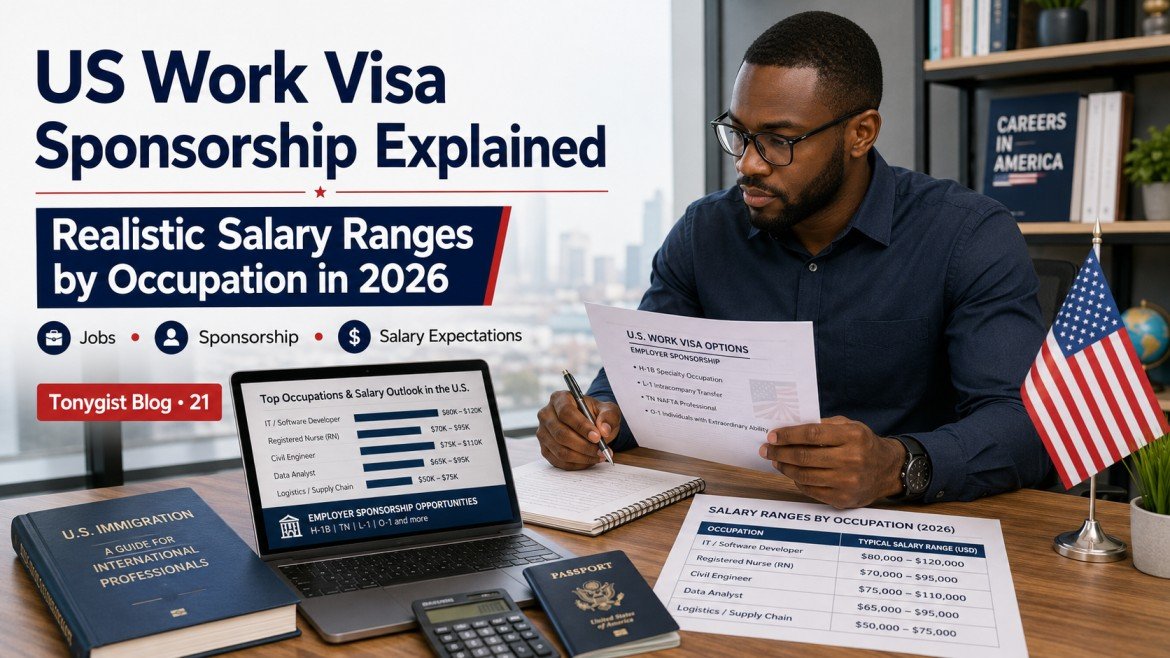
Software engineers and developers sponsored under H-1B commonly see salaries in the range of $90,000 to $160,000 annually, with significant variation based on seniority, specific technical specialization, and location, and considerably higher figures at senior or specialized levels in major technology hubs such as the San Francisco Bay Area or Seattle.
Data Science and Analytics Roles
Data scientists and data analysts sponsored under H-1B typically see salaries in the range of $85,000 to $150,000 annually, again varying significantly by seniority, specific technical skill set, and employer.
Engineering Roles
Mechanical, electrical, and civil engineers sponsored under H-1B typically see salaries in the range of $72,000 to $125,000 annually, depending on specialization, experience, and whether the role requires professional licensure.
Finance and Accounting Roles
Financial analysts and accountants sponsored under H-1B typically see salaries in the range of $68,000 to $115,000 annually, with considerable variation based on the specific role, employer size, and location.
Why H-1B Salaries Tend Toward the Higher End
Because H-1B positions must meet prevailing wage requirements and generally require at least a bachelor’s degree in a relevant field, sponsored salaries in this category tend to sit at or above typical entry-level pay for the broader occupation, rather than at the bottom of the range.
The Prevailing Wage System Explained
Understanding the prevailing wage system clarifies why salary ranges look the way they do across these visa categories.
How Prevailing Wage Is Calculated
The Department of Labor determines prevailing wage levels for specific occupations in specific geographic areas, generally divided into four wage levels reflecting different degrees of experience, education, and job complexity. Employers sponsoring most H-1B and many EB-2 or EB-3 positions must attest that the offered salary meets or exceeds the applicable prevailing wage level for that specific role and location.
Why This Matters for Your Salary Expectations
This system means that the same job title can have meaningfully different minimum acceptable salaries depending on where in the United States the position is based, since cost of living and local wage data vary considerably by region. A software engineering role in San Francisco will generally have a higher prevailing wage floor than the same title in a lower cost-of-living city, and sponsored salaries should be evaluated with this regional context in mind rather than against a single national figure.
L-1 Visa: Intracompany Transfers and Typical Salary Bands
The L-1 visa applies to employees being transferred within the same multinational company, typically from an overseas office to a US office, and it works somewhat differently from H-1B in terms of salary expectations.
L-1A for Managers and Executives
L-1A is for intracompany transferees in managerial or executive roles, and salaries tend to reflect the seniority of the position, often in the range of $95,000 to $190,000 or more annually, depending heavily on the company, industry, and specific level of responsibility.
L-1B for Specialized Knowledge Employees
L-1B is for employees with specialized knowledge of the company’s products, services, or procedures, and salaries here vary more widely, often in the range of $68,000 to $125,000 annually, depending on the specific role and industry.
Why L-1 Salary Ranges Differ From H-1B
L-1 visas do not always involve the same prevailing wage attestation process as H-1B, though employers must still generally demonstrate that compensation is consistent with the role and company practices. This can create somewhat more flexibility in salary structuring compared to H-1B, though the position itself must still genuinely qualify under L-1’s specific managerial, executive, or specialized knowledge requirements.
O-1 Visa: Extraordinary Ability and Why Salary Works Differently
The O-1 visa, for individuals with extraordinary ability in their field, does not have a standardized salary range in the way H-1B does, because eligibility is based on demonstrated achievement and recognition in your field rather than meeting a specific wage threshold tied to a standardized occupational category.
Salaries for O-1 visa holders vary enormously depending on the specific field, the nature of the work, and the individual’s level of recognition, and there is no meaningful “typical” figure that applies broadly across this category. This visa is genuinely reserved for a narrow group of applicants who can document sustained, significant achievement in their field, and it should not be viewed as a general-purpose alternative to H-1B for typical skilled professionals.
EB-2 and EB-3 Green Card Categories: Salary and Sponsorship
These employment-based immigrant visa categories lead to permanent residency rather than temporary work authorization, and they also involve prevailing wage requirements through the PERM labor certification process.
EB-2 for Advanced Degree Professionals
EB-2 generally requires an advanced degree (master’s or higher) or a bachelor’s degree combined with at least five years of progressive experience, and sponsored salaries typically reflect mid-to-senior professional roles, often in the range of $78,000 to $145,000 annually, depending heavily on occupation and location.
EB-3 for Skilled and Other Workers
EB-3 covers a broader range, including skilled workers requiring at least two years of training or experience, professionals with a bachelor’s degree, and an “other workers” subcategory for positions requiring less than two years of training. Salaries vary enormously across this range, from roles in the $38,000 to $58,000 range for less specialized positions, up to $85,000 or more for skilled professional roles.
Processing Time and Salary Are Linked to Country of Origin
It is worth understanding that EB-2 and EB-3 processing times, including how long you may wait for a visa number to become available, vary significantly depending on your country of birth, due to per-country numerical limits that create different backlogs for applicants from different countries. This does not change the salary requirement itself, but it significantly affects your realistic timeline, sometimes by several years depending on your nationality.
H-2B Visa: Lower-Wage Temporary Work Explained Honestly
The H-2B visa, covering temporary non-agricultural work, generally involves lower salary ranges than H-1B, L-1, or the EB categories, reflecting the nature of the work it typically covers.
H-2B positions, common in hospitality, landscaping, and certain construction and seafood processing roles, typically pay in the range of $30,000 to $46,000 annually on an equivalent basis, though pay is often structured hourly rather than as an annual salary, and actual annual earnings depend on how many hours of seasonal work are available during the visa period.
Why H-2B Salaries Stay Lower
H-2B is also subject to prevailing wage rules, but because the occupations it typically covers are classified at lower wage levels under Department of Labor methodology, the resulting wage floors are correspondingly lower than those for H-1B professional roles. This is also the visa category most exposed to the annual numerical cap, meaning even employers offering legitimate, fairly paid positions face genuine uncertainty about whether a visa number will be available in a given period.
Healthcare-Specific Visa Pathways and Salary Realities
Healthcare occupations occupy a distinct space in US sponsorship because of both genuine workforce shortages and specific licensing requirements that interact with visa eligibility.
Registered Nurses
Foreign-trained registered nurses sponsored under EB-3 (the category most commonly used for this occupation) typically see salaries in the range of $62,000 to $95,000 annually, varying by state, facility type, and specialization, with considerably higher figures in high-demand specialties or high-cost regions.
Physicians
Physicians sponsored through various pathways, often involving complex interactions between visa category, residency training requirements, and state licensing, see salary ranges that vary enormously by specialty, from primary care roles often in the $180,000 to $230,000 range up to considerably higher figures for certain specialist fields, though the pathway to practicing medicine in the US as a foreign-trained physician involves a lengthy credentialing and licensing process separate from the visa itself.
Why Healthcare Salary Figures Need Extra Caution
Healthcare sponsorship is one of the areas where the gap between a job offer and an enforceable visa outcome is widest, since state licensing boards, specialty credentialing bodies, and immigration authorities all operate independently of each other. A genuinely high salary figure does not remove the need to separately verify licensing eligibility in your specific target state.
How Location Affects Salary and Visa Feasibility
Because prevailing wage calculations are tied to specific metropolitan or rural wage data, the same occupation can have a meaningfully different minimum acceptable salary depending on where the sponsoring employer is located.
Major metropolitan areas with high costs of living, such as New York, San Francisco, Seattle, and Boston, generally have higher prevailing wage floors across most occupations, which in turn means sponsored salaries in these areas tend to be higher in nominal terms, though this needs to be weighed against correspondingly higher living costs.
Mid-sized cities and lower cost-of-living regions often have lower prevailing wage floors, meaning sponsored salaries may be lower in nominal terms but can still represent solid purchasing power once living costs are factored in.
Why Some High-Demand Roles Still Struggle to Get Sponsored
It can seem counterintuitive that occupations with genuine, well-documented shortages sometimes still face real sponsorship obstacles, but this happens for specific, structural reasons.
Annual caps on certain visa categories, particularly H-1B, mean that even when an employer wants to sponsor a qualified candidate, a lottery system may simply not select that petition in a given year, regardless of how genuine the need is.
Per-country limits on green card categories create years-long backlogs for applicants from certain countries with high demand, meaning the wait time, not the salary or qualification, becomes the binding constraint.
Licensing and credentialing requirements in regulated fields, particularly healthcare and certain engineering disciplines, operate on a completely separate track from the visa process itself, meaning a strong salary offer does not resolve underlying credentialing timelines.
Key Things to Know
Most major US work visa categories tie salary to a government-calculated prevailing wage standard specific to your occupation and location.
H-1B salaries generally range from the high $60,000s to well over $150,000 depending on occupation, seniority, and location, with technology and specialized engineering roles typically at the higher end.
EB-2 and EB-3 green card categories involve similar wage standards but add country-of-birth-based backlogs that can significantly affect timeline regardless of salary.
H-2B and lower-wage temporary categories involve meaningfully lower pay ranges and are also the most exposed to annual numerical caps.
Healthcare sponsorship involves licensing and credentialing requirements that operate independently of the visa process and must be verified separately.
Common Mistakes to Avoid
Assuming a single salary figure applies nationally regardless of where the sponsoring employer is located, when prevailing wage standards vary significantly by region.
Treating O-1 visa salary expectations as comparable to H-1B, when O-1 eligibility and compensation depend on individual achievement rather than a standardized wage calculation.
Overlooking how significantly country-of-birth backlogs affect EB-2 and EB-3 timelines, leading to unrealistic timeline expectations even when salary and qualifications are strong.
Believing that a high salary offer alone guarantees a positive visa or licensing outcome in regulated fields like healthcare, when separate credentialing processes apply.
Relying on outdated salary figures from previous years without checking current Department of Labor wage data for your specific occupation and location.
Practical Tips
Check current Department of Labor prevailing wage data for your specific occupation and the metropolitan area where your prospective employer is located, rather than relying on national averages.
If you are in a healthcare field, research your specific state’s licensing requirements separately and early, since this process often takes longer than the visa petition itself.
If your country of birth has a significant EB-2 or EB-3 backlog, factor this realistically into your planning rather than assuming salary or qualification alone will accelerate your timeline.
Ask any prospective employer directly which specific visa category they intend to use and whether they have a track record of successfully sponsoring that category previously.
Compare any salary offer against current, location-specific wage data rather than evaluating it in isolation, since the same number can be generous in one US region and modest in another.
Frequently Asked Questions
1. What is a realistic H-1B salary for a software engineer in 2026?
Salaries commonly range from about $90,000 to $160,000 annually, varying significantly by seniority, specific technical specialization, and location, with major technology hubs generally at the higher end of this range.
2. Does a higher salary guarantee my H-1B petition will be selected in the lottery?
No. Salary level does not affect lottery selection odds. The H-1B lottery is a random selection process among eligible registrations, and a high salary offer does not improve your chances of being selected, though it does support the petition’s overall legitimacy once selected.
3. Why do EB-2 and EB-3 processing times vary so much by country?
These green card categories have per-country numerical limits set by US immigration law, which means applicants from countries with very high demand relative to their allocation face significantly longer backlogs than applicants from countries with lower demand, regardless of individual qualifications or salary.
4. Is the O-1 visa a good alternative to H-1B for typical professionals?
Generally not. O-1 is designed for individuals who can document extraordinary ability and sustained recognition in their field, which is a genuinely high bar. It is not a broadly accessible alternative for typical skilled professionals who do not meet this specific standard.
5. What is prevailing wage and why does it matter for my salary expectations?
Prevailing wage is a Department of Labor calculation of the standard wage for a specific occupation in a specific geographic area, divided into wage levels reflecting experience and complexity. Most major work visa categories require sponsored salaries to meet or exceed this figure, which shapes realistic salary expectations for any given role and location.
6. Do H-2B jobs ever lead to a path toward permanent residency?
H-2B itself is a temporary, non-immigrant visa and does not directly lead to permanent residency. Some H-2B workers may separately pursue other immigration pathways if they become eligible, but this is not an automatic or guaranteed progression from H-2B status itself.
7. Are healthcare salaries in visa sponsorship cases generally higher than other fields?
Many healthcare roles, particularly physicians and certain nursing specialties, do see relatively high salary figures, but the sponsorship and licensing process in healthcare is also more complex, involving separate state licensing and credentialing requirements that must be satisfied independently of the visa itself.
8. Does my salary offer need to be different depending on which US city I will work in?
Yes, in terms of meeting minimum requirements. Prevailing wage floors vary by metropolitan or regional area, so the same job title may have a different minimum acceptable salary depending on location, and you should evaluate any offer against current wage data for that specific area.
9. Can my employer pay me less than the prevailing wage if I am willing to accept it?
No, in visa categories where prevailing wage attestation is required, employers are legally obligated to pay at least the applicable prevailing wage for the role and location, regardless of what the worker might be willing to accept.
10. How can I check current US visa cap numbers and processing times?
These figures are published and updated by USCIS and the Department of State, and current cap numbers, lottery results, and processing time estimates should always be checked directly through their official websites rather than relying on potentially outdated third-party sources.
Conclusion
US work visa sponsorship is genuinely tied to salary in most major categories, but the relationship is more structured and regionally specific than many general summaries suggest. H-1B and EB-2 or EB-3 sponsorship generally require meeting a government-calculated prevailing wage tied to your specific occupation and location, which means realistic salary expectations vary considerably depending on where you will work and what role you are being sponsored for. Lower-wage categories like H-2B exist for a different segment of the labor market and come with their own constraints, particularly around annual caps.
Approaching this topic with accurate, location-specific wage expectations, an honest understanding of country-of-birth backlogs for green card categories, and a clear separation between visa eligibility and any field-specific licensing requirements will serve you far better than relying on generalized salary claims. The opportunity for genuine sponsorship is real across many occupations, but it is shaped by specific, verifiable rules rather than universal promises.