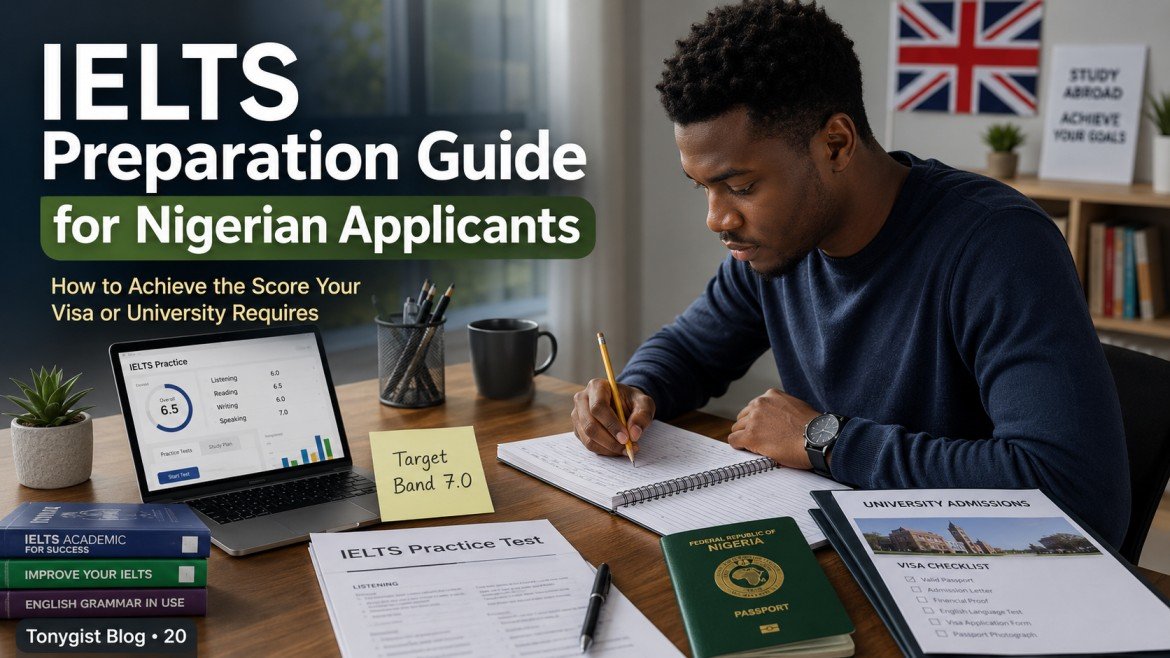
If you are in Nigeria and planning to study at a foreign university, apply for a skilled worker visa, or relocate abroad, there is a good chance someone has asked you: “Have you done your IELTS?”
ADVERTISEMENT
The International English Language Testing System — IELTS — is one of the most widely recognised English proficiency tests in the world. Universities in the UK, Canada, Australia, and Ireland often require it. Immigration programmes in these same countries, and others, also use it as a standard benchmark.
For many Nigerian applicants, IELTS is not just a test. It is a gateway. A low score can delay a visa application or close the door to a university offer. A strong score, on the other hand, can strengthen your overall profile and give you options you would not otherwise have.
This guide is written specifically for Nigerian test-takers — whether you are sitting IELTS for the first time or preparing to retake it. You will find practical information on registration, what to expect in each section, how to prepare effectively, and the most common mistakes people make along the way.
Please note: requirements for specific institutions and visa categories change from time to time. Always verify the latest band score requirements directly with the institution, embassy, or official immigration authority relevant to your situation before making decisions.
Table of Contents
What Is IELTS and Why Does It Matter for Nigerian Applicants
IELTS Academic vs. IELTS General Training: Which One Do You Need
What Score Do You Need? Common Requirements for Visas and Universities
How to Register for IELTS in Nigeria
Understanding the Four Sections of IELTS
How Long Should You Prepare and Where Should You Start
Section-by-Section Preparation Strategies
Using Free and Paid Resources Available in Nigeria
What to Expect on Test Day in Nigeria
Key Things to Know Before Your IELTS Exam
Common Mistakes Nigerian IELTS Candidates Make
Practical Tips to Improve Your Band Score
Frequently Asked Questions
Conclusion
1. What Is IELTS and Why Does It Matter for Nigerian Applicants
IELTS is a standardised English language test jointly managed by the British Council, IDP: IELTS Australia, and Cambridge Assessment English. It measures your ability to listen, read, write, and speak in English across real-life and academic contexts.
Results are given as a band score, ranging from 0 (did not attempt) to 9 (expert user). Most applicants fall between Band 5 and Band 8, depending on their English exposure and preparation level.
For Nigerian applicants specifically, IELTS matters for several reasons:
University admissions abroad — Institutions in the UK, Canada, Australia, Ireland, and New Zealand frequently set minimum IELTS requirements for international students.
Visa applications — Countries like Canada (through Express Entry and Provincial Nominee Programmes), the UK (student and skilled worker visas), and Australia (skilled migration) use IELTS scores as part of their assessment process.
Professional registration — Nurses, doctors, engineers, and other professionals seeking registration with overseas licensing bodies may be required to submit IELTS scores.
Immigration points — In points-based immigration systems like Canada’s, a higher IELTS score can earn you additional points toward your application.
Even if English is your first or dominant language — as it is for many Nigerians — IELTS still requires preparation. The test has a specific format, and familiarity with that format can make a significant difference in your final score.
2. IELTS Academic vs. IELTS General Training: Which One Do You Need
There are two main versions of IELTS: Academic and General Training. They share the same Listening and Speaking sections, but differ in Reading and Writing.
IELTS Academic
This version is designed for people who want to:
Enrol in undergraduate or postgraduate programmes at universities abroad
Apply for professional registration (medical, nursing, pharmacy, etc.)
Pursue research-level studies
The Reading and Writing tasks in the Academic version are more complex and require a higher level of analytical thinking.
IELTS General Training
This version is intended for people who want to:
Apply for skilled worker visas (such as the UK Skilled Worker Visa or Canadian Express Entry)
Migrate for work or family reunion
Enrol in secondary education or vocational training programmes
The reading texts and writing tasks in General Training tend to be more practical and everyday in nature, though this does not necessarily make them easier.
How to decide which one you need: Check the specific requirements of the university, employer, or immigration programme you are applying to. They will tell you which version they accept. Taking the wrong version could mean your score is rejected entirely.
3. What Score Do You Need? Common Requirements for Visas and Universities
Band score requirements vary widely depending on the destination country, the specific university, and the type of application. Below are some general patterns, though you should always verify exact requirements from official sources.
University Admissions
Many undergraduate programmes at UK universities ask for a minimum of Band 6.0 to 6.5, with no individual section falling below 5.5 or 6.0.
Postgraduate programmes, particularly in competitive fields like medicine, law, or business, may require Band 6.5 to 7.5 or higher.
Some Canadian and Australian universities accept Band 6.0 for general programmes and Band 7.0 or above for graduate admission.
UK Visa Requirements
The UK Student Visa typically requires IELTS for UKVI (a secure English language test version), with requirements set by the sponsoring university.
The UK Skilled Worker Visa requires proof of English ability, which can often be met by IELTS, depending on the specific occupation.
Canadian Immigration
Under Canada’s Express Entry system, IELTS scores are converted to Canadian Language Benchmark (CLB) levels. Higher IELTS scores generally translate to more Comprehensive Ranking System (CRS) points.
Provincial Nominee Programmes (PNPs) vary — some require minimum CLB 7 (roughly Band 6.0), while others require CLB 9 (roughly Band 7.5).
Australian Skilled Migration
Australia’s skilled migration visas use IELTS scores in combination with skills assessments. Many visa subclasses require at least Band 6.0 in each component, while some professional streams require Band 7.0 or above.
Again, these are general patterns, not guarantees. Requirements change, and the decision rests entirely with the institution or government authority involved. Always check official sources before preparing.
4. How to Register for IELTS in Nigeria
IELTS can be taken as a paper-based test or a computer-delivered test (CDT) in Nigeria. Both versions test exactly the same content and give the same results — the only difference is how you interact with the test.
Where to Register
In Nigeria, IELTS is administered by:
The British Council Nigeria — with test centres in Lagos, Abuja, and Port Harcourt.
IDP Nigeria — also operating in major cities.
You can register online through their official websites or visit a test centre directly. Availability varies by city, so it is advisable to book well in advance, particularly if you have a deadline for a visa application or university admission.
What You Will Need
A valid international passport (this is the only accepted form of ID for IELTS in Nigeria)
A valid email address
Payment for the test fee (fees can change, so check the current rate on the British Council or IDP website)
Computer-Delivered vs. Paper-Based
Computer-delivered IELTS is becoming increasingly popular in Nigeria for a few reasons:
Results are typically available within 3 to 5 days, compared to 13 days for paper-based tests.
Typing speed and comfort with a keyboard can affect your performance — if you are not comfortable typing quickly, paper-based may suit you better.
The Speaking test in both formats is conducted face-to-face with a real examiner.
IELTS on Paper vs. IELTS Online
Some institutions and countries also accept IELTS Online (taken from home), but this option is not universally recognised. Always confirm with your target institution or visa authority whether they accept IELTS Online before choosing that format.
5. Understanding the Four Sections of IELTS
The IELTS test has four sections: Listening, Reading, Writing, and Speaking. Each section contributes equally to your overall band score.
Listening (30–40 minutes)
You will listen to four recordings and answer 40 questions. The recordings include:
A conversation between two people in a social context
A monologue in a social context (such as a speech)
A conversation between multiple speakers in an academic setting
A monologue on an academic topic
The recordings are played only once, and you must answer questions as you listen. You then have 10 minutes (paper-based) or 2 minutes (computer-delivered) to transfer or check your answers.
Reading (60 minutes)
You will read three passages and answer 40 questions. For Academic IELTS, these are taken from books, journals, and magazines — usually complex, argumentative texts. For General Training, texts range from advertisements to workplace notices to longer articles.
Questions test your ability to locate specific information, understand main ideas, follow arguments, and understand vocabulary in context.
Writing (60 minutes)
There are two tasks:
Task 1 (20 minutes, 150 words minimum):
Academic: Describe a graph, chart, diagram, or map.
General Training: Write a letter (formal, semi-formal, or informal) responding to a given situation.
Task 2 (40 minutes, 250 words minimum):
Both versions: Write an essay in response to a point of view, argument, or problem.
Task 2 carries more weight than Task 1.
Speaking (11–14 minutes)
This is a face-to-face interview with a trained examiner. It has three parts:
Part 1: General questions about yourself, your life, and familiar topics.
Part 2: A two-minute monologue on a topic given to you on a card. You get one minute to prepare.
Part 3: A deeper discussion related to the Part 2 topic, involving more abstract thinking.
Examiners assess your fluency, vocabulary range, grammatical accuracy, and pronunciation.
6. How Long Should You Prepare and Where Should You Start
There is no single answer to how long IELTS preparation takes. It depends on your current English level, your target band score, and how consistently you can study.
As a general guide:
If you are already comfortable with English and your target score is Band 6.0–6.5, a focused preparation period of 4 to 8 weeks may be sufficient.
If you need Band 7.0 or above and your current level is around Band 5.5–6.0, a period of 2 to 4 months is more realistic.
If your English is at a pre-intermediate level, building foundational English skills first — before focusing on IELTS format — will serve you better in the long run.
Where to Start
Take a diagnostic practice test. Use a free official or widely trusted practice test to identify your current approximate band score in each section.
Identify your weakest areas. Most people have one or two sections where they consistently underperform. Focus energy there.
Get familiar with the test format. Knowing what to expect reduces anxiety and helps you manage time better.
Set a realistic study schedule. Consistency matters more than marathon cramming. Even 1 to 2 hours of daily focused practice is more effective than studying only on weekends.
7. Section-by-Section Preparation Strategies
Improving Your Listening Score
Listen actively every day. Podcasts, BBC World Service, TED Talks, and news broadcasts in standard English will help train your ear to different accents.
Practice with official IELTS recordings. The test features British, Australian, American, and other accents. Exposure to all of them is important.
Work on note-taking skills. In the actual test, you cannot pause the recording. Learn to write key words quickly while continuing to listen.
Read ahead. In the few seconds before each section begins, scan the questions so you know what to listen for.
Improving Your Reading Score
Practice time management. You have roughly 20 minutes per passage and cannot afford to spend too long on any single question. Learn to move on and come back.
Do not read the passage completely before looking at the questions. Skim for structure first, then read the relevant sections in detail as you answer.
Pay attention to paraphrasing. Questions rarely use the exact words from the text. Learning to spot synonyms and rephrasing is a core skill.
Learn to distinguish between True/False/Not Given. This question type trips up many test-takers. “Not Given” means the information is simply not in the passage — it does not mean it is false.
Improving Your Writing Score
Learn what examiners actually look for. Writing is marked on Task Achievement, Coherence and Cohesion, Lexical Resource, and Grammatical Range and Accuracy. Understanding these four criteria helps you focus your practice.
Practise writing to time. Task 2 essays should be at least 250 words, written in 40 minutes. Do this under real conditions regularly.
Develop a range of vocabulary. Using the same basic words repeatedly will limit your Lexical Resource score. Read widely and note useful academic and formal phrases.
Avoid common pitfalls in Task 1. For Academic IELTS, describe what you see — do not speculate about why a trend happened unless the question specifically asks. Summarise the most significant features and use comparative language clearly.
Improving Your Speaking Score
Speak English every day if you can. Even talking to yourself, describing your surroundings, or narrating your actions in English builds fluency.
Record yourself. Listening back to your own speaking can reveal habits you were not aware of — filler words, grammatical errors, pronunciation issues.
Work on Part 2 specifically. Many candidates struggle with speaking continuously for two minutes. Practise giving short talks on everyday topics, covering a main point, supporting details, and a conclusion.
Do not memorise scripts. Examiners are trained to detect and penalise memorised responses. Aim to speak naturally and spontaneously.
Pronunciation does not mean accent. You do not need a British or American accent. You need to be clearly understood. Work on word stress and sentence rhythm rather than trying to imitate a specific accent.
8. Using Free and Paid Resources Available in Nigeria
Free Resources
British Council Learn English website — Offers grammar lessons, vocabulary exercises, and practice materials.
IELTS.org — The official IELTS website has free sample questions, videos explaining each section, and practice tests.
Cambridge IELTS books (available in Nigerian bookshops) — These contain official past test papers and are widely considered the most reliable practice materials.
YouTube channels — Several reputable IELTS preparation channels offer free tutorials on specific question types, writing structures, and speaking techniques.
Paid Resources and Classes
British Council preparation courses in Nigeria — The British Council runs IELTS preparation workshops and courses in Lagos, Abuja, and Port Harcourt. These can be helpful if you learn better in a structured classroom environment.
Private tutors — Many qualified IELTS tutors operate in Nigerian cities. If you choose this route, ask about their experience and results, and be cautious of guarantees of specific band scores — no ethical tutor can promise a particular result.
Online preparation platforms — Several internationally recognised platforms offer IELTS preparation courses that are accessible in Nigeria. These vary in quality, so read reviews carefully.
A Word of Caution
Be wary of services claiming to help you “cheat” the IELTS or offering illegitimate score certificates. IELTS scores are verified directly by universities and immigration authorities, and fraud can result in permanent bans, visa refusals, or serious legal consequences.
9. What to Expect on Test Day in Nigeria
Arrival
Arrive at the test centre at least 30 minutes before your scheduled start time. Bring only what is permitted — your international passport and any confirmation documents you were asked to bring.
Most personal items, including mobile phones, smart watches, wallets, and food, must be stored in a locker. You cannot bring notes, dictionaries, or any electronic devices into the test room.
Security Checks
IELTS test centres in Nigeria conduct thorough identity verification, including biometric checks (fingerprints and photographs) and comparison of your appearance with your passport photo. These are standard procedures.
During the Test
For paper-based tests, Listening, Reading, and Writing are completed in one continuous session in the morning. Speaking may take place on a different day — confirm your speaking appointment when you register.
For computer-delivered tests, the sections may be scheduled differently.
You are not allowed to leave the room during the test without permission.
Receiving Your Results
Paper-based IELTS: Results are available approximately 13 days after the test.
Computer-delivered IELTS: Results are typically available within 3 to 5 days.
Results are shared via the online candidate portal and can be sent directly to institutions you specified during registration. You can also purchase additional copies of your Test Report Form (TRF) to send to other organisations.
IELTS Score Validity
IELTS scores are valid for two years from the date of the test. If your scores expire before you complete your application, you may need to retake the test.
10. Key Things to Know Before Your IELTS Exam
Always bring your international passport. No other ID is accepted. If your passport has expired, renew it before your test date.
Check your speaking test date and time separately. Many candidates miss this, especially for paper-based tests.
Understand the marking system. Scores are given in full and half bands (e.g., 6.0, 6.5, 7.0). Your overall score is the average of all four sections, rounded to the nearest half band.
You can retake IELTS as many times as you need. There is no limit on the number of attempts, though each attempt costs money, so effective preparation before each sitting is important.
One-Skill Retake (OSR) is available for some formats. If you are close to your target score but have one weak section, some test formats allow you to retake just that section rather than the full test. Check whether this option is available to you.
Verify whether IELTS for UKVI is required. The UK requires a specific “Secure English Language Test” version for visa applications. Not all IELTS tests qualify — check with the relevant authority.
11. Common Mistakes Nigerian IELTS Candidates Make
Underestimating the Test
Many Nigerian candidates are highly educated and fluent in English. This can lead to a false sense of confidence. IELTS is not just a test of general English — it has specific formats and requirements that require dedicated preparation.
Only Practising with Non-Official Materials
The internet is full of IELTS practice materials, many of which are poorly made or inaccurate. Prioritise official Cambridge IELTS books and materials from the British Council or IDP. Quality matters more than quantity.
Spending Too Much Time on One Section During the Test
Particularly in Reading and Writing, time management is crucial. Candidates often spend too long on difficult questions and run out of time for the rest of the paper.
Writing Below the Word Count
In Writing Task 1 (minimum 150 words) and Task 2 (minimum 250 words), writing less than the required amount will reduce your Task Achievement score. Always check your word count before finishing.
Memorising Template Essays
Some preparation centres teach students to memorise model answers. This approach often backfires. Examiners are experienced at recognising unnatural, memorised language, and it can hurt your score.
Neglecting the Speaking Section
Many candidates focus heavily on Reading and Writing and treat Speaking as secondary. Yet Speaking can be the difference between Band 6.0 and Band 7.0. Treat all four sections with equal seriousness.
Not Checking Answers in Listening
During the Listening section’s transfer/check time, some candidates sit idle. Use every second available to review and correct your answers.
Leaving Answers Blank
Unlike some other tests, IELTS does not penalise wrong answers. Always write something for every question — even an educated guess — rather than leaving blanks.
12. Practical Tips to Improve Your Band Score
Simulate real test conditions. Take full practice tests under timed conditions without interruption. Doing this regularly helps you build the mental stamina the actual test requires.
Read the questions carefully. Many marks are lost not because candidates do not know the answer, but because they misread the question. Pay close attention to instruction words like “no more than two words,” “choose one letter,” or “true/false/not given.”
Expand your academic vocabulary. For the Academic version especially, a wide vocabulary range is important. Read quality news sources and academic articles, noting useful phrases and how they are used in context.
Get feedback on your writing. Practising essays is helpful, but having someone evaluate them against the IELTS marking criteria is far more valuable. If you have access to a qualified tutor or preparation class, use that opportunity.
Focus on the type of English used in IELTS. Nigerian English has its own patterns and vocabulary that may differ from the standard English used in IELTS texts. Exposure to British and international English through reading and listening will help you adapt.
Do not neglect grammar. Grammatical Range and Accuracy is a key criterion in both Writing and Speaking. Review common grammatical structures — particularly conditionals, passive voice, relative clauses, and complex sentence structures.
Use the preparation time wisely. In Speaking Part 2, you have one minute to prepare. Use it to jot down key points and structure your response rather than trying to script every sentence.
Sleep well and eat before the test. This sounds basic, but many candidates underperform simply because they are tired or hungry. The test can run for several hours, and mental fatigue is real.
13. Frequently Asked Questions
Q1: Can I take IELTS in Nigeria without any special preparation?
You can, but it is generally not advisable. Even if your English is strong, the test has a specific format and timing requirements that can reduce your score if you are not familiar with them. Investing in preparation usually leads to better results.
Q2: How much does IELTS cost in Nigeria?
Test fees change over time and may vary between test centres. Check the current fee on the British Council Nigeria or IDP Nigeria website. The fee typically covers all four sections and one set of results sent to a limited number of institutions.
Q3: Can I retake just one section of IELTS?
The IELTS One Skill Retake (OSR) feature is available for some formats and allows eligible candidates to retake a single section. Check with your test centre whether this option is available to you after your initial test.
Q4: Are IELTS scores accepted everywhere?
IELTS is widely accepted, but not universally. Some US universities prefer TOEFL, and a few institutions have their own accepted test lists. Always confirm that the institution or authority you are applying to accepts IELTS before registering.
Q5: How is the overall IELTS band score calculated?
Your four section scores (Listening, Reading, Writing, Speaking) are averaged and rounded to the nearest 0.5. For example, if your scores are 7.0, 6.5, 6.0, and 6.5, your overall score is 6.5.
Q6: What if my IELTS score has expired?
IELTS scores are valid for two years. If your score has expired and you still need it for an application, you will generally need to retake the test. There are no extensions.
Q7: What is IELTS for UKVI, and do I need it for the UK?
IELTS for UKVI is a version of the IELTS test that meets the UK Home Office’s security requirements. If you are applying for a UK visa or settlement, you may need this specific version rather than the standard test. Check the UK Visas and Immigration website or your sponsor institution for clarity.
Q8: Can I prepare for IELTS entirely on my own in Nigeria?
Yes, many candidates successfully prepare independently using official Cambridge IELTS books, free online resources, and consistent self-discipline. However, getting feedback on your writing and speaking from a qualified person can significantly improve your performance in those sections.
Q9: Is there a difference between taking IELTS on paper and on a computer?
The content is the same. The main differences are the delivery format (pen and paper vs. keyboard), how quickly results are released (computer delivers results in 3–5 days), and practical considerations like typing comfort. Choose the format that suits you best.
Q10: What happens if I am not happy with my IELTS score?
You have the option to request an Enquiry on Results (EOR) if you believe one or more of your section scores may have been marked incorrectly. There is a fee for this service, which is refundable if a score is revised upward. You can also simply retake the test.
Q11: Is there a minimum age requirement for IELTS in Nigeria?
The minimum recommended age for IELTS is 16 years old. Test centres may decline to test candidates younger than this.
Q12: What Nigerian cities have IELTS test centres?
Currently, IELTS is available at test centres in Lagos, Abuja, and Port Harcourt through the British Council and IDP. Availability and schedules vary, so check directly with the test provider.
14. Conclusion
The IELTS test is a meaningful requirement for many Nigerian applicants pursuing education, work, or migration opportunities abroad. It is not an impossible hurdle — but it does reward those who prepare thoughtfully and consistently.
The path to your target band score begins with understanding what the test actually measures, choosing the right version for your goals, and giving yourself enough time to prepare properly. Whether you are aiming for Band 6.0 for a university offer or Band 7.5 for a competitive immigration programme, the same principles apply: practise deliberately, get feedback where you can, and do not underestimate any of the four sections.
Most importantly, always verify the exact requirements for your specific situation directly with the institution, embassy, or official immigration authority involved. Requirements differ by institution and change over time, and an error at this stage can cost you significantly more than the cost of a preparation course.
Prepare well, stay consistent, and give yourself the best possible chance on test day.