Introduction
Social work is one of the most demanding and most important professions in any society. It sits at the intersection of welfare, law, mental health, child protection, and community support — and the people who do it well bring a combination of professional knowledge, emotional intelligence, and practical judgment that is genuinely difficult to find.
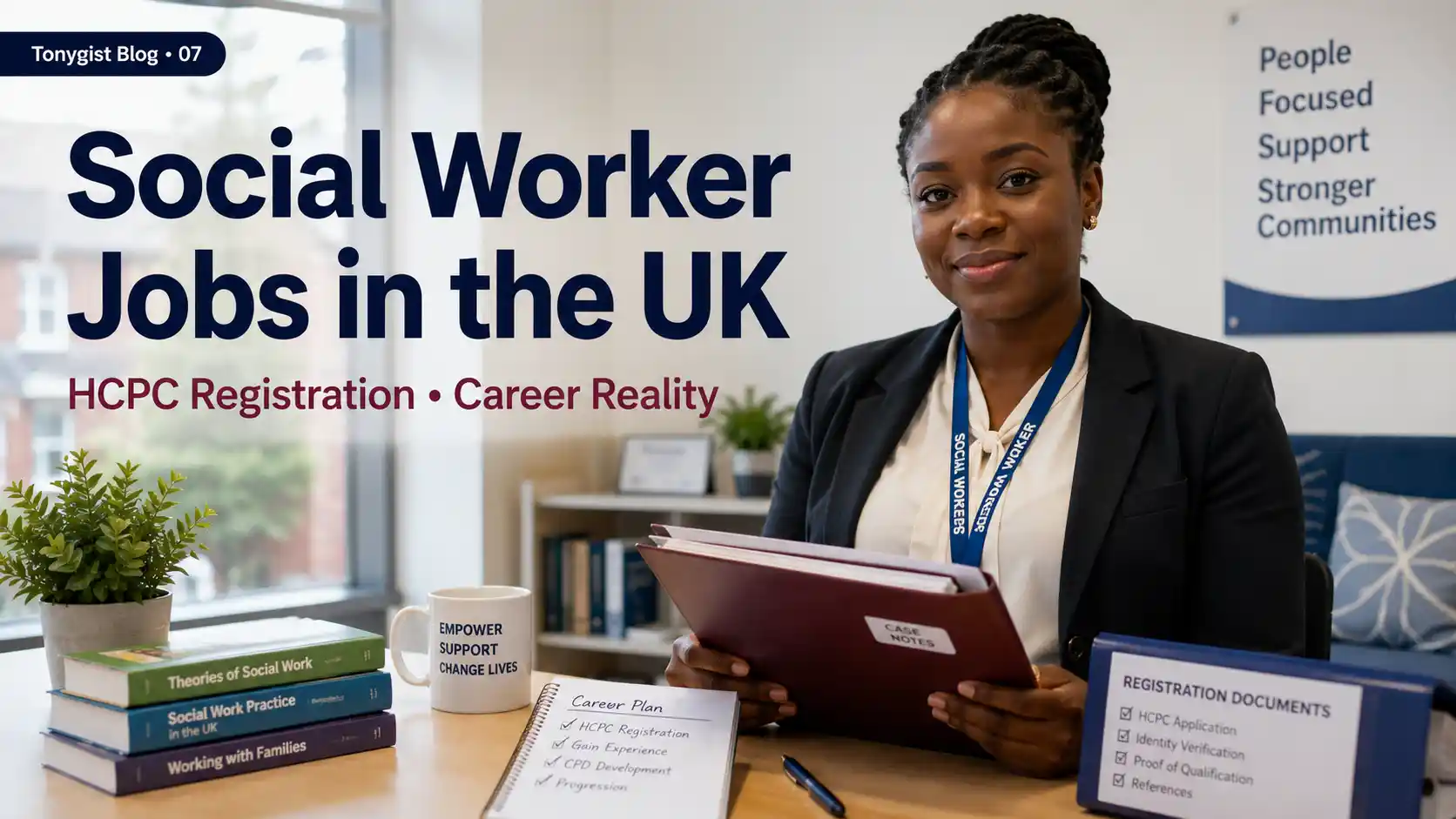
In the United Kingdom, social work is a regulated profession. You cannot call yourself a social worker or practise social work in the UK without being registered with the Health and Care Professions Council (HCPC). This applies equally to UK-trained social workers and those who qualified internationally, including those from Nigeria.
For Nigerian professionals with social work qualifications and experience, the UK represents a significant opportunity. Local authorities — the councils responsible for delivering social services in England, Wales, Scotland, and Northern Ireland — have faced persistent recruitment difficulties for years. The demand is genuine, the salaries are competitive, and the career development pathways are structured.
But the route from Nigerian qualification to registered UK social worker involves specific steps that must be followed in the right order. Understanding those steps clearly — what the HCPC registration process involves, what supporting evidence is needed, what UK employers expect, and what the immigration pathway looks like — is what this guide provides.
Nothing here is immigration or legal advice. Rules change, and always verify current requirements through the HCPC and official UK government sources.
Table of Contents
- Why the UK Recruits Social Workers From Abroad
- Understanding HCPC Registration: What It Is and Why It Matters
- Is Social Work on the UK Skilled Worker Visa Eligible List?
- HCPC Registration for Overseas-Qualified Social Workers
- How a Nigerian Social Work Degree Is Assessed
- When an Adaptation Programme Is Required
- The Different Areas of UK Social Work Practice
- Salary and Pay Scales for Social Workers in the UK
- What UK Employers Look for in International Social Work Applicants
- Working Conditions and the Reality of UK Social Work
- Career Progression in UK Social Work
- The UK Skilled Worker Visa and Social Work
- Key Things to Know
- Common Mistakes to Avoid
- Practical Tips
- Frequently Asked Questions
- Conclusion
Why the UK Recruits Social Workers From Abroad
The UK social work sector has experienced a long-standing recruitment and retention challenge. Local authorities across England, Wales, Scotland, and Northern Ireland consistently report vacancies that are difficult to fill domestically. The profession requires a specific combination of academic training, practical placement experience, and emotional resilience that takes years to develop — and the pipeline of domestic graduates has not kept pace with demand.
Several factors drive the shortage. Social work carries a significant emotional burden, and retention is a challenge even when recruitment succeeds. Caseloads in some local authorities are heavy, contributing to burnout. Pay, while reasonable, has not always kept pace with the complexity of the role. And public perception of social work — shaped significantly by high-profile child protection cases that attract media attention — has sometimes deterred potential domestic recruits.
For all these reasons, UK local authorities and social care organisations have increasingly turned to international recruitment. Nigerian social workers are part of this picture, alongside professionals from Zimbabwe, Jamaica, South Africa, India, and a range of other countries with established social work training traditions.
Understanding this context is important. When you approach UK employers as an internationally qualified social worker, you are not asking for a favour — you are offering a solution to a genuine problem that these organisations face every day.
Understanding HCPC Registration: What It Is and Why It Matters
What the HCPC Does
The Health and Care Professions Council is the statutory regulatory body for social workers in England, as well as for a wide range of other health and care professions including physiotherapists, paramedics, occupational therapists, and radiographers.
In Wales, social workers are regulated by Social Care Wales. In Scotland, by the Scottish Social Services Council (SSSC). In Northern Ireland, by the Northern Ireland Social Care Council (NISCC). The focus of this guide is primarily the HCPC, which covers England — where the largest number of social work vacancies exist — but the same general principle applies: you must be registered with the relevant regulatory body before you can legally practise as a social worker.
Why Registration Is Non-Negotiable
The title “social worker” is legally protected in the UK. This means that using that title without being registered with the HCPC (or equivalent body in the devolved nations) is a criminal offence under the Care Standards Act 2000. This is not a technicality — it is enforced.
UK employers, including local councils and NHS Trusts, will verify HCPC registration as part of their hiring process. They will not offer a social work post to someone who is not registered, regardless of experience or qualifications.
This means that the HCPC registration process is the single most important step for any Nigerian social work professional targeting UK employment. Everything else — the job search, the visa application, the interview follows from having a valid registration or a clear path to one.
What HCPC Registration Certifies
Registration with the HCPC as a social worker certifies that you have met the Standards of Proficiency for social workers, that your qualification meets the required level, and that you are fit to practise. It must be renewed periodically (currently every two years) through a process of continuing professional development.
Is Social Work on the UK Skilled Worker Visa Eligible List?
This is an important question for Nigerian professionals planning their route to the UK.
Social worker roles do appear within the UK Skilled Worker Visa eligible occupations framework. The relevant Standard Occupational Classification (SOC) codes covering social workers are included in the Appendix Skilled Occupations list that determines which roles can be sponsored.
This means that a local authority or social care organisation that holds a valid Home Office Sponsor Licence can, in principle, sponsor a Nigerian social worker for a Skilled Worker Visa provided:
- The role meets the salary threshold applicable to that SOC code
- The worker holds HCPC registration (or is in the process of obtaining it through a route recognised by the employer)
- The employer holds a valid sponsor licence
The salary thresholds for Skilled Worker Visas changed significantly in 2024. Verify current applicable thresholds through the official gov.uk guidance, as these figures are subject to change and the specific going rate for your SOC code applies.
Importantly, many UK local authorities do hold sponsor licences, making them viable sponsoring employers for internationally qualified social workers.
HCPC Registration for Overseas-Qualified Social Workers
This section covers the mechanics of how the HCPC assesses international applications. The process has specific requirements that must be understood carefully.
The International Application Route
The HCPC has a specific application pathway for applicants who trained outside the UK. This involves submitting documentation that allows the HCPC to compare your Nigerian training and qualifications against the Standards of Education and Training (SETs) that UK-approved social work programmes must meet.
What Documentation You Typically Need
The HCPC application for internationally qualified social workers typically requires:
Proof of identity: Passport or official identification document.
Evidence of your social work qualification: Certified copies of your degree certificate(s), academic transcripts showing the courses covered in your programme, and a syllabus or programme documentation that describes the content and structure of your training.
Evidence of registration or licence in your country of training or current practice: A letter or certificate from the relevant professional regulatory body in Nigeria — typically the National Association of Social Workers of Nigeria (NASOWN) or relevant institutional authority — confirming your standing as a qualified social worker.
English language proficiency: The HCPC requires internationally qualified applicants to demonstrate English language proficiency. Acceptable tests include IELTS (International English Language Testing System) with a minimum overall score of 7.0 and no component below 6.5, or equivalent scores on other approved tests. Verify current HCPC English language requirements directly, as these can change.
A reference or declaration of good character: Evidence that you are fit to practise professionally.
How the HCPC Assesses Your Application
Once your application is submitted with all required documentation, the HCPC reviews your qualification against its Standards of Education and Training. This involves comparing the content of your Nigerian social work training against what UK-approved programmes cover.
The assessment can result in:
- Full registration: Your qualification is assessed as meeting the standards and you are registered without further requirements.
- Conditional registration or an adaptation period: Gaps are identified between your training and UK standards, and you are required to complete an adaptation programme or test of competence before or alongside registration.
- Application declined: Your qualification is assessed as not meeting the required standards, and you are advised of the reasons and any alternative pathways.
The majority of internationally trained social workers who apply do receive some form of outcome, though the specific result depends entirely on the individual application and the evidence provided. Allow adequate time — the assessment process can take several months. Check current HCPC processing times when you submit your application.
How a Nigerian Social Work Degree Is Assessed
Nigerian social work training is delivered through universities (typically a BSW — Bachelor of Social Work, or a degree in sociology or social work combined with professional training) and through professional programmes accredited by relevant Nigerian bodies.
What the HCPC Looks For
When assessing a Nigerian social work qualification, the HCPC is looking for evidence that your training covered:
- Social work values and ethics
- Social work theory and its application to practice
- Human development and behaviour in social contexts
- Law and policy relevant to social work practice
- Practical placement experience (supervised practice in real social work settings)
- Communication, assessment, and intervention skills
- Research and reflective practice
The practical placement element is particularly important. UK-approved social work programmes require a significant number of supervised practice hours in real settings. If your Nigerian training included documented practice placements, this strengthens your application considerably.
Degree Level and Duration
The HCPC assesses whether your qualification is at degree level and whether the duration and content of the programme meet UK standards. A four-year BSW from a recognised Nigerian university typically has the foundational structure to be assessed, though the specific content and how well it aligns with UK standards determines the outcome.
A two-year postgraduate diploma or master’s in social work from Nigeria may also be assessed, depending on the institution and content.
The Importance of the Syllabus Document
One of the most important pieces of documentation for the HCPC application is a detailed description of your academic programme — the modules studied, their content, assessment methods, and the proportion of practice versus academic study. Many Nigerian applicants do not obtain this proactively and then face delays when the HCPC requests it.
Contact your Nigerian university or training institution to obtain a comprehensive programme description, course catalogue, or module descriptions before you begin the HCPC application.
When an Adaptation Programme Is Required
If the HCPC assessment identifies gaps between your training and UK standards, you may be required to complete an adaptation programme before or as a condition of full registration.
What an Adaptation Programme Involves
An adaptation programme is a structured period of supervised practice in the UK, combined in some cases with additional theoretical learning, during which you demonstrate that you can meet UK professional standards in practice.
The length and structure of an adaptation programme vary based on the specific gaps identified. Some programmes are a few months of supervised practice. Others may involve more substantial periods of learning and assessment.
How to Arrange an Adaptation Programme
Adaptation programmes in social work are typically arranged in partnership with a UK employer. Some local authorities specifically hire internationally qualified social workers under arrangements where the adaptation programme is built into the first period of employment. This can be a practical and financially viable model — you are employed, supervised, and assessed simultaneously.
If a local authority offers you employment with an adaptation programme component, this is a legitimate and structured pathway. Ensure the terms are clearly outlined in your contract and that the adaptation programme is formally recognised by the HCPC.
The Different Areas of UK Social Work Practice
Social work in the UK is divided into several specialist practice areas, and understanding which area aligns with your background and interests affects where you search for jobs.
Children and Families Social Work
This is the largest area of social work employment in UK local authorities and encompasses:
- Child protection and safeguarding: Working with families where children are at risk of harm. This is often the most emotionally demanding area and carries significant legal responsibility.
- Looked-after children (LAC): Working with children in foster care, residential care, or other alternative care arrangements.
- Family support: Working with families to prevent children from entering the care system through targeted intervention and support.
- Adoption and fostering: Assessing and supporting prospective adoptive parents and foster carers.
Adult Social Work
Adult social work focuses on supporting adults with various needs:
- Older adults: Assessment and care planning for elderly people who need support to remain independent or require residential care.
- Physical disability: Supporting adults with physical conditions affecting their daily functioning.
- Learning disability: Working with adults with intellectual disabilities and their families and support networks.
- Mental health social work: Often based within Community Mental Health Teams (CMHTs) or NHS Mental Health Trusts, this involves assessment, care coordination, and statutory Mental Health Act responsibilities (for Approved Mental Health Professionals — a post-qualification specialist role).
Hospital Social Work
Many social workers are employed by NHS Trusts in hospital settings, working on discharge planning, safeguarding, and connecting patients to community support.
Community and Voluntary Sector
Beyond local authorities and the NHS, social workers are employed by voluntary sector organisations, housing associations, and private social care providers in various roles.
Salary and Pay Scales for Social Workers in the UK
Pay for social workers in UK local authorities follows scales that vary by grade, experience, and local authority. The following are general ranges — always check current pay scales with specific employers.
Qualified Social Worker (Newly Qualified)
Newly qualified social workers (NQSW) in England typically earn in the range of £30,000 to £36,000 per year, depending on the local authority and London weighting.
London and surrounding areas pay more because of the higher cost of living. Inner London local authorities may start newly qualified social workers at £38,000 or above.
Experienced Social Worker
With two to five years of post-qualification experience, social workers commonly earn between £35,000 and £45,000 in most areas, with London rates higher.
Senior Social Worker and Team Manager
Senior social workers and team managers typically earn £42,000 to £55,000 or above, depending on level of responsibility and location.
Advanced Practitioner and Service Manager
Advanced practitioner and service manager roles carry higher responsibility and compensation, often in the range of £50,000 to £65,000+.
Agency Social Work
Many UK social workers, including some internationally qualified professionals who have established their registration, work through social work agencies as locums (temporary contract workers). Agency social work often pays higher day rates than permanent employment, though without the benefits of pension, sick pay, and job security. Day rates for qualified social workers in the UK through agencies typically range from £200 to £350 per day depending on specialism and location.
What UK Employers Look for in International Social Work Applicants
Beyond HCPC registration, UK employers assess international social work candidates against the same standards they apply to all applicants, plus some additional considerations.
Knowledge of UK Law and Policy
UK social work practice is governed by specific legal frameworks that may differ significantly from Nigerian social welfare law. Key legislation includes the Children Act 1989, the Children Act 2004, the Care Act 2014, the Mental Capacity Act 2005, and the Mental Health Act 1983 (as amended). Being able to demonstrate at least foundational knowledge of these frameworks and genuine willingness to develop deeper knowledge in practice reassures employers.
Safeguarding Understanding
Child protection and adult safeguarding in the UK are underpinned by specific policies and multi-agency frameworks (Working Together to Safeguard Children being the primary guidance in England). UK employers expect all social workers to understand safeguarding principles and take them seriously.
Communication and Professional Judgment
Social work in the UK involves significant communication with vulnerable individuals, other professionals (police, healthcare workers, teachers), courts, and managers. Clear, professional communication — written and verbal is assessed at interview and observed in practice.
Self-Awareness and Reflective Practice
UK social work culture places significant emphasis on reflective practice — the ability to critically examine your own decision-making, manage emotional responses to difficult situations, and learn continuously from practice. Interviews often include questions that test this capacity.
Working Conditions and the Reality of UK Social Work
It would be dishonest not to address the realities of working as a social worker in the UK, particularly for people making significant decisions about relocating internationally.
Caseloads and Workload
UK social work particularly in children’s services can involve heavy caseloads. The volume and complexity of cases in some local authorities is genuinely challenging, and this contributes to the retention difficulties that create the vacancies being discussed throughout this guide. Understanding this before you arrive is important.
Some local authorities have better caseload management, supervision structures, and support systems than others. Researching the reputation of specific employers before accepting a job offer using resources like Ofsted inspection reports for children’s services is genuinely valuable.
Supervision and Support
Most UK social work employers provide regular supervision weekly or fortnightly one-to-one sessions with a team manager to discuss cases and professional development. For newly registered or newly arrived practitioners, the quality of this supervision matters enormously. Ask about supervision arrangements at interview.
The Newly Qualified Social Worker (NQSW) Programme
England operates a structured support programme for newly qualified social workers in their first year of practice. Even if you are not technically newly qualified in Nigeria, local authorities may treat newly UK-registered international practitioners with some of the same induction and support frameworks. Ask about this when discussing employment.
Emotional Demands
Working with families in crisis, children in danger, adults in mental health emergencies, or elderly people in neglectful situations carries an emotional cost that accumulates over time. Strong self-care practices, peer support, good supervision, and organisational support structures are all important factors in sustainable social work practice.
Career Progression in UK Social Work
For international social workers who establish themselves in UK practice, there are clear progression pathways.
Post-Qualifying Development
UK social workers can pursue post-qualifying training in specialist areas including:
- Practice Educator (PE) status — qualifying you to supervise social work students on placement
- Approved Mental Health Professional (AMHP) — a post-qualifying role with specific statutory powers under the Mental Health Act, requiring approved training
- Best Interests Assessor (BIA) — specialising in Mental Capacity Act assessments
- Child Protection Conference Chair — senior safeguarding roles
- Social Work Masters and Doctoral programmes — for those pursuing academic or highly specialised practice routes
Management Pathways
Moving from senior social worker to team manager and then service manager involves both practice expertise and management capability. Local authorities typically support internal candidates for management roles, and internationally qualified social workers who demonstrate strong practice and leadership potential move into management over time.
Independent Practice
Experienced social workers can also move into independent practice — working as expert witnesses in court proceedings, providing independent assessments, or consultancy in specific specialist areas. These roles typically require a substantial depth of UK practice experience before they are viable.
The UK Skilled Worker Visa and Social Work
Visa Eligibility for Social Workers
As noted earlier, social work roles in the UK can be sponsored under the Skilled Worker Visa when the employer holds a valid sponsor licence and the salary meets the applicable threshold. Many UK local authorities hold sponsor licences specifically because international recruitment is part of their workforce strategy.
Right to Work Verification
UK employers are legally required to verify that every employee has the right to work in the UK before they begin work. This is separate from the HCPC registration check both are required.
The Health and Care Worker Visa
Social workers may be eligible for the Health and Care Worker Visa, a sub-category of the Skilled Worker Visa that carries some advantages including lower application fees and an exemption from the Immigration Health Surcharge. Whether your specific role qualifies under this route depends on the SOC code and whether the employer is an eligible health or care provider.
Verify current eligibility for the Health and Care Worker Visa specifically through gov.uk, as the list of qualifying occupations and employers for this route has been updated and may continue to change.
Immigration Health Surcharge
Most Skilled Worker Visa holders must pay the Immigration Health Surcharge (IHS) as part of their visa application. This gives access to NHS services in the UK. The annual rate is set by the government and changes — verify the current amount on gov.uk before budgeting for your application.
Key Things to Know
- HCPC registration is legally required before you can practise as a social worker in England — there are no exceptions
- The HCPC has a specific international application pathway that requires detailed documentation of your Nigerian training
- English language proficiency at a minimum IELTS 7.0 overall (with no component below 6.5) is typically required for international HCPC applications — verify current requirements
- Social work roles appear in the Skilled Worker Visa eligible occupations list and can be sponsored by local authorities holding valid sponsor licences
- The Health and Care Worker Visa sub-route may apply to social work roles in eligible settings — check current qualifying conditions
- UK social work practice involves specific legal frameworks (Children Act, Care Act, Mental Health Act) that international practitioners need to develop knowledge of
- Children and Families social work and Adult social work are the two main practice areas — the demands and culture differ significantly between them
- Adaptation programmes provide a structured supervised practice route for practitioners whose qualifications have identified gaps against UK standards
Common Mistakes to Avoid
Applying for jobs before beginning the HCPC process. Some Nigerian social workers apply for UK roles before starting their HCPC application, then discover the registration process takes longer than expected. Begin the HCPC application early — ideally months before you expect to start a UK role.
Submitting incomplete documentation to the HCPC. The HCPC requires specific documents, and incomplete applications are a common source of delay. Read the international applicant guidance carefully, prepare all required documents, and have certified copies properly authenticated before submitting.
Not obtaining your programme syllabus from your Nigerian university. This is one of the most commonly overlooked requirements. Your Nigerian university’s programme description or course catalogue is essential for the HCPC to assess whether your training covered the required content areas.
Assuming all local authorities are the same. UK local authorities vary significantly in their culture, caseloads, management quality, and support structures. Researching specific employers — including reading Ofsted inspection reports for children’s services departments — helps you make informed choices.
Not researching relevant UK legislation. Going into a UK social work interview without any knowledge of the Children Act, Care Act, or Mental Capacity Act (depending on your practice area) leaves a poor impression. These are the legal frameworks within which you will be practising.
Underestimating the adaptation period. Even experienced social workers from Nigeria typically need a period of orientation to UK systems, law, culture, and practice expectations. Approaching this with humility and genuine openness to learning — rather than as an obstacle to overcome — sets you up for a better transition.
Ignoring the emotional demands of the role. UK social work is demanding work. Going in without adequate self-care strategies, support networks, and realistic expectations about the emotional load is a risk to your wellbeing and your career sustainability.
Practical Tips
Start the HCPC application process before you start your job search. The registration process takes time, and some UK employers require confirmation of HCPC registration (or a confirmed pathway to it) before making an offer. Being proactive about registration puts you ahead of the queue.
Contact your Nigerian university early to obtain programme documentation. Request a comprehensive programme description, module content documents, and your academic transcripts. Have these certified and notarised appropriately for international submission.
Research specific local authorities that actively recruit internationally. Some UK councils have well-established international recruitment programmes with HR teams experienced in supporting incoming international social workers through the HCPC and visa processes. These employers provide a smoother experience than councils doing international recruitment for the first time.
Join the British Association of Social Workers (BASW). BASW is the UK’s professional association for social workers. International members can join before moving to the UK and access resources, guidance, and community that support the transition into UK practice.
Prepare UK-specific interview responses. UK social work interviews typically include questions about specific legislation, safeguarding scenarios, and reflective practice. Research and practise answering these types of questions specifically — not just generic interview preparation.
Build knowledge of UK cultural context. UK child protection, mental health, and adult social care operate within specific cultural, historical, and policy contexts that differ from Nigeria. Reading widely about UK social care history, current policy debates, and high-profile cases gives you valuable contextual understanding.
Connect with Nigerian social workers already working in the UK. The community exists and is accessible through social media groups and professional networks. First-hand experience from people who have navigated the HCPC process, secured employment, and adapted to UK practice is invaluable.
Understand the agency versus permanent employment decision. Once registered with the HCPC, you will face the choice between permanent local authority employment and agency locum work. Permanent positions offer stability, supervision, and development support — important for newly arrived practitioners. Agency work offers higher pay but with less job security and often less support. For most internationally registered practitioners, starting with a permanent position to build UK practice experience is advisable.
Frequently Asked Questions
1. How long does the HCPC registration process take for an overseas social worker?
The HCPC’s assessment of international applications can take several months. Processing times vary and are published on the HCPC website. A realistic planning assumption is three to six months from submitting a complete application to receiving a decision. Incomplete applications take longer because the HCPC must request additional documentation. Always check current processing times on the HCPC website.
2. Can I work as a social worker in the UK while my HCPC application is being processed?
No. You cannot practise as a social worker in the UK or use the title “social worker” until you are registered with the HCPC (or equivalent body for devolved nations). Some individuals work in related support roles (care support worker, family support worker) while awaiting registration, but these are different roles with different titles and responsibilities.
3. Does the HCPC require IELTS for Nigerian applicants?
Yes, the HCPC requires internationally qualified applicants to demonstrate English language proficiency through an approved test. IELTS Academic or IELTS for UKVI are commonly used, with a minimum overall score of 7.0 and no component below 6.5 typically required. Verify the current requirement directly through the HCPC, as these specifications can change.
4. What is the difference between HCPC and Social Care Wales or SSSC?
The HCPC regulates social workers in England. Social Care Wales regulates social workers in Wales. The Scottish Social Services Council (SSSC) regulates social workers in Scotland. The Northern Ireland Social Care Council (NISCC) regulates in Northern Ireland. If you plan to work in Scotland, Wales, or Northern Ireland, you must register with the relevant body for that nation, not the HCPC.
5. Will I need to do an adaptation programme?
It depends on the outcome of your HCPC assessment. If gaps are identified between your Nigerian training and UK Standards of Education and Training, the HCPC may require an adaptation programme or test of competence. Not all international applicants are required to complete one. The specific outcome depends on the content and evidence of your individual application.
6. Do UK local authorities sponsor the Skilled Worker Visa for social workers?
Many do. Local authorities with active international recruitment programmes typically hold Home Office Sponsor Licences. You can verify whether a specific local authority holds a licence using the Register of Licensed Sponsors on gov.uk. Larger councils with significant social care workforce pressures — particularly in London and urban areas — are most likely to have this infrastructure in place.
7. What areas of social work are in most demand in the UK?
Children and families social work — particularly child protection and looked-after children — is consistently the area with the highest vacancy rates in UK local authorities. Adult social work with older adults and people with physical disabilities or learning disabilities also has significant demand. Mental health social work, including the specialist AMHP role, is in demand but requires additional post-qualifying training that must typically be completed in UK practice.
8. How does Nigerian social work experience transfer to UK child protection practice?
Nigerian social workers with backgrounds in child welfare, family support, and community-based practice bring relevant transferable skills. The core competencies of assessment, communication, intervention planning, and working with families under stress transfer across contexts. The primary areas of adaptation involve UK-specific legal frameworks, documentation systems, multi-agency working structures, and specific safeguarding protocols. These are learnable through supervised practice and continuous professional development.
9. Is social work included in the UK Health and Care Worker Visa?
Social workers may qualify for the Health and Care Worker Visa in certain circumstances — specifically when the employer is an NHS Trust, a local authority, or another eligible health or care provider, and the role falls under the applicable SOC codes. This route carries advantages including lower visa fees and exemption from the Immigration Health Surcharge. Verify current eligibility criteria directly through gov.uk, as the qualifying conditions for this sub-route have been updated and may change.
10. What salary should I expect as a Nigerian social worker newly registered in the UK?
As a newly registered social worker (or a newly qualified equivalent), you would typically start on the Newly Qualified Social Worker scale in most local authorities — generally in the range of £30,000 to £36,000 in most parts of England, with London rates higher. With experience in the UK, salaries progress through the pay scale over time. Some local authorities offer enhanced starting salaries or recruitment bonuses for particularly hard-to-fill roles, particularly in London.
11. Can Nigerian social workers work for the NHS in the UK?
Yes. Social workers are employed across NHS settings in England, including mental health trusts, acute hospitals, and integrated care settings. NHS employment for social workers is subject to the same HCPC registration requirement and Skilled Worker Visa eligibility as local authority employment. The NHS also holds sponsor licences for international recruitment in many trusts.
12. How is reflective practice assessed in UK social work interviews?
Reflective practice questions in UK social work interviews typically ask you to describe a challenging situation, explain how you handled it, what you felt at the time, what decisions you made and why, what you would do differently, and what you learned. They are looking for genuine self-awareness, professional judgment, and evidence of learning from experience — not perfect decision-making. Prepare specific examples from your Nigerian practice that demonstrate these qualities.
Conclusion
UK social work is a profession with genuine and sustained demand for qualified practitioners, and the pathway from Nigerian social work qualifications to UK registration and employment is structured and navigable. It is not quick, and it is not without requirements — but it is a well-defined process that many Nigerian social workers have successfully completed.
The HCPC registration process is the cornerstone of the journey. Beginning it early, preparing documentation thoroughly, and engaging honestly with any adaptation requirements the HCPC identifies are the practical foundations of success.
Beyond registration, understanding the UK legal and policy context, preparing specifically for UK-style social work interviews, researching individual employers carefully, and approaching the transition with genuine openness to learning UK practice norms — while bringing the genuine strengths of your Nigerian training and experience — sets you up for a career that is professionally meaningful and financially rewarding.
UK local authorities need skilled, compassionate, professionally grounded social workers. Nigerian professionals who meet those standards and who approach the process correctly are offering something that is genuinely in demand.