Introduction
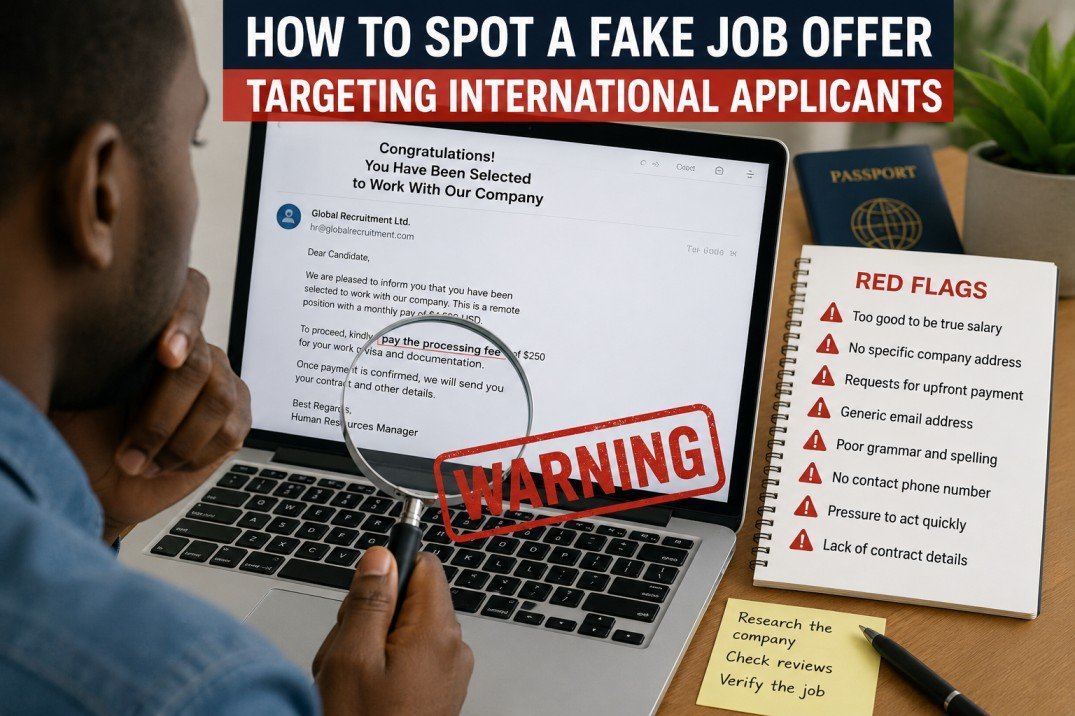
If you’ve been job hunting internationally, you’ve probably already encountered something that felt slightly off. Maybe it was a job offer that arrived without you ever applying. Maybe it was a recruiter who seemed unusually eager, or a salary figure that felt too generous for the role described. These instincts are worth listening to, because fake job offers targeting people who want to work abroad are a genuine and well-documented problem, and they specifically prey on hope, urgency, and unfamiliarity with how legitimate international hiring actually works.
This article walks through exactly how to recognize a fake job offer before it costs you money, personal information, or wasted months of your life. It covers the specific patterns scammers use, the verification steps that genuinely protect you, and the difference between normal, slightly unusual hiring practices and the kind of red flags that should make you stop entirely. None of this requires special technical skill. It requires knowing what to look for and being willing to slow down and check, even when an offer feels exciting.
Job scam tactics evolve constantly, and the specific platforms and methods scammers use change over time. The underlying patterns described here, however, tend to remain consistent regardless of which country or industry is involved.
Table of Contents
- Why International Job Seekers Are Specifically Targeted
- The Single Biggest Red Flag: Any Request for Payment
- Unsolicited Offers You Never Applied For
- Vague Job Descriptions and Unverifiable Employers
- Pressure Tactics and Artificial Urgency
- Communication Through Informal Channels Only
- Salary and Benefit Promises That Don’t Match the Role
- Requests for Personal or Financial Information Too Early
- Fake Visa Sponsorship and Immigration Promises
- How to Verify an Employer Is Genuine
- How to Verify a Recruiter Is Genuine
- What to Do If You Suspect You’re Being Scammed
- Key Things to Know
- Common Mistakes to Avoid
- Practical Tips
- Frequently Asked Questions
- Conclusion
Why International Job Seekers Are Specifically Targeted
People searching for work abroad are, unfortunately, an attractive target for scammers, and understanding why helps explain the specific tactics that follow throughout this article.
International job seekers are often highly motivated, sometimes desperate to leave difficult economic or personal circumstances, and frequently unfamiliar with the specific hiring norms, regulatory bodies, and verification resources of the country they’re targeting. This combination of motivation and unfamiliarity creates genuine vulnerability, and scammers have built entire operations specifically designed to exploit it.
Many international job seekers are also less likely to know who to contact if something feels wrong, since they may not be familiar with the consumer protection agencies, labor authorities, or local fraud reporting bodies that exist in their target country. Scammers rely on this gap.
The Single Biggest Red Flag: Any Request for Payment
If you take away only one thing from this entire article, it should be this: legitimate employers do not ask candidates to pay money to secure a job.
Why This Rule Is So Reliable
This holds true across virtually every country, every industry, and every type of role. Legitimate employers cover their own recruitment, onboarding, and (where applicable) visa sponsorship costs as a normal cost of doing business. They do not pass these costs onto the candidate, and they certainly do not require payment before you’ve even started working.
The Many Disguises This Scam Takes
Payment requests rarely say “pay us to get this job” outright, since that would be obviously suspicious. Instead, they’re dressed up as legitimate-sounding fees:
- A “processing fee” for your job application or visa paperwork
- A fee to “reserve” your position or training slot
- Payment for a background check, medical exam, or document verification that you’re told must go through a specific, named provider
- A request to purchase your own equipment, uniform, or training materials upfront, with reimbursement promised later
- A fee to release your “approved” visa or work permit documents
Each of these can sound plausible in isolation, especially if you’re unfamiliar with how the process is supposed to work. The common thread is the same: money flowing from you to the employer or their associates before you’ve received anything concrete in return.
Unsolicited Offers You Never Applied For
One of the clearest warning signs is receiving a job offer for a position you never applied to, especially when it arrives out of nowhere through email, social media, or messaging apps like WhatsApp or Telegram.
Legitimate employers do occasionally headhunt candidates directly, particularly for senior or highly specialized roles, but this is the exception, not the norm, and it typically comes through a verifiable channel like LinkedIn, with a real recruiter whose profile and employment history you can check.
If you receive a message claiming you’ve been “selected” for a position at a well-known company, but you have no memory of applying, and the message arrived through an unofficial channel, treat this with serious skepticism before responding further.
Vague Job Descriptions and Unverifiable Employers
Genuine job offers describe a specific role, with specific responsibilities, at a specific, verifiable company. Fake offers often blur these details deliberately.
Signs the Employer Itself Is Suspicious
- You cannot find the company through an independent search beyond the materials the recruiter sent you
- The company’s website looks recently created, generic, or copied from another business
- The company has no verifiable registration with the relevant government business registry in its claimed country of operation
- Contact details lead only to personal email addresses or phone numbers rather than official company channels
- Reviews or mentions of the company online are sparse, suspiciously uniform, or entirely absent
Signs the Job Description Itself Is a Warning Sign
- The role description is generic and could apply to almost any job (“work from home, earn money, flexible hours”)
- The specific duties, reporting structure, and team you’d be working with are never clearly explained
- You’re offered the role with minimal or no genuine interview process, despite the role supposedly requiring real skill or experience
Pressure Tactics and Artificial Urgency
Scammers want you to act quickly, before you have time to think clearly or verify anything. Legitimate hiring processes, even fast ones, rarely require you to make irreversible decisions (like paying money or sharing sensitive documents) within hours.
Common pressure tactics include being told the position will be given to someone else if you don’t respond or pay immediately, being told a “limited number of visa slots” are about to close, or being pushed to make a decision on a job offer without adequate time to review the contract or ask questions.
A genuine employer, especially one going through a real visa sponsorship process, understands that immigration paperwork, document verification, and decision-making take time. Artificial urgency is a tool scammers use specifically because it works against careful thinking.
Communication Through Informal Channels Only
Pay close attention to how you’re being contacted and how the conversation is expected to continue.
Legitimate employers and licensed recruitment agencies generally communicate through official company email addresses, formal documentation, and traceable, professional channels. If every interaction with a supposed employer happens exclusively through WhatsApp, Telegram, or a personal Gmail or Yahoo account, with no official company email ever used, this is a meaningful warning sign, even if the company name sounds legitimate.
This doesn’t mean any use of WhatsApp automatically means fraud, since many legitimate businesses do use messaging apps for convenience. The concern is when informal channels are the only channel, with no official correspondence backing it up at any point.
Salary and Benefit Promises That Don’t Match the Role
If a job offer promises a salary or benefits package that seems unusually generous for the role, location, and your stated experience level, this deserves scrutiny rather than excitement.
Genuine employers set salaries based on market rates for the specific role, location, and required experience. Scammers, by contrast, often inflate salary figures specifically because a higher number is more persuasive and emotionally compelling, especially to someone hoping for a significant improvement in their financial circumstances.
Compare any salary offer against publicly available wage data or job listings for similar roles in that specific country and city. If the gap between what’s offered and what similar legitimate roles typically pay is large and unexplained, that gap itself is worth investigating before you go any further.
Requests for Personal or Financial Information Too Early
Legitimate hiring processes do eventually require sensitive information, things like your passport details, bank account information for payroll, and sometimes background check authorization. The issue is not that this information is ever requested, it’s when and how it’s requested.
Be cautious if you’re asked for detailed financial information, banking credentials, or copies of sensitive documents (passport, national ID, proof of address) very early in the process, before any real interview, before any formal written offer, or before you’ve had a chance to verify the employer independently.
Legitimate employers generally request this kind of sensitive information only after a genuine offer has been made and accepted, often as part of formal onboarding rather than as a condition of simply being considered for the role.
Fake Visa Sponsorship and Immigration Promises
This category deserves special attention because it specifically targets people whose primary goal is relocating abroad, making the emotional stakes especially high.
Common Fake Sponsorship Claims
- Promising visa sponsorship that the employer cannot legally provide, because they are not actually a licensed sponsor in the relevant country
- Guaranteeing a specific visa outcome, when no legitimate employer or recruiter can guarantee a government immigration decision
- Claiming a “special” or “fast-track” visa programme that bypasses normal government processing, when no such legitimate shortcut exists
- Asking you to pay for “visa processing” directly, rather than the employer handling sponsorship costs as part of their own legal obligations
Why This Is So Effective on Hopeful Applicants
Immigration processes are genuinely complex, and people unfamiliar with the specific rules of their target country are often unsure what’s realistic and what isn’t. This uncertainty is exactly what scammers exploit, presenting confident, detailed-sounding claims about visa processes that, on closer inspection, don’t match how the actual immigration system in that country works.
How to Verify an Employer Is Genuine
Verification doesn’t require special expertise, just a willingness to check before you commit time, money, or personal information.
Search for the company independently online, using a search engine rather than relying solely on links the recruiter or employer sent you. Look for the company’s own official website, separate from any materials emailed to you, and confirm the contact details and job listing match what you were told.
Check whether the company is registered with the relevant government business registry in its claimed country of operation. Most countries maintain a public, searchable company registry (such as Companies House in the UK, or equivalent registries elsewhere), and a company that cannot be found there, despite claiming to be an established business, should raise concern.
If the role involves visa sponsorship, check whether the employer appears on the relevant government’s official list of licensed sponsors, where such lists exist. Many countries with structured employer-sponsored visa systems publish these registers publicly specifically so candidates can verify employers independently.
Look at the company’s presence on professional networking platforms like LinkedIn, checking how long the company page has existed, how many genuine employees are listed and connected to it, and whether those employee profiles look established and consistent with a real, functioning business.
How to Verify a Recruiter Is Genuine
If you’re dealing with a recruitment agency rather than directly with an employer, additional verification steps apply.
Check whether the agency is licensed or registered, where licensing requirements exist for recruitment agencies in the relevant country or sector, and ask the agency directly for their license or registration number, which they should be able to provide without hesitation.
Ask which specific employer they are recruiting for, and verify that employer independently using the steps above, rather than relying solely on the agency’s claims. A legitimate agency working with a real employer should be able to name that employer and provide verifiable details.
Search for reviews, complaints, or warnings about the specific agency name, since patterns of fraud are sometimes documented by previous applicants, consumer protection bodies, or news reporting once a fraudulent operation has been operating for a while.
Be especially cautious of agencies that ask you, the candidate, to pay any fee for placement services, since in many legitimate recruitment models, the employer pays the agency’s fee, not the candidate.
What to Do If You Suspect You’re Being Scammed
If something feels wrong, the safest move is always to stop and verify before proceeding, rather than continuing in the hope that your concerns are unfounded.
Do not send any money, regardless of how the request is framed or how close you feel to securing the position. Do not share sensitive documents like your passport, national ID, or banking details until you have independently verified the employer through the steps described above. Do not feel pressured by urgency tactics, since a genuine opportunity will generally still be there after you’ve had time to properly check it out.
If you have already shared sensitive information or sent money, contact your bank or payment provider immediately to discuss whether the transaction can be reversed or flagged, and consider reporting the incident to the relevant consumer protection or fraud reporting body in your own country, as well as in the country the fraudulent employer claimed to be based in.
Key Things to Know
Legitimate employers and licensed recruiters do not ask candidates to pay fees to secure a job, process a visa, or release employment documents.
Unsolicited job offers for positions you never applied to, arriving through informal channels, deserve significant skepticism.
Salary offers that seem unusually generous compared to genuine market rates for the same role and location are a meaningful warning sign, not just good fortune.
No legitimate employer or recruiter can guarantee a specific visa or immigration outcome, since this depends on the relevant government’s decision, not the employer’s promise.
Independent verification, checking company registries, sponsor licence registers, and professional networking presence, is the most reliable protection against fraud, and it costs you nothing but a small amount of time.
Common Mistakes to Avoid
Treating urgency as a sign of genuine opportunity rather than a manipulation tactic, when real employers generally allow reasonable time for decisions and document verification.
Relying solely on documents, websites, or contact details provided directly by the recruiter or employer, instead of independently searching for the company through your own separate research.
Assuming that because a company name sounds familiar or prestigious, the specific offer you received from them must be genuine, when scammers frequently impersonate well-known company names.
Sharing passport copies, financial details, or other sensitive personal information before any formal, verifiable offer has been made and the employer has been independently checked.
Paying any fee, however small or however it’s framed, in connection with securing a job or visa, when this is one of the most consistent and reliable indicators of fraud across virtually all legitimate hiring systems.
Practical Tips
Before responding to any unsolicited job offer, search the company name independently alongside words like “scam,” “review,” or “complaint” to see whether others have reported issues with that specific name.
Ask directly for the name and registration details of the company, and check those details against the relevant country’s official business registry before proceeding any further in the conversation.
If visa sponsorship is part of the offer, check whether your target country publishes a public register of licensed sponsoring employers, and verify the specific company appears on it.
Slow down deliberately whenever you feel pressured to act quickly, since this feeling of urgency is one of the most reliable signals that something may be wrong, regardless of how legitimate the rest of the offer appears.
Talk to someone you trust, ideally someone with relevant experience or knowledge of the specific country or industry, before sending money or sensitive documents, since an outside perspective often catches warning signs you might miss when you’re emotionally invested in the opportunity.
Frequently Asked Questions
1. Can a legitimate employer ever ask me to pay for anything during the hiring process?
Generally, no, when it comes to fees for processing your application, securing the job itself, or releasing visa or employment documents. Some narrow legitimate exceptions exist in specific contexts, such as candidate-funded background checks in certain industries, but these are clearly explained, optional or standard in that specific field, and never tied to “releasing” an already-promised job or visa.
2. Is it normal for a job offer to come through WhatsApp or Telegram?
It can happen as a convenience even with legitimate employers, but it becomes a red flag when it’s the only channel used, with no official company email, formal documentation, or verifiable presence ever provided alongside it.
3. How can I check if a company is real before responding to a job offer?
Search for the company independently online, check whether it’s registered with the relevant government business registry in its claimed country, and look for its presence on professional platforms like LinkedIn, including how long it’s been active and whether real employees are connected to it.
4. What should I do if I’ve already paid money to a fake employer?
Contact your bank or payment provider immediately to ask whether the transaction can be reversed or flagged, and report the incident to the relevant consumer protection or fraud authority in both your own country and the country the employer claimed to operate in.
5. Are unusually high salary offers always a scam?
Not always, but they deserve scrutiny. Compare the offer against genuine, publicly available wage data for that specific role, location, and experience level. A large, unexplained gap between the offer and typical market rates is a meaningful warning sign worth investigating before proceeding.
6. Can a recruiter guarantee me a visa if I pay them?
No legitimate recruiter or employer can guarantee a specific visa or immigration outcome, since this decision rests with the relevant government authority, not with any private company or individual. Any claim of a guaranteed visa outcome in exchange for payment should be treated as a serious warning sign.
7. How do I know if a recruitment agency is licensed?
Ask the agency directly for their license or registration number, and check this against the relevant licensing or regulatory body for recruitment agencies in that specific country, where such requirements and public registers exist.
8. Is it suspicious if I’m offered a job without an interview?
Yes, particularly for roles that would normally require demonstrating skill or experience. A legitimate hiring process for most meaningful roles generally includes some genuine interview or assessment process, and skipping this entirely is worth questioning.
9. What information should I avoid sharing early in a job application process?
Avoid sharing detailed financial information, banking credentials, or copies of sensitive identity documents like your passport before a genuine, verifiable offer has been made and you’ve independently confirmed the employer’s legitimacy.
10. Should I trust a job offer just because the company name is well known?
No. Scammers frequently impersonate well-known, reputable company names specifically because this familiarity lowers people’s guard. Always verify that the specific contact, offer, and communication channel genuinely originates from that company, rather than assuming legitimacy based on name recognition alone.
Conclusion
Fake job offers targeting international applicants rely on a fairly consistent set of tactics: urgency, vague or unverifiable details, requests for payment, and promises (especially around visas) that no legitimate employer could actually guarantee. None of these tactics are particularly sophisticated once you know what to look for, but they’re effective precisely because they target people who are hopeful, motivated, and sometimes unfamiliar with how legitimate hiring in their target country actually works.
The protection against this is straightforward, even if it requires some discipline: never pay money to secure a job, always verify the employer independently rather than relying on what they tell you about themselves, and treat pressure to act quickly as a warning sign rather than a sign of genuine opportunity. Taking the time to check before you commit costs you very little, while skipping that step can cost you a great deal.