If you’re researching how to move to Canada permanently, you’ve probably run into two competing pieces of advice. Some sources say studying in Canada first is the smartest route, since it leads naturally into Canadian work experience and eventually permanent residence. Others argue that going straight for a work permit skips years of tuition fees and gets you earning sooner. Both arguments have some truth in them, and which one actually applies to you depends on your specific circumstances far more than either camp tends to admit.
ADVERTISEMENT
This article lays out both pathways honestly, using current, verified rules rather than generalized claims. It covers how the Post-Graduation Work Permit actually works today, what’s changed recently in both the study and work routes, how Express Entry and the Canadian Experience Class fit into each path, and what genuinely determines which route is faster for a given person. Canadian immigration policy has shifted meaningfully in the past two years, including some changes specific to 2026, so a generic “study path vs work path” comparison written even a year ago would already be out of date in several respects.
Immigration rules, processing times, and eligibility criteria for both routes are reviewed and adjusted by IRCC regularly. Always verify current details directly through the official Government of Canada immigration website before making major decisions.
Table of Contents
The Two Pathways at a Glance
The Study Route: How It Actually Works Today
What Changed With PGWP Rules Recently
The Work Route: Entering Without Studying First
How Canadian Work Experience Feeds Into Express Entry
The Canadian Experience Class Explained
Common Mistakes That Derail the Study Route
Common Mistakes That Derail the Work Route
Cost Comparison: Tuition vs Time
Which Route Genuinely Suits Which Profile
Key Things to Know
Common Mistakes to Avoid
Practical Tips
Frequently Asked Questions
Conclusion
The Two Pathways at a Glance
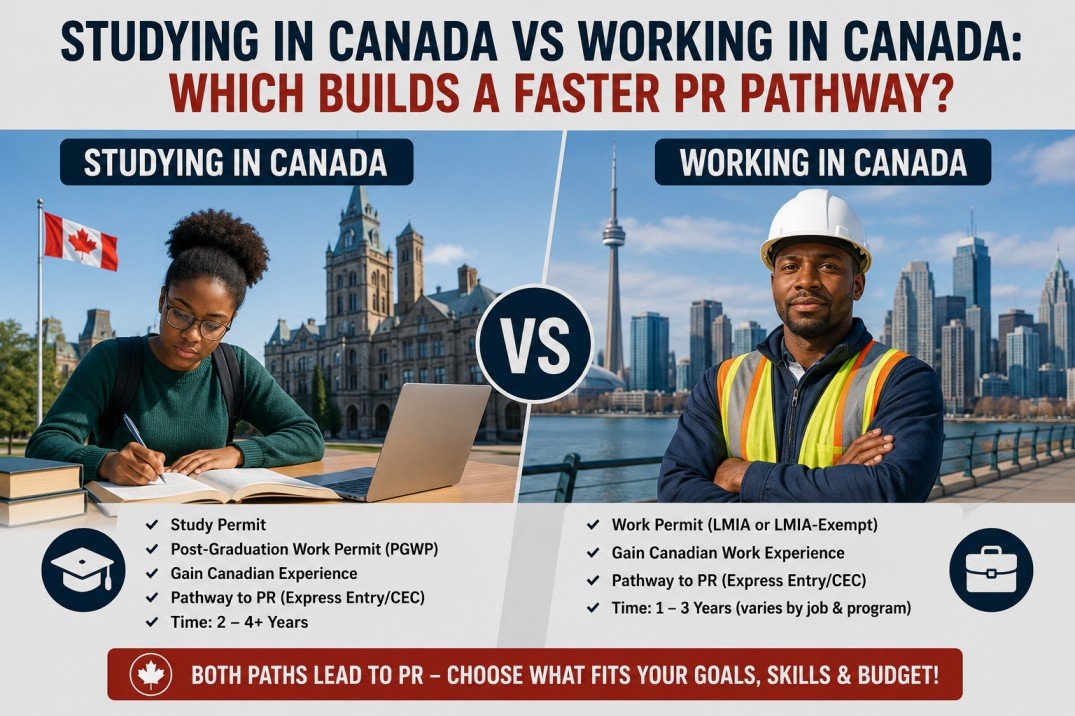
Both routes ultimately aim at the same destination: accumulating qualifying Canadian work experience, then using that experience to apply for permanent residence, most commonly through the Canadian Experience Class under Express Entry. The difference is in how you arrive at that work experience stage.
The study route works like this: graduate from 2-year Canadian program → receive 3-year PGWP, then work in Canada, then apply for PR. The work route skips the study stage entirely, going straight to a Canadian work permit (typically employer-specific) and building qualifying experience from there.
The Study Route: How It Actually Works Today
The Post-Graduation Work Permit is the backbone of the study pathway, and it’s worth understanding precisely because so much of its value depends on getting specific details right.
What the PGWP Actually Gives You
PGWP Canada 2026 is an open work permit, meaning you choose the employer, the field, and the city. There is no LMIA requirement and no employer sponsorship. This is a genuinely significant advantage over most work permit categories, since unlike employer-specific work permits, you do not need a job offer or a Labour Market Impact Assessment.
How Long You Get
Duration is tied to your program length, with one major exception. From 8 months to 2 years of study, you should expect one month of work for every month of the program… Master’s students can expect a 3 year work permit regardless of the length of their program. Over 2 years, you should expect a 3-year work permit. This is why so many international students specifically choose 2-year master’s or bachelor’s programmes specifically to qualify for a 3-year PGWP.
Eligibility Requirements You Cannot Skip
To qualify at all, you need to have at least 8 months of full-time study at a Designated Learning Institution… In Quebec, the minimum is 900 hours, and you must have maintained full-time enrollment throughout the program. Dropping to part-time in any semester disqualifies you.
The application deadline is unforgiving. You apply within 180 days of your official graduation date. If you graduate June 15, your deadline is December 12. Miss it by one day and IRCC will refuse you.
What Changed With PGWP Rules Recently
This is where many older summaries of the study pathway are now inaccurate, and it’s worth understanding the specific changes.
Language Testing Is Now Mandatory
As of November 1, 2024, the eligibility requirements for a PGWP changed. Most PGWP applicants now need to give proof of language results when they apply. The required level depends on your study level: A Canadian Language Benchmark of level 7 will be necessary for university graduates, and test results must be from the last 24 months.
Field-of-Study Restrictions for Non-Degree Graduates
This is a genuinely important distinction between degree and non-degree study paths. If you are a degree graduate (bachelor’s, master’s, doctoral), you are exempt from field-of-study requirements. If you graduated from a diploma, certificate, or post-graduate certificate program, your program must be on IRCC’s approved CIP code list. As of now, the list of 1,107 eligible programs has been frozen for all of 2026, no programs will be added or removed this year.
This matters enormously when choosing a programme. Degree-level graduates remain exempt from the field-of-study list. This rule continues unchanged in 2026 and makes degree pathways the most stable option for PGWP eligibility. If you’re choosing between a degree and a diploma specifically with PR in mind, this is a real factor to weigh, and if you graduated from a college program in hospitality, recreation, media, or humanities, your CIP code may not be on the list.
Online and Outside-Canada Study Time Now Counts Against You
For students with a “lock-in date” on or after September 1, 2024, you must complete at least 50% of your program in class in Canada. Time spent outside Canada is deducted from PGWP length.
PGWP Cannot Be Extended Just Because You’re Established
This is one of the most important practical realities to understand if you’re betting your entire PR strategy on the study route. A PGWP cannot be renewed or extended based on economic employment equity. An international graduate cannot secure an extension simply because they have lived in Canada for years, hold a management role, or possess a permanent, long-term employment contract. The narrow exception that does exist is specific: the only scenario where IRCC will legally authorize a direct extension of a Post-Graduation Work Permit is when the initial permit’s duration was artificially restricted by the validity of your physical travel document.
This means your PGWP window is a hard deadline, not a flexible buffer. If you haven’t secured PR (or a bridging mechanism) before it expires, you generally need to leave Canada or transition onto a different visa category entirely.
One Recent Simplification Worth Knowing
Not every change has added friction. IRCC also simplified work authorization for international students by eliminating the separate co-op work permit
The Work Route: Entering Without Studying First
Skipping study entirely and going straight to a Canadian work permit is the other major route, and it has its own distinct mechanics.
This generally means securing an employer-specific work permit, often supported by a Labour Market Impact Assessment (LMIA) showing the employer couldn’t fill the role domestically, or through specific exemption categories under the International Mobility Program. Unlike the PGWP, this route ties you to a specific employer from day one, which creates a different kind of risk profile, since changing jobs generally requires a new application rather than simply switching employers freely the way a PGWP holder can.
The advantage of this route is time and cost. You skip tuition fees entirely (which for international students in Canada often run well into the tens of thousands of dollars per year) and you start earning Canadian income immediately rather than after one or more years of study. The trade-off is that you generally need to already have, or quickly secure, a genuine job offer from a willing Canadian employer, which is a real and sometimes difficult condition to satisfy from outside the country.
How Canadian Work Experience Feeds Into Express Entry
Regardless of which route gets you here, the actual immigration value lies in accumulating qualifying Canadian work experience, and not all work counts equally.
The Skill Level Matters
A common mistake is accumulating 12 months of work experience in a job that falls under NOC TEER 4 or 5 (unskilled). Cashier, food counter attendant, and general labourer positions typically do not qualify for CEC. This is one of the most consequential and frequently misunderstood details in either pathway. Spending a year in a job that doesn’t count toward CEC eligibility wastes time you can’t easily get back, particularly if you’re racing against a PGWP expiry date.
Student Work Generally Doesn’t Count
Work done while a full-time student does not count toward CEC minimums (including co-op). The clock only really starts once you’re working post-graduation under your PGWP (or under a qualifying work permit, for the work-first route).
The Canadian Experience Class Explained
CEC is the federal program most PGWP holders and many work-permit holders ultimately use to apply for PR, and it has clear, specific requirements.
Canadian Experience Class: For people with at least 12 months of skilled work experience in Canada within the last three years. This is the most common pathway for PGWP holders.
The scale of this pathway is significant nationally. In 2025, approximately 42% of all Express Entry invitations went to PGWP holders, reflecting Canada’s continued reliance on former international students to fill its skilled workforce. This is a meaningful data point: it confirms the study-to-PR pipeline is genuinely the dominant route in practice, not just a theoretical option.
Language Scores Drive Your Competitiveness
Your CRS score under Express Entry is heavily influenced by language test results. Improving from IELTS 6.0 (CLB 7) to IELTS 7.5 (CLB 9) adds approximately 44 points to your CRS score — the difference between waiting years and being invited within months. This applies regardless of which route brought you to the work-experience stage.
Provincial Nominations Remain the Strongest Lever
If your Express Entry CRS score is not high enough for a federal draw, PNPs can help… A provincial nomination adds 600 points to your CRS score — effectively guaranteeing an ITA. This applies equally whether your underlying Canadian work experience came through the study route or the work route.
Common Mistakes That Derail the Study Route
The single most consequential risk in this pathway is timing. Since the temporary public policies that previously authorized blanket 18-month open work permit extensions for expiring PGWPs have permanently expired, there is no longer a general safety net if your PGWP runs out before you’ve secured PR or a qualifying job. As federal Comprehensive Ranking System scores remain elevated, an increasing number of young professionals are reaching the final months of their open status without a clear Invitation to Apply in hand.
If you do find yourself in this position with no other options, the safe move is procedural, not improvised. If you have completely exhausted your work permit fallback tracks, you must file a digital application to change your status to a Visitor before your PGWP expires. This action successfully protects your legal status inside Canada under maintained status rules… though you must immediately stop all employment activities. Attempting to simply file a generic extension request instead is described as triggering an outright refusal rather than buying you time, so this is not a step to take casually or without proper guidance.
Common Mistakes That Derail the Work Route
The most common issue here is accepting any job offer without checking whether it genuinely supports your immigration goals, particularly around NOC skill level. A work permit that gets you into Canada but places you in a TEER 4 or 5 role builds time toward nothing in terms of CEC eligibility, even though you’re legitimately working and paying taxes.
The other major risk is being tied too tightly to a single employer. Because most entry-level work-route permits are employer-specific, losing that job, or having the employer’s circumstances change, can disrupt your immigration timeline in a way that PGWP holders, with their open work authorization, don’t face.
Cost Comparison: Tuition vs Time
The study route requires a substantial upfront financial commitment: tuition for at least 8 months and often one to two years or more, plus living costs during that period with limited or no income. The work route requires no tuition investment but demands that you already have, or can secure, a genuine job offer, which is itself a real and sometimes difficult barrier depending on your field and experience level.
Neither cost structure is objectively “cheaper” in a way that applies to everyone. A well-funded student entering a strong master’s program may reach PR faster overall than someone struggling for years to find an employer willing to sponsor a work permit. Equally, an experienced professional with an existing in-demand skill set may reach PR through direct employment faster than spending two years and significant tuition money on a study program first.
Which Route Genuinely Suits Which Profile
If you don’t yet have strong, in-demand work experience or a Canadian employer relationship, but you do have the financial means to fund tuition and living costs, the study route gives you a structured, predictable pathway: study, receive PGWP, work, apply through CEC.
If you already have strong professional experience and skills that are in clear demand, and especially if you already have, or can realistically secure, a genuine job offer from a Canadian employer, the work route can be considerably faster, since it skips the study period entirely.
If your study options are limited to diploma or certificate programs outside the currently frozen list of approved CIP codes, the work route, or a degree-level study program instead, may be more reliable for PR purposes specifically, even if a diploma seemed like the cheaper or faster academic option.
If you are choosing a study program specifically with PGWP and PR in mind, a two-year (or master’s level) degree program currently offers the most stable and longest PGWP outcome, given the field-of-study exemption for degree holders and the guaranteed 3-year permit length.
Key Things to Know
The study route’s core value lies in the Post-Graduation Work Permit, an open work permit requiring no job offer or LMIA, valid for up to three years depending on your program.
Degree graduates are exempt from field-of-study restrictions on PGWP eligibility; diploma and certificate graduates must check their program against a list of approved CIP codes that is frozen for 2026.
Language test results are now mandatory for PGWP applications, and your specific CRS-relevant language score also significantly affects your competitiveness for Express Entry.
PGWPs cannot generally be extended just because you’ve established yourself in Canada; the deadline is largely fixed regardless of your employment situation.
Not all Canadian work experience counts toward the Canadian Experience Class; the role must meet specific NOC skill-level requirements (TEER 0 through 3).
Common Mistakes to Avoid
Choosing a diploma or certificate program without first checking whether it appears on the current PGWP-eligible field-of-study list, when this list is frozen and your specific program may not qualify.
Assuming your PGWP can be extended indefinitely if you’re employed and established, when extensions are now narrowly limited to passport-related shortfalls rather than economic circumstances.
Accepting any available Canadian job simply to “get work experience,” without checking whether the specific NOC TEER level actually counts toward Canadian Experience Class eligibility.
Missing the 180-day PGWP application deadline after graduation, which results in outright ineligibility with no exceptions for lateness.
Spending significant time studying or working in a role without tracking your language test validity, since results expire and need to be current both for PGWP applications and for maximizing your Express Entry score.
Practical Tips
If pursuing the study route, choose a two-year-or-longer degree program (or any master’s program) specifically to secure the maximum 3-year PGWP duration and the field-of-study exemption that comes with degree-level study.
Take your language test (IELTS, CELPIP, or an equivalent) early and aim meaningfully above the minimum threshold, since the resulting CRS point difference can be the deciding factor in whether you receive an invitation to apply within months versus years.
If pursuing the work route, verify the NOC TEER classification of any job offer before accepting it, to confirm it will genuinely count toward Canadian Experience Class eligibility later.
Track your PGWP expiry date against your Express Entry progress from day one, and have a clear contingency plan (such as a Bridging Open Work Permit application timed correctly, or a Visitor status change as a last resort) well before you reach the final months of validity.
If you’re a diploma or certificate-track student, confirm your specific program’s CIP code with your institution’s registrar before enrolling, rather than discovering after graduation that your program isn’t on the current PGWP-eligible list.
Frequently Asked Questions
1. Is studying in Canada definitely faster than working there first for getting PR?
Not definitely, and it depends heavily on your individual profile. The study route offers a predictable structure through the PGWP and CEC, but it requires significant tuition investment and one or more years before you even start working. The work route can be faster for people who already have strong, in-demand experience and a genuine employer relationship, but securing that employer relationship from abroad is itself often difficult.
2. Do I need a job offer to get a Post-Graduation Work Permit?
No. The PGWP is an open work permit, meaning you don’t need a job offer, an employer, or a Labour Market Impact Assessment to receive it. You can apply for any employer and any role once you have the permit.
3. Can I extend my PGWP if I haven’t found qualifying work experience yet?
Generally, no. PGWPs cannot be extended on economic or employment grounds. The narrow exception applies only when your original permit was shortened due to your passport’s expiry date, not because you need more time to find work or secure PR.
4. Does all Canadian work experience count toward permanent residence?
No. For the Canadian Experience Class specifically, your work experience needs to be in a role classified at NOC TEER level 0 through 3. Roles classified as TEER 4 or 5, such as many cashier, food service, or general labour positions, typically do not count.
5. What’s the difference between a diploma and a degree for PGWP eligibility?
Degree graduates (bachelor’s, master’s, doctoral) are automatically exempt from PGWP field-of-study restrictions. Diploma and certificate graduates must confirm their specific program appears on IRCC’s approved list of eligible fields of study, which is currently frozen for 2026.
6. How much does a strong language test score actually affect my chances?
Significantly. Improving your IELTS score from roughly CLB 7 to CLB 9 level can add around 44 points to your Express Entry CRS score, which can be the difference between a long wait and being invited to apply within months.
7. What happens if my PGWP expires before I get an Invitation to Apply?
If you have no other valid work permit option, the safe step is to apply to change your status to a Visitor before the PGWP expires, which protects your legal status in Canada, though you must stop working. Filing a generic, unsupported extension request instead can result in outright refusal.
8. Is a provincial nomination equally available to both study-route and work-route candidates?
Yes. A provincial nomination, which adds 600 points to your Express Entry CRS score, is available to qualifying candidates regardless of whether their Canadian work experience came through the study or work pathway, as long as they meet that province’s specific eligibility criteria.
9. Do I need to take a language test for the PGWP even if my program was taught in English?
In most cases, yes, since the November 2024 rule change requires proof of language results for most PGWP applicants regardless of the language of instruction, though it’s worth checking current IRCC guidance for any specific programme-related exemptions that may apply to your situation.
10. Can I switch employers freely while building work experience toward PR?
This depends on your work permit type. PGWP holders can work for any employer without restriction. Work permits obtained through the direct work-first route are often employer-specific, meaning a change of employer generally requires a new application rather than a simple switch.
Conclusion
Neither the study route nor the work route is inherently faster for everyone, and most of the genuinely current, reliable comparisons come down to specifics rather than generalities: which NOC TEER level your work falls under, whether your study program survives the current field-of-study freeze, how strong your language test results are, and whether your PGWP timeline realistically allows you to reach an Invitation to Apply before it expires.
What’s clear from current data is that the study-to-PGWP-to-CEC pipeline remains the dominant route in practice, accounting for a large share of recent Express Entry invitations, which suggests it’s a genuinely well-trodden and workable path for those who plan it carefully. But the work-first route remains a legitimate and sometimes faster option for people who already have strong, qualifying experience and a real employer relationship lined up. The right choice depends on your specific financial situation, your field, your existing connections in Canada, and how precisely you can track and plan around the firm deadlines built into whichever path you choose.