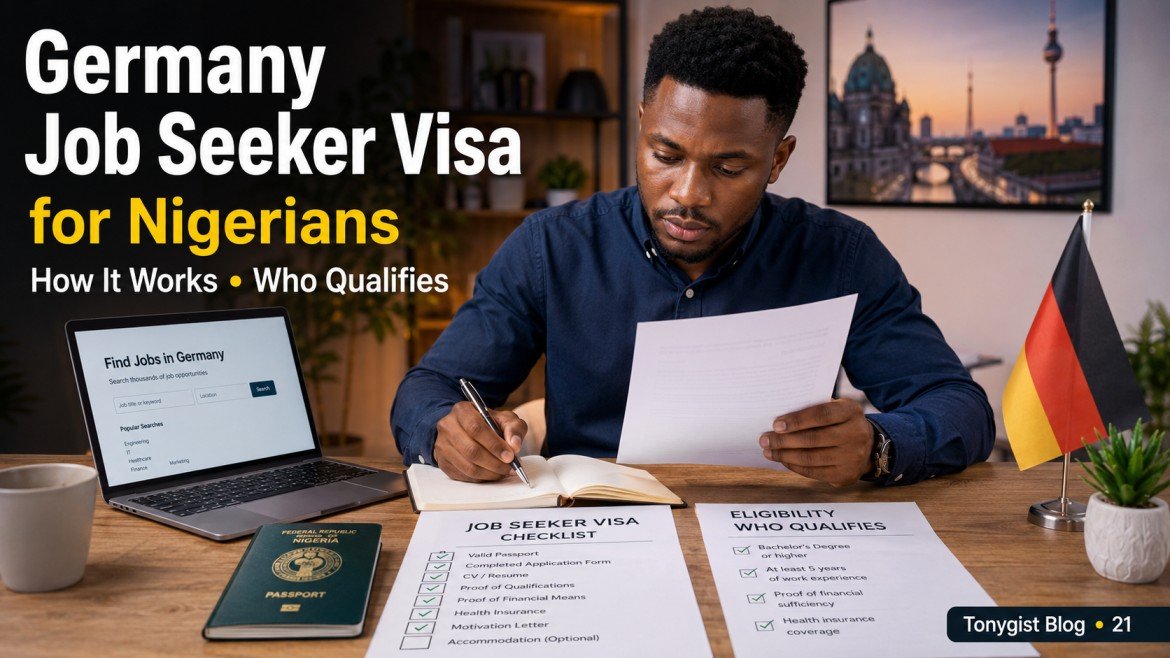
Germany is not the first country that comes to mind for many Nigerians thinking about working abroad — the UK, Canada, and the United States typically dominate that conversation. But Germany has quietly become one of the more genuinely accessible destinations for skilled Nigerian professionals, particularly because of one specific immigration tool: the German Job Seeker Visa.
ADVERTISEMENT
Unlike most work visa routes that require you to already have a job offer in hand, the Job Seeker Visa allows you to travel to Germany specifically to search for employment in person, for a limited period, while you are physically present in the country. For Nigerians with relevant qualifications and a serious, well-prepared approach, this is a genuinely different kind of opportunity from the standard “find a sponsor first” model used by the UK and other countries.
It is not, however, a simple or casual process. Germany has specific qualification recognition requirements, financial proof obligations, and — perhaps most importantly — a language and cultural context that differs significantly from English-speaking destinations. Understanding exactly how the visa works, who genuinely qualifies, and what happens after you arrive is essential before you invest time and money into pursuing this route.
This guide walks you through the entire process in detail. As with all immigration topics, requirements change, and you should verify current rules through the German Embassy in Nigeria or the official German immigration authorities before making decisions.
Table of Contents
What Is the Germany Job Seeker Visa?
Who Can Apply: Eligibility Requirements
Qualification Recognition: The Anabin Database and Anerkennung Process
The Opportunity Card (Chancenkarte): A Related and Evolving Route
Financial Requirements and the Blocked Account
German Language Requirements: How Much Do You Really Need?
How to Apply at the German Embassy in Nigeria
Required Documents for the Application
What Happens Once You Arrive in Germany
From Job Seeker Visa to a Work Permit
Which Sectors Have Genuine Demand for Nigerian Professionals
Key Things to Know
Common Mistakes to Avoid
Practical Tips
Frequently Asked Questions
Conclusion
What Is the Germany Job Seeker Visa?
The Germany Job Seeker Visa (Visum zur Arbeitsplatzsuche) is a national visa that allows qualified individuals from non-EU countries, including Nigeria, to enter Germany for a limited period specifically to search for employment matching their qualifications. It does not authorise you to work upon arrival — its sole purpose is to give you legal status while you look for a job in person.
This is fundamentally different from how the UK Skilled Worker Visa or Canada’s LMIA-based work permits operate. Those routes require a confirmed job offer before you can apply for the visa. Germany’s Job Seeker Visa flips that sequence — you can come to Germany first, attend interviews, meet employers face to face, and then convert your status once you secure a position.
Why Germany Offers This Route
Germany has a well-documented and serious shortage of skilled workers across multiple sectors — engineering, IT, healthcare, skilled trades, and more. The German government has recognised that requiring a job offer before allowing entry creates a practical barrier: many German employers prefer to meet candidates in person, particularly for roles requiring strong communication and team integration, and many qualified candidates abroad find it difficult to secure interviews without being physically present.
The Job Seeker Visa addresses this gap. It is part of a broader set of reforms Germany has introduced in recent years to make its labour market more accessible to skilled workers from outside the EU, including from Nigeria.
How Long the Visa Lasts
The Job Seeker Visa is typically granted for up to six months. This is your window to search for and secure employment. If you find a job within this period, you can apply to convert your status to a work-based residence permit. If you do not, you are expected to leave Germany when the visa expires.
Who Can Apply: Eligibility Requirements
Germany’s Job Seeker Visa has specific eligibility criteria, and not every Nigerian professional automatically qualifies.
The Core Requirement: A Recognised or Recognisable Qualification
To be eligible, you generally need one of the following:
A German university degree, or
A foreign university degree that is comparable to a German degree, or
A foreign vocational qualification that is recognised as equivalent to a German vocational qualification (particularly relevant for skilled trades)
This is the most important eligibility filter, and it requires understanding Germany’s qualification recognition system, which we cover in detail in the next section.
Work Experience Requirements
Beyond the qualification itself, you typically need to demonstrate relevant professional experience related to your field of study or vocational training. The specific amount of experience required can vary depending on your qualification type and the current rules in place — verify current requirements through the German Embassy in Nigeria.
Financial Means
You must demonstrate that you can financially support yourself during your stay in Germany without working, since the Job Seeker Visa does not permit employment until you have secured a position and converted your status. This typically involves either a blocked account with a specific minimum balance, a formal sponsorship declaration from someone in Germany, or proof of sufficient personal funds.
Health Insurance
You need valid health insurance coverage for your stay in Germany. This is a standard requirement across most German visa categories.
No Age Restriction in the Traditional Sense
Unlike some Youth Mobility-style visas that cap eligibility at a certain age, the standard Job Seeker Visa does not have a strict age limit, though your overall profile (qualifications, experience, German language ability) affects your practical chances of success regardless of age.
Qualification Recognition: The Anabin Database and Anerkennung Process
This is one of the most important and most misunderstood parts of the entire Job Seeker Visa process, and it deserves careful attention.
What “Recognition” Means in the German Context
Germany has a structured system for assessing whether a foreign qualification is comparable to a German one. This assessment — known as Anerkennung (recognition) — determines whether your Nigerian degree or vocational qualification is treated as equivalent to a German qualification for employment and, in many cases, for visa eligibility purposes.
The Anabin Database
Anabin is a database maintained by the German Central Office for Foreign Education (Zentralstelle für ausländisches Bildungswesen) that lists information about foreign higher education institutions and the degrees they award, indicating their comparability to German qualifications.
If your Nigerian university and your specific degree programme appear in Anabin with a favourable comparability rating, this significantly simplifies your path. If your institution is not listed, or is listed with a less favourable rating, you may need to undergo additional individual assessment.
Checking your specific Nigerian university and degree programme in Anabin before beginning your visa application is one of the most important early research steps. This is publicly accessible and a sensible first move for anyone seriously considering this route.
The Recognition Process for Regulated Professions
For certain professions — particularly in healthcare (doctors, nurses), law, and some engineering disciplines — German law requires formal recognition of your qualification before you can practise, regardless of visa status. This recognition process is handled by the specific regulatory body responsible for that profession in the German state (Bundesland) where you intend to work.
For non-regulated professions, formal recognition is not always a strict legal requirement to work, but it remains highly relevant for both visa eligibility purposes and for how seriously German employers will treat your application.
The Recognition Process for Vocational Qualifications
For skilled trades — electricians, plumbers, mechanics, and similar occupations — recognition is assessed through Germany’s vocational qualification recognition framework, coordinated through the “Anerkennung in Deutschland” portal and assessed by the relevant Chamber of Crafts (Handwerkskammer) or Chamber of Industry and Commerce (Industrie- und Handelskammer) depending on the trade.
If gaps are identified between your Nigerian vocational training and German standards, you may be offered partial recognition with a requirement to complete additional training or testing (an Anpassungsqualifizierung, or adaptation qualification) to close the gap.
Why This Matters Before You Apply for the Visa
The recognition process can take weeks to months, depending on the complexity of your case and the documentation you provide. Starting this process — or at minimum researching your likely outcome through Anabin and the Anerkennung in Deutschland portal — before you submit your Job Seeker Visa application gives you a realistic sense of where you stand and avoids investing in a visa application for a qualification pathway that may face significant obstacles.
The Opportunity Card (Chancenkarte): A Related and Evolving Route
Germany introduced the Opportunity Card (Chancenkarte) as part of its broader skilled immigration reforms, and it is worth understanding alongside the traditional Job Seeker Visa because the two routes overlap in purpose but differ in structure.
How the Opportunity Card Works
The Opportunity Card uses a points-based system, awarding points for factors including:
Qualification level and recognition status
German language skills
English language skills
Work experience
Age
Connection to Germany (such as prior stays)
Potential for skilled labour shortage occupations
Applicants who meet the points threshold can be granted the Opportunity Card, which — similar to the traditional Job Seeker Visa — allows entry to Germany to search for work, but with somewhat more flexibility, including the ability to undertake trial employment (Probebeschäftigung) for limited hours per week while searching for a permanent role.
How It Relates to Nigerian Applicants
For Nigerians, the Opportunity Card represents a potentially more flexible pathway than the traditional Job Seeker Visa, particularly because it explicitly allows some paid work during the search period rather than requiring you to be entirely self-funded with no income.
Since this is an evolving area of German immigration policy, the specific points thresholds, qualifying criteria, and procedural details should be verified directly through the German Federal Foreign Office or the German Embassy in Nigeria at the time you are preparing your application, as the framework has been refined since its introduction.
Financial Requirements and the Blocked Account
Because the Job Seeker Visa does not permit employment, you must demonstrate that you can support yourself financially during your stay without earning income in Germany.
The Blocked Account (Sperrkonto)
The most common way Nigerian applicants meet this requirement is through a German blocked account. This is a special type of bank account, opened with a provider recognised by German authorities, into which you deposit a lump sum that covers your estimated living costs for the duration of your visa.
The account is “blocked” in the sense that you cannot withdraw the full amount immediately — instead, a fixed monthly amount is released to you, calculated to cover reasonable living expenses, ensuring you do not run out of funds before the visa period ends.
The specific minimum balance required changes periodically based on German cost-of-living assessments. Always verify the current required amount through the German Embassy in Nigeria or official immigration sources before opening an account, as using an outdated figure can cause your application to be rejected.
Alternative Financial Evidence
Instead of a blocked account, some applicants demonstrate financial means through:
A formal letter of sponsorship (Verpflichtungserklärung) from a person resident in Germany who commits to covering your costs
Proof of sufficient personal income or assets that satisfy the visa officer’s assessment
Setting Up a Blocked Account From Nigeria
Several providers offer blocked accounts specifically designed for visa applicants, and the account opening process can typically be completed online from Nigeria before you travel. Processing the account setup, transferring the required funds, and receiving the necessary confirmation documents takes time — factor this into your overall application timeline.
German Language Requirements: How Much Do You Really Need?
This is one of the most significant practical differences between targeting Germany versus the UK, Canada, or Australia, and it deserves a direct and honest answer.
Is German Language Proficiency Required for the Visa Itself?
The formal visa application process does not always mandate a specific minimum German language certificate for the standard Job Seeker Visa in the way that, for example, the UK requires English test scores for some routes. However, the practical reality of finding employment in Germany without German language ability is genuinely difficult outside of a narrow set of internationally-oriented sectors (some IT roles, certain multinational corporate environments, and English-language academic or research positions).
Why German Matters in Practice
German employers, even when recruiting internationally, typically expect candidates to demonstrate at least functional German for day-to-day workplace communication, understanding contracts and workplace documentation, and interacting with colleagues, customers, and German bureaucracy generally.
A B1 or B2 level of German (intermediate proficiency, as measured by the Common European Framework of Reference for Languages) is a realistic and sensible target before you arrive in Germany to search for work. Without at least this level, you significantly narrow your realistic job prospects, regardless of how strong your professional qualifications are.
Where to Learn German Before You Travel
The Goethe-Institut has a presence and language learning resources accessible to Nigerians, and various German language schools and online platforms (including apps and structured online courses) can support learning from Lagos, Abuja, or anywhere else in Nigeria before you depart. Investing six months to a year in serious German language study before applying for the Job Seeker Visa significantly improves your realistic chances of success once you arrive.
How to Apply at the German Embassy in Nigeria
Where to Apply
Nigerian applicants apply for the Job Seeker Visa through the German Embassy or Consulate responsible for visa processing for Nigeria. Germany has historically processed visa applications through its embassy in Abuja, sometimes working with external service providers for appointment scheduling and biometric data collection. Verify the current application centre and process through the German Embassy’s official website for Nigeria, as procedures and any outsourced visa service partners can change.
Booking an Appointment
Visa appointment availability can vary significantly, and in periods of high demand, waiting times for an appointment slot can extend to weeks or months. Booking your appointment as early as possible once you have your documents in order is important.
The Application Interview
The visa application process typically includes an in-person appointment where you submit your documents, provide biometric data, and may be asked questions about your qualifications, your job search plans, and your intentions in Germany. Being well prepared to explain your qualification, your career plan, and your understanding of the German job market for your field strengthens your application.
Processing Time
Processing times for the Job Seeker Visa vary and are not always quick. Building in several months of lead time between submitting your application and your intended travel date is a sensible approach, particularly given the additional time often required for qualification recognition assessments.
Required Documents for the Application
While specific requirements should always be verified directly with the German Embassy in Nigeria before you apply, the general document categories typically include:
A valid passport with sufficient remaining validity
Completed visa application form
Passport photographs meeting German visa specifications
Proof of academic or vocational qualifications (degree certificates, transcripts, vocational training certificates)
Evidence of relevant work experience (employment letters, reference letters)
Evidence of financial means (blocked account confirmation, sponsorship declaration, or other accepted proof)
Proof of health insurance valid for your stay in Germany
A cover letter or statement explaining your qualifications, your intended job search plan, and your career goals in Germany
Anabin database printout or evidence relating to your qualification’s recognition status, where relevant
Evidence of German language ability, if you have it (not always mandatory, but strengthens your application)
What Happens Once You Arrive in Germany
Registering Your Address (Anmeldung)
One of the first practical steps after arriving in Germany is registering your residential address with the local registration office (Bürgeramt or Einwohnermeldeamt), a legal requirement in Germany. This registration is necessary for various subsequent administrative processes, including opening certain types of bank accounts and applying for an extension or conversion of your residence status.
Searching for Employment
With your Job Seeker Visa in hand, you can attend interviews, network with employers, and use German job platforms (such as the Federal Employment Agency’s job portal, Bundesagentur für Arbeit, and various private job boards) to search actively for roles matching your qualifications.
The Time Pressure
The six-month window is a real constraint. Effective job searching in Germany — particularly without strong existing local networks — requires sustained effort from the moment you arrive. Many successful Job Seeker Visa holders begin networking and submitting applications even before they travel, using the visa period primarily for interviews and finalising offers rather than starting the search from zero.
From Job Seeker Visa to a Work Permit
If you secure a job offer during your Job Seeker Visa period, you can apply to convert your visa status to an appropriate work-based residence permit — most commonly the EU Blue Card (for highly qualified professionals meeting specific salary thresholds) or a standard skilled worker residence permit (Aufenthaltserlaubnis zur Erwerbstätigkeit).
The EU Blue Card
The EU Blue Card is available to non-EU nationals with a recognised university degree and a job offer meeting a specific minimum salary threshold (which is generally lower for shortage occupations, including many engineering, IT, and STEM roles, and verified periodically by German authorities). It offers a relatively fast pathway toward permanent residency compared to some other routes, and family reunification provisions are generally favourable.
The Standard Skilled Worker Residence Permit
For qualified professionals whose job offer does not meet the Blue Card salary threshold, or whose qualification pathway falls under standard skilled worker provisions rather than Blue Card criteria, the standard skilled worker residence permit is the relevant route. This still requires your qualification to be recognised as comparable to a German qualification and your job offer to be appropriate to that qualification level.
Switching Status Without Leaving Germany
In most cases, if you secure a qualifying job offer while in Germany on your Job Seeker Visa, you can apply to change your residence permit status from within Germany, without needing to return to Nigeria to reapply. Confirm the specific procedural requirements with the local Foreigners’ Registration Office (Ausländerbehörde) responsible for your area of residence.
Which Sectors Have Genuine Demand for Nigerian Professionals
Germany’s skilled labour shortage spans multiple sectors, and understanding where genuine demand exists helps you target your job search effectively.
Engineering
Mechanical, electrical, civil, and industrial engineering have faced sustained shortages in Germany. Nigerian engineers with recognised qualifications and reasonable German language ability are positioned well in this sector, particularly given Germany’s manufacturing and industrial base.
Information Technology
Software development, data engineering, and IT infrastructure roles are in high demand, and some multinational and technology-focused companies operate with English as a working language, somewhat reducing the German language barrier compared to other sectors — though German remains an advantage even here.
Healthcare
Nursing and medical professions have severe shortages in Germany, but these are regulated professions requiring formal recognition (Approbation for doctors, separate nursing recognition processes) before practising, and German language requirements for healthcare roles tend to be stricter given the patient communication demands involved.
Skilled Trades
Electricians, plumbers, mechatronics technicians, and other skilled trades are in significant demand, assessed through the vocational qualification recognition framework described earlier. The Chamber-based recognition process is specific to each trade.
Logistics and Supply Chain
Germany’s position as Europe’s logistics hub creates demand for supply chain, logistics, and procurement professionals, similar to demand patterns seen in the UK.
Key Things to Know
The Job Seeker Visa allows you to enter Germany to search for work in person — it does not permit employment until your status is converted
Qualification recognition through Anabin and the Anerkennung process is the central eligibility filter — check your university and degree in Anabin before applying
The Opportunity Card (Chancenkarte) is a related, points-based, and somewhat more flexible alternative worth researching alongside the traditional Job Seeker Visa
A blocked account is the most common way to demonstrate financial means, and the required minimum amount changes — verify the current figure before opening one
German language ability is not always a strict formal visa requirement, but B1 or B2 level German dramatically improves your realistic chances of finding employment
The visa is typically valid for up to six months, creating real time pressure to secure employment
Successful job offers can lead to conversion into an EU Blue Card or standard skilled worker residence permit, often processed without leaving Germany
Common Mistakes to Avoid
Not checking Anabin before applying. Many applicants invest significant time and money into the visa application process without first checking whether their specific Nigerian university and degree programme have a favourable comparability rating. This is a free, accessible first step that should happen before anything else.
Underestimating the German language requirement. Some applicants assume that because the visa itself does not always mandate a language certificate, German is optional. In practice, lacking functional German severely limits realistic job prospects outside a narrow set of English-medium roles. Treat German language learning as a core part of your preparation, not an afterthought.
Using an outdated blocked account figure. The minimum required balance for blocked accounts changes periodically. Using a figure from an old article or an outdated source can result in your financial evidence being rejected. Always verify the current required amount directly with the German Embassy in Nigeria or official sources before transferring funds.
Arriving without a job search plan. The six-month window moves quickly. Arriving in Germany with no prior networking, no applications submitted, and no understanding of the German job market for your specific field wastes valuable time. Begin researching German employers, German job platforms, and German recruitment norms from Nigeria before you travel.
Assuming all qualifications are treated equally. Regulated professions (healthcare, law, certain engineering disciplines) require formal recognition before you can practise, regardless of your visa status. Research whether your profession is regulated in Germany and what the specific recognition pathway involves.
Not budgeting for the recognition process itself. Qualification assessments, document translations (German authorities typically require certified translations of foreign documents), and notarisation all carry costs and take time. Factor these into both your budget and your timeline.
Practical Tips
Check Anabin for your university and degree as your very first step. This single action gives you the clearest early indication of how straightforward or complicated your qualification recognition journey is likely to be.
Begin German language study as early as possible. Even modest progress toward B1 level German, started well before your visa application, compounds significantly by the time you are searching for jobs in Germany. Treat this as a parallel project running alongside your visa preparation, not something to start after arrival.
Get certified translations of your documents early. German authorities generally require certified German translations of Nigerian academic and professional documents. Identify a qualified, recognised translator and begin this process well ahead of your visa application submission.
Research the specific Chamber or regulatory body relevant to your profession. If you are in a skilled trade or regulated profession, identify the specific German body responsible for assessing your qualification and understand their process and typical timeline before you begin.
Network with the existing Nigerian and African community in Germany. Diaspora networks in cities like Berlin, Frankfurt, Munich, and Hamburg can provide genuinely valuable, first-hand insight into the realistic job search experience, German workplace culture, and practical settling-in advice that no guide can fully replicate.
Use German job platforms actively, even before you travel. Familiarising yourself with the Bundesagentur für Arbeit job portal and other German recruitment platforms, and beginning to make connections or submit speculative applications before your visa is even granted, can shorten your effective job search timeline once you arrive.
Be realistic about your target cities. Major economic centres like Munich, Frankfurt, Stuttgart, and Berlin have more job opportunities in many sectors but also higher living costs. Research the specific regional demand for your profession, as some shortage occupations are more acute in certain German states than others.
Frequently Asked Questions
1. Can I work while on the Germany Job Seeker Visa?
Generally, no. The standard Job Seeker Visa is intended specifically for job searching and does not permit employment. The Opportunity Card (Chancenkarte), a related and more flexible route, does allow limited trial employment under specific conditions. Verify the current rules for whichever specific visa category you are applying under.
2. How do I know if my Nigerian degree is recognised in Germany?
Check the Anabin database, maintained by the German Central Office for Foreign Education, which lists foreign institutions and their comparability ratings to German qualifications. If your specific university and programme are not listed or have an unfavourable rating, you may need an individual assessment through the relevant German recognition authority for your profession.
3. How much money do I need in a blocked account for the Job Seeker Visa?
The required minimum balance changes periodically based on German cost-of-living calculations. Always verify the current figure directly through the German Embassy in Nigeria or official German immigration sources before opening a blocked account, as using outdated information risks your financial evidence being rejected.
4. Do I need to speak German to get the Job Seeker Visa?
The visa application itself does not always strictly require a German language certificate, though having one strengthens your application. However, practically finding employment in Germany without functional German is genuinely difficult outside a narrow set of English-medium roles. Aiming for at least B1 level German before you travel is a sensible and realistic preparation goal.
5. What is the difference between the Job Seeker Visa and the Opportunity Card?
The traditional Job Seeker Visa is a straightforward visa requiring you to demonstrate qualifications, experience, and financial means, granting entry purely to search for work with no employment permitted. The Opportunity Card uses a points-based system considering language skills, qualifications, age, and experience, and offers somewhat more flexibility, including limited trial employment during the search period. Verify the current specific eligibility criteria for each, as the Opportunity Card framework has evolved since its introduction.
6. How long does the Germany Job Seeker Visa application process take from Nigeria?
Processing times vary and depend on embassy appointment availability, the completeness of your documentation, and whether additional qualification verification is required. Building in several months of lead time between starting your preparation and your intended travel date is a sensible and realistic approach.
7. Can I bring my family with me on a Job Seeker Visa?
The Job Seeker Visa is generally intended for the individual job seeker, and family reunification provisions are typically more relevant once you have secured employment and converted to a work-based residence permit, such as the EU Blue Card, which has more established family reunification pathways. Verify current family accompaniment rules for the specific visa category before making plans.
8. What happens if I do not find a job within six months on the Job Seeker Visa?
If your visa expires without securing qualifying employment, you are generally expected to leave Germany. There is no automatic extension solely for continued job searching under the standard route, though individual circumstances and any policy changes should be verified with German immigration authorities directly.
9. Is the EU Blue Card better than a standard work permit?
The EU Blue Card generally offers a faster pathway to permanent residency and more favourable family reunification provisions, but it requires a job offer meeting a specific minimum salary threshold (lower for recognised shortage occupations). Whether it is “better” for you depends on your specific job offer, salary, and profession. Both routes lead to legal employment in Germany; the Blue Card simply has additional long-term advantages for qualifying applicants.
10. Are Nigerian vocational qualifications recognised in Germany?
Nigerian vocational qualifications are assessed individually through Germany’s vocational recognition framework, coordinated through the Anerkennung in Deutschland portal and the relevant Chamber (Handwerkskammer for trades, or the equivalent body for your specific occupation). Full recognition, partial recognition with additional training requirements, or non-recognition are all possible outcomes depending on how closely your training matches German standards.
11. Which German cities have the most job opportunities for Nigerian professionals?
Major economic centres including Berlin, Munich, Frankfurt, Hamburg, and Stuttgart tend to have the broadest range of opportunities across multiple sectors, though specific shortage occupations can be more acute in particular regions. Research the regional demand for your specific profession rather than assuming any one city is universally best.
12. Can I apply for the Job Seeker Visa if I already have a job offer from a German employer?
If you already have a confirmed job offer, you would typically apply for a different visa category — a work-based residence permit or, if eligible, the EU Blue Card — directly, rather than the Job Seeker Visa, which is specifically designed for those who do not yet have an offer. Discuss your specific situation with the German Embassy in Nigeria to determine which visa category is appropriate.
Conclusion
Germany’s Job Seeker Visa represents a genuinely distinctive opportunity within the landscape of international migration options available to Nigerian professionals. Unlike most routes that demand a confirmed job offer before you can even apply, this visa lets you enter the country and search for employment in person — a meaningful advantage for candidates whose qualifications and experience are strong but who have struggled to secure interviews from abroad.
That said, this is not an easy or casual pathway. Qualification recognition through Anabin and the broader Anerkennung framework is a real and sometimes complex hurdle that must be researched and understood before you commit. Financial requirements through a blocked account demand genuine savings. And while German language ability may not always be a strict formal visa requirement, the practical reality of the German job market means that serious language preparation is essential for most professionals who want a realistic chance of success.
For Nigerian engineers, IT professionals, skilled tradespeople, and other qualified individuals willing to invest in German language learning and navigate the qualification recognition process properly, Germany offers a structured, achievable pathway toward skilled employment and, eventually, more permanent residency status through routes like the EU Blue Card.
Approach this process with the same seriousness you would bring to any major career and life decision — verify every requirement through official German sources, start your qualification check and language learning early, and build a realistic, well-funded plan before you travel.