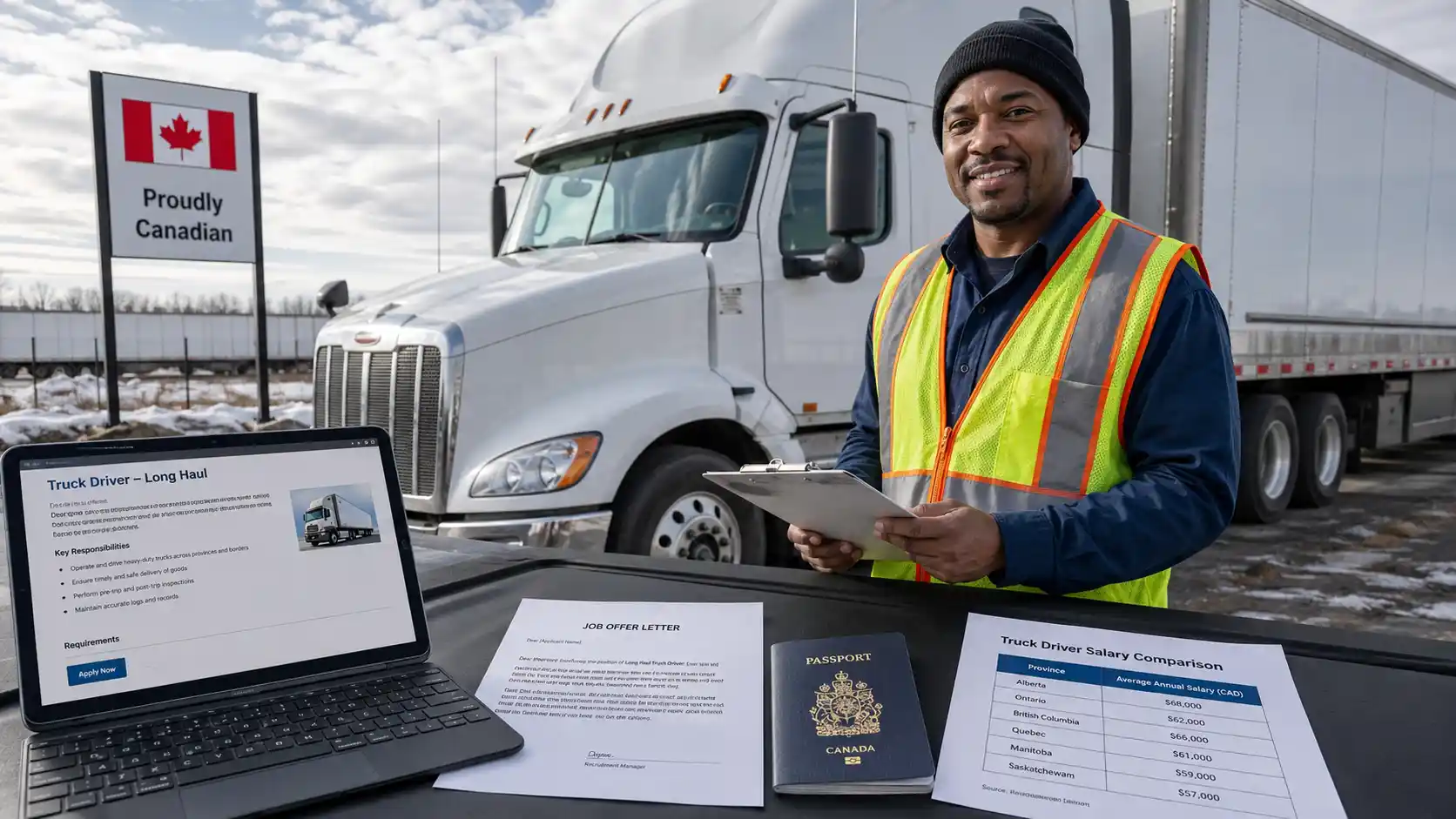
Introduction
Canada needs truck drivers. That is not a marketing slogan — it is a documented reality that has shaped immigration policy, provincial nominee programmes, and employer recruitment strategies for years. The country’s road freight network is enormous, spanning vast distances between cities and provinces, and the domestic supply of qualified commercial drivers has consistently struggled to meet demand.
For foreign workers with commercial driving experience, this creates a genuine opportunity. But it is an opportunity that requires careful understanding. The immigration pathways are real, but they are also specific, structured, and sometimes complicated. The licensing requirements are real, but they vary by province. The salaries are competitive, but they exist within a cost-of-living context that differs enormously from most countries where applicants are based.
This guide gives you the full picture. You will learn exactly which immigration routes are available for foreign truck drivers coming to Canada, what the National Occupational Classification system means for your application, how the Labour Market Impact Assessment process works, what provincial licensing requires, and what truck drivers actually earn across different parts of the country.
Whether you are coming from Nigeria, the Philippines, India, or anywhere else with commercial driving experience, this article will help you understand what the realistic path to Canada looks like — and how to approach it correctly.
This is not immigration advice. Rules change, and the specifics of your situation may differ from general guidance. Always verify current requirements through the official websites of Immigration, Refugees and Citizenship Canada (IRCC) and the relevant provincial authorities.
Table of Contents
- Why Canada Recruits Truck Drivers From Abroad
- The NOC Code for Truck Drivers in Canada: What It Means
- Work Permit Options for Foreign Truck Drivers
- The LMIA Process: How Employer Sponsorship Works in Canada
- Express Entry and Provincial Nominee Programmes for Truck Drivers
- Provincial Truck Driving Licences: What You Need to Know
- Converting a Foreign Driving Licence to a Canadian Commercial Licence
- Truck Driver Salaries Across Canadian Provinces
- Working Conditions and What to Realistically Expect
- English and French Language Requirements
- Key Things to Know
- Common Mistakes to Avoid
- Practical Tips
- Frequently Asked Questions
- Conclusion
Why Canada Recruits Truck Drivers From Abroad
Canada’s geography alone explains much of the demand. The country is the second largest in the world by land area, and road transport is the primary method of moving goods between provinces, to and from ports, and across the US border. Railways carry bulk freight, but the first and last mile — and enormous amounts of everything in between — travels by truck.
The domestic driver shortage has multiple causes. An aging workforce means experienced drivers are retiring faster than new ones are being licensed. Long-haul driving is a lifestyle that not everyone is willing to sustain over a full career. And training pipelines, while functioning, have not kept pace with the cumulative demand created by years of growth in e-commerce, construction activity, and resource extraction.
The result is that Canadian trucking employers have increasingly turned to international recruitment as a practical necessity. This is not charity toward foreign workers — it is a response to a real operational problem. Understanding that context helps you position yourself correctly when approaching employers and immigration processes.
Provinces with the most active logistics and freight sectors — Ontario, British Columbia, Alberta, and Manitoba — tend to show the most consistent demand for qualified drivers from abroad.
The NOC Code for Truck Drivers in Canada: What It Means
Canada’s immigration system uses the National Occupational Classification (NOC) framework to categorise jobs. Every occupation has a specific code, and that code determines which immigration streams you are eligible for and what the English or French language requirements might be.
NOC 73300: Transport Truck Drivers
The primary NOC code for long-haul and transport truck drivers in Canada is 73300. Under Canada’s newer TEER (Training, Education, Experience, and Responsibilities) categorisation system, this falls in TEER Category 3.
This classification is important because it determines:
- Which immigration streams you are eligible for
- What language benchmark levels you may need to demonstrate
- How your work experience is credited toward immigration points
TEER 3 occupations require completion of secondary school and several years of on-the-job training, apprenticeship, or specific occupation training programmes. It is not the highest category, but it is not the lowest either — it sits comfortably in the middle of the skilled work spectrum.
Other Related NOC Codes
Depending on your specific role, you might also encounter:
- NOC 73400: Delivery and courier service drivers (different from long-haul, not typically what people mean when they search for truck driver immigration)
- NOC 72600: Automotive service technicians and related roles (completely different occupation)
Make sure you are targeting the correct NOC code when preparing your application, as your documented experience needs to match the code you are applying under.
Work Permit Options for Foreign Truck Drivers
There are several distinct pathways through which a foreign truck driver can come to Canada to work. Each has different requirements, timelines, and implications for your longer-term situation.
Temporary Work Permit via LMIA
The most common route for foreign truck drivers entering Canada is through a temporary work permit supported by a Labour Market Impact Assessment. This requires a Canadian employer to hire you and obtain government approval to do so.
We will cover the LMIA process in detail in the next section.
Open Work Permits
Some categories of open work permit allow you to work for any employer in Canada without a specific job offer attached. These include:
- International Mobility Programme permits arising from specific trade agreements
- Spousal or dependent open work permits if your partner is a principal applicant in a specific programme
- Post-graduation work permits for people who have studied in Canada
Open work permits are generally not the primary entry route for foreign truck drivers specifically, but they can create pathways for people who arrive in Canada through another route and then pursue driving work.
Permanent Residency Pathways
For many foreign truck drivers, the goal is not just temporary work but permanent residency in Canada. This is achievable through several routes, which we cover in detail in the Express Entry and Provincial Nominee sections below.
The LMIA Process: How Employer Sponsorship Works in Canada
The Labour Market Impact Assessment is a document that Employment and Social Development Canada (ESDC) issues to employers who want to hire foreign workers. It essentially confirms that the employer has demonstrated a genuine need that cannot be filled from within the existing Canadian labour market.
How the LMIA Process Works for Truck Drivers
- The employer advertises the role in Canada for a minimum required period, demonstrating that no qualified Canadian or permanent resident was available or willing to take the position.
- The employer applies to ESDC for a positive LMIA, submitting evidence of the recruitment efforts, the job offer details, the planned wage, and the need for the role.
- ESDC reviews the application and, if satisfied, issues a positive LMIA — sometimes called a confirmation letter.
- The employer shares the LMIA with the foreign worker, who then uses it to apply for a work permit through IRCC.
- The worker applies for a work permit, submitting the LMIA reference number, the job offer letter, evidence of their qualifications and experience, and other required documents.
- If approved, the worker receives a work permit tied to the specific employer and occupation.
The High Wage vs Low Wage LMIA Stream
Canada distinguishes between high-wage and low-wage LMIA applications based on whether the offered wage is above or below the provincial or territorial median wage. Long-haul truck driving wages in most provinces typically fall above the median, meaning LMIA applications for these roles generally fall into the high-wage stream. This matters because different compliance requirements and transition plan obligations apply to each stream.
What a Positive LMIA Does Not Mean
Receiving a positive LMIA and being offered a job does not guarantee that your work permit will be approved. You still need to meet all requirements of the work permit application — health, character, immigration history, and the specifics of your documents. Never pay anyone claiming that a positive LMIA guarantees entry to Canada.
Finding Canadian Trucking Employers Who Use LMIA
This is often the most practically challenging part of the process. Not every Canadian trucking company has experience with LMIA applications, and some smaller owner-operator fleets have never done one. Larger trucking companies — particularly those with established HR departments and cross-border freight operations — are more likely to have familiarity with the process.
Canada’s Job Bank (the government-operated employment website) lists jobs where employers have indicated willingness to support foreign worker applications. This is a legitimate starting point for research. Specialist recruitment agencies that focus on transport and logistics in Canada sometimes facilitate introductions between international candidates and LMIA-willing employers.
Express Entry and Provincial Nominee Programmes for Truck Drivers
Beyond temporary work permits, Canada offers pathways to permanent residency that can include truck drivers. This is one of the most significant distinctions between Canada’s immigration approach and that of many other countries.
Express Entry
Canada’s Express Entry system manages applications for three federal economic immigration programmes:
- Federal Skilled Worker Programme (FSWP)
- Canadian Experience Class (CEC)
- Federal Skilled Trades Programme (FSTP)
Your eligibility depends on your specific NOC code, language scores, education, and experience. Transport truck drivers under NOC 73300 may qualify for some of these streams depending on their profile.
The Comprehensive Ranking System (CRS) assigns you a score based on:
- Age (younger applicants score higher, up to a threshold)
- Education level and the equivalency of foreign credentials
- Official language proficiency (English and/or French)
- Canadian and foreign work experience
- Arranged employment in Canada
- Adaptability factors
Immigration, Refugees and Citizenship Canada periodically runs targeted draws specifically for certain occupations, including transport drivers, where applicants within a specific NOC category receive invitations regardless of overall CRS score. These draws have occurred in the past and represent a significant opportunity for truck drivers — but they are not continuous, and future draws cannot be guaranteed.
The Canadian Experience Class
If you are already in Canada on a work permit and have accumulated at least one year of skilled work experience in Canada, you may be eligible for the Canadian Experience Class pathway through Express Entry. This is why many foreign truck drivers view an LMIA-based work permit not just as employment but as the first step toward permanent residency.
The CEC requires meeting language benchmarks (CLB 4 minimum for TEER 3 occupations) and having gained the experience while working with proper authorisation in Canada.
Provincial Nominee Programmes (PNPs)
Provincial Nominee Programmes allow individual Canadian provinces and territories to nominate workers for permanent residency based on their own labour market needs. This is one of the most productive routes for foreign truck drivers because several provinces have specifically included transport truck drivers in their nominee streams.
Key provinces with historical truck driver PNP streams:
- Alberta: The Alberta Advantage Immigration Programme has included semi-skilled and skilled worker streams where truck driving experience has qualified candidates.
- Saskatchewan: The Saskatchewan Immigrant Nominee Programme (SINP) has included truck drivers in its Occupation In-Demand stream.
- Manitoba: The Manitoba Provincial Nominee Programme has had streams that have accommodated truck drivers.
- British Columbia: BC PNP has streams for skilled workers in sectors experiencing shortage.
- Ontario: The Ontario Immigrant Nominee Programme has various business and skilled worker streams.
Critically, provincial programmes open and close streams based on current labour market conditions. What is available today may not be available in six months. You must check directly with each province’s immigration authority for current programme availability and eligibility.
The Advantage of a Provincial Nomination
A provincial nomination adds 600 CRS points to your Express Entry profile, which in practice makes an Invitation to Apply almost certain in the next available draw. This makes PNP pathways particularly valuable for truck drivers whose base CRS score might not be high enough to receive an invitation through a general draw.
Provincial Truck Driving Licences: What You Need to Know
Driving licences in Canada are administered provincially, not federally. This means the specific licensing requirements — including what class of licence you need, what tests are required, and how foreign licences are treated — vary depending on which province you will be working in.
Commercial Licence Classes
While there are provincial variations in naming conventions, the general framework for commercial vehicle licences across Canada looks like this:
- Class 1 (or Class A in some provinces): The highest commercial licence, required for tractor-trailer (articulated) combination vehicles. This is what most long-haul truck drivers need.
- Class 2: For buses — not relevant to most freight trucking.
- Class 3 (or Class D in some provinces): For straight trucks (rigid vehicles) over a certain weight, without a trailer over a threshold weight.
- Class 5/G: Standard car and light vehicle licence — not sufficient for commercial freight.
For long-haul trucking — the most commonly recruited category — a Class 1 (or Class A) licence is the standard requirement. If you are driving a straight truck on certain local or regional routes, a Class 3 may suffice, but Class 1 opens the most doors.
Knowledge Test and Road Test
To obtain a commercial licence in Canada, you typically need to:
- Pass a written knowledge test covering traffic laws, commercial vehicle regulations, pre-trip inspection procedures, and safety standards specific to the province
- Complete a practical road test conducted by the provincial licensing authority
- Meet medical fitness standards (including vision requirements)
- Maintain a clean driving record — commercial licence holders are held to higher standards than regular drivers
Some provinces also require an air brake endorsement if you will be operating vehicles equipped with air brakes, which includes most Class 1 vehicles.
Converting a Foreign Driving Licence to a Canadian Commercial Licence
Canada does not have a universal foreign licence exchange agreement for commercial driving licences — meaning there is no general automatic conversion from a foreign commercial licence to a Canadian equivalent.
The Province-Specific Reality
Each province handles foreign licence conversion according to its own rules. Some provinces have reciprocal agreements with specific countries for standard car licences, but commercial licence conversion is almost always more involved.
For most foreign applicants — including those from Nigeria, India, the Philippines, and other non-designated countries — the general process involves:
- Surrendering your foreign licence (in some cases)
- Applying for a provincial learner or probationary commercial licence
- Passing the province’s written knowledge test
- Completing a practical road test
In some provinces, demonstrated foreign experience may allow you to skip certain probationary periods or move directly to a road test rather than a graduated process. This varies significantly — check with the Ministry of Transportation (or equivalent) in the specific province where you will be based.
Practical Implications
In practice, many foreign truck drivers who come to Canada through an LMIA pathway have their employer’s support in navigating the licence conversion process. Larger trucking companies may provide orientation, connect new employees with training resources, and give initial work in the yard or on routes where the licence process is being completed.
Budget time for this process when planning your transition. You should not expect to arrive and immediately start driving revenue-generating routes before the provincial licensing is sorted.
Truck Driver Salaries Across Canadian Provinces
Truck driver salaries in Canada vary by province, type of freight, whether you are long-haul or local, the specific employer, and whether you are paid on a per-kilometre basis (common in long-haul) or an hourly rate.
The following are general salary ranges that reflect the market. These can change and you should always research current listings to verify what employers are actively advertising.
Ontario
Ontario is Canada’s most populous province and has the largest freight volumes. Long-haul Class 1 drivers typically earn between CAD 55,000 and CAD 80,000 annually. Local and regional delivery drivers may earn somewhat less, with rates influenced by whether work is through agencies or direct employment.
British Columbia
BC’s location as a gateway for Pacific trade and its active construction and resource sectors create strong demand. Class 1 driver salaries typically range from CAD 55,000 to CAD 85,000, with experienced drivers on specialist loads potentially earning more.
Alberta
Alberta’s oil and gas, construction, and agriculture sectors all drive strong freight demand. Long-haul drivers can earn between CAD 60,000 and CAD 90,000, and specialist work (oilfield, oversize loads) can push into six figures for experienced operators.
Saskatchewan and Manitoba
These central provinces have strong agricultural freight demands. Salaries are generally in the range of CAD 50,000 to CAD 75,000 for long-haul Class 1 work.
Quebec
Quebec has significant demand but the French language factor shapes employment dynamics. English-only drivers may find more limited options in predominantly French-speaking areas, though cross-border and long-haul work with bilingual or English-speaking employers does exist. Salaries typically range from CAD 50,000 to CAD 75,000.
Atlantic Provinces
Nova Scotia, New Brunswick, Prince Edward Island, and Newfoundland and Labrador have smaller freight markets but active provincial nominee programmes. Salaries are generally somewhat lower than the western provinces, typically CAD 45,000 to CAD 65,000.
Per-Kilometre Pay Explained
Long-haul trucking in Canada often pays by the kilometre driven rather than by the hour. Rates typically range from CAD 0.50 to CAD 0.65+ per kilometre for experienced drivers, with some carriers paying more for certain lanes or loads. This model rewards drivers who maximise miles driven but can lead to lower earnings during slow periods or when driving time is limited by cargo availability, regulatory hours-of-service rules, or seasonal factors.
Working Conditions and What to Realistically Expect
Understanding what day-to-day life actually looks like for truck drivers in Canada helps you make an informed decision rather than one based purely on salary figures.
Hours of Service Regulations
Canadian federal and provincial regulations govern how many hours a commercial driver can drive in a day and in a week, with mandatory rest requirements. These rules exist for road safety reasons and are enforced through log books (paper or electronic logging devices — ELDs). Violations can result in fines and affect your driving record.
Understanding hours-of-service compliance is part of professional driving in Canada, and employers expect drivers to manage this correctly.
Long-Haul Reality
Long-haul driving in Canada means extended time away from home — often a week or more at a time when running cross-country routes. You sleep in the truck’s sleeper berth. You eat at truck stops. Your social life and family time are significantly constrained by the lifestyle.
This is not a minor consideration. Many experienced drivers internationally underestimate the lifestyle dimension because they are focused on the salary. Be honest with yourself about whether this lifestyle is compatible with your personal situation and priorities.
Canadian Weather
Canada’s winters are severe in most provinces. Driving in snow, ice, and extreme cold requires specific skills, appropriate equipment, and careful judgment. Employers expect professional drivers to manage in these conditions, and the risks of winter driving on Canadian roads are real. If you have only driven in tropical or temperate climates, prepare yourself for this dimension of the job.
Urban Delivery vs Long-Haul
Not all truck driving jobs in Canada are long-haul. Many openings exist for local and regional delivery driving — within a city, between nearby towns, or on fixed regional circuits. These roles offer more predictable hours and more time at home, but typically pay less than long-distance runs. Whether this trade-off suits you depends on your priorities.
English and French Language Requirements
Language proficiency matters for both immigration and employment in Canada, and it is worth understanding how it affects you specifically.
For Immigration
IRCC measures language ability using the Canadian Language Benchmarks (CLB) for English or Niveaux de compétence linguistique canadiens (NCLC) for French. The minimum benchmarks required vary by immigration stream.
For the Canadian Experience Class, TEER 3 occupations typically require CLB 4 in all four abilities (reading, writing, listening, speaking). IELTS is one of the most widely used tests for demonstrating English language ability for Canadian immigration, with specific score bands corresponding to CLB levels.
Higher language scores improve your CRS score in Express Entry, which improves your chances of receiving an Invitation to Apply. Investing in language preparation before testing is one of the most direct ways to improve your immigration competitiveness.
For Employment
For most English-speaking provinces, functional spoken English is a practical requirement for employment as a truck driver. You need to communicate with dispatchers, understand delivery instructions, interact with customers and loading dock workers, and handle paperwork in English.
In Quebec, the working language is French for most employers, though English is used in some cross-border and long-haul operations. If you are targeting Quebec specifically, French language preparation is important.
Key Things to Know
- Canada’s truck driver shortage is well documented and reflected in immigration policy, but pathways require proper process and preparation
- NOC 73300 is the key classification code for transport truck drivers and determines which immigration streams apply
- LMIA-backed work permits require a Canadian employer to take specific steps before you can apply — the employer must initiate the process
- Provincial Nominee Programmes have included truck drivers in various streams, but availability changes — verify current offerings directly with each province
- Driving licences in Canada are provincial, not federal, and foreign licences generally require provincial testing rather than simple exchange
- Long-haul salaries are competitive but come with a demanding lifestyle that includes weeks away from home
- Language proficiency has a direct impact on both immigration score and day-to-day employment success
- Always verify employers and any agent or recruiter through verifiable channels before sharing personal information or paying any fees
Common Mistakes to Avoid
Paying recruiters or agents who claim to guarantee Canadian truck driving jobs. Legitimate job placement and immigration processes do not come with guarantees, and paying upfront fees for job offers — especially when you cannot verify the employer independently — is one of the most common ways people lose money to scams in this space. If someone contacts you with a Canadian truck driving job and asks for payment, be very cautious.
Assuming your foreign commercial licence transfers automatically. It does not, in most cases. Budget time and potentially some cost for the provincial licensing process before you expect to be driving commercially in Canada.
Ignoring the language requirement. Many applicants spend years hoping to qualify for Canadian immigration but never invest seriously in improving their English test scores. Your IELTS score has a direct mathematical effect on your CRS score. Treat it as seriously as any other qualification.
Not researching provincial nominee programmes thoroughly. The PNP landscape changes regularly. A stream that was open last year may be closed now, and a new one may have opened. Check current province-specific information rather than relying on articles or forum posts that may be out of date.
Underestimating the lifestyle adjustment. Long-haul driving in Canada means months of cumulative time away from home over a year, driving in Canadian winters, and adapting to a very different social environment. Researching this honestly before committing is not pessimism — it is good planning.
Using unregistered immigration consultants. In Canada, immigration consultants must be registered with the College of Immigration and Citizenship Consultants (CICC). Using someone who is not registered puts you at risk of poor advice, incorrect applications, and outright fraud. Verify any consultant’s registration before engaging them.
Failing to document your driving experience properly. When it comes time to support your immigration application or your provincial licence application with evidence of experience, you will need verifiable records — employer letters, reference contacts, logbook history if available. Start organising this documentation now rather than scrambling for it later.
Practical Tips
Start with your IELTS preparation. Whatever else you are doing to prepare, improving your English language test score is one of the most direct actions you can take to improve your Canadian immigration prospects. Register for a preparation programme, take practice tests, and understand which band scores correspond to which CLB levels for your target immigration stream.
Research which provinces are actively recruiting truck drivers right now. PNP streams open and close based on provincial labour market conditions. Checking provincial immigration websites regularly — Alberta, Saskatchewan, Manitoba, British Columbia — keeps you informed about where genuine opportunity exists at any given time.
Get a World Education Services (WES) credential evaluation if you have relevant education. For Express Entry, having your foreign credentials formally assessed by WES (or another designated organisation) adds points to your CRS score and strengthens your application. Do this early in the process rather than late.
Use Canada’s Job Bank to find LMIA-willing employers. The government’s Job Bank is a legitimate platform where employers post roles, sometimes with flags indicating willingness to support foreign worker applications. It is a useful starting point for identifying Canadian trucking employers who have experience with international recruitment.
Learn about Canadian Hours of Service regulations before you arrive. Demonstrating familiarity with Canadian HOS rules — including the federal regulations that apply to inter-provincial transport — makes you a more credible candidate in employer interviews and shows you are serious about professional standards.
Prepare financially for the transition period. Between obtaining a work permit, arriving in Canada, completing provincial licensing, and starting paid work, there can be several weeks where you are not earning income but are incurring expenses. Building a financial buffer before you begin the process reduces stress and vulnerability.
Network with Nigerians and other African nationals who have successfully qualified and are working as truck drivers in Canada. Diaspora communities often have first-hand experience to share — about specific provinces, specific employers, specific challenges — that articles like this one cannot fully capture. These conversations can be practically invaluable.
Be patient with the timeline. Realistic timelines for moving from research to employment in Canada for foreign truck drivers often run twelve to thirty-six months when you account for language preparation, documentation, finding an employer, LMIA processing, work permit processing, and provincial licensing. Build this into your expectations from the start.
Frequently Asked Questions
1. What NOC code applies to truck drivers in Canada?
Transport truck drivers fall under NOC 73300 in Canada’s current TEER-based classification system. This is the code that typically applies to long-haul and freight truck drivers. Always verify the correct code for your specific role when preparing your immigration application, as using the wrong NOC can cause problems with your application.
2. Can I come to Canada as a truck driver without a job offer?
Some Express Entry pathways do not require a job offer — your profile may be competitive enough based on language scores, education, and experience to receive an Invitation to Apply without arranged employment. However, a valid job offer with an LMIA adds significant points to your CRS score and can be decisive. Most people working toward a truck driving work permit specifically do require a job offer.
3. How long does the LMIA process take?
Processing times for LMIA applications vary and can change based on ESDC’s workload. Standard applications have taken anywhere from a few weeks to several months. Global Talent Stream applications (for different occupation types) have faster processing. Check current processing times on the ESDC website. Plan for variability rather than assuming a fixed timeline.
4. Do I need to speak French to work as a truck driver in Canada?
For most provinces outside Quebec, English is the working language and French is not required. In Quebec, French is the dominant working language, though some cross-border and long-haul operations use English. If you are not targeting Quebec specifically, strong English proficiency is what matters most.
5. Is it possible to bring my family when I come to Canada as a truck driver on a work permit?
In many cases, yes. Spouses of workers on open or employer-specific work permits may be eligible for open work permits of their own, and dependent children can often accompany the principal applicant. Specific entitlements depend on the type of work permit and the family’s situation. Verify current IRCC rules for dependants of work permit holders.
6. What is the difference between a Class 1 and Class 3 licence in Canada?
A Class 1 (or Class A) commercial licence is required for tractor-trailer combination vehicles — the large articulated trucks used in most long-haul freight work. A Class 3 (or Class D in some provinces) covers straight trucks — rigid vehicles over a certain weight without a trailer above the threshold. Long-haul trucking employers typically require Class 1.
7. Can truck driving experience in Canada lead to permanent residency?
Yes, this is a genuine pathway. After working legally in Canada on a temporary work permit for at least one year, you may qualify for the Canadian Experience Class through Express Entry. Provincial nominee programmes also offer pathways to permanent residency for truck drivers in certain provinces. Working legally in Canada first and then applying for PR is a well-trodden path.
8. Are there any free programmes that help foreign truck drivers come to Canada?
Be very cautious about anything described as free. While some provinces have publicly funded immigrant integration resources, there is no general government programme that places foreign nationals in Canadian truck driving jobs at no cost to the worker. Legitimate costs include immigration application fees, language testing, credential evaluations, and provincial licensing fees. Anyone claiming to offer completely free arrangements should be verified thoroughly.
9. What happens to my work permit if my Canadian employer terminates my employment?
A standard employer-specific work permit ties you to that employer. If the employment ends, your work permit may technically no longer authorise you to work. Canada has provisions — including the Maintained Status rule — that can give you time to find a new employer and apply to change conditions, but this is a real and important risk to understand. Discuss the implications with a registered immigration consultant before your situation changes.
10. How does the per-kilometre pay model work and is it better than hourly?
Per-kilometre pay compensates you based on the distance you drive rather than the hours you work. At rates of CAD 0.50 to CAD 0.65 or more per kilometre, an active long-haul driver running significant distances can earn very well. However, during slow freight periods, adverse weather, waiting time at loading docks (which may or may not be compensated separately), or when hours-of-service regulations limit your driving, your earnings can drop. Hourly pay provides more predictability. Neither model is universally better — it depends on your driving patterns and the employer.
11. What medical requirements do I need to meet to drive commercially in Canada?
Commercial drivers in Canada must meet medical fitness standards set by the province and — for inter-provincial and international operations — federal standards. These cover vision, hearing, cardiovascular health, and conditions that could affect safe driving. You will need to pass a medical examination by a licensed physician. Certain conditions may disqualify you or require special assessment. Check the standards for the specific province and the applicable federal regulations before beginning the process if you have any health concerns.
12. What English language test scores do I need for Canadian immigration as a truck driver?
For the Canadian Experience Class with a TEER 3 occupation, the minimum is CLB 4 in all four language abilities (reading, writing, listening, speaking). In IELTS General Training terms, CLB 4 generally corresponds to approximately band 4.0–4.5 across components. However, higher scores significantly increase your CRS score and immigration competitiveness. Aim for CLB 7 or above (approximately IELTS 6.0) if your goal is to maximise your Express Entry score rather than merely meeting the minimum.
Conclusion
Canada offers one of the most structured and genuine immigration pathways for foreign truck drivers of any country in the world. The demand is real. The pathways — LMIA work permits, Express Entry targeted draws, Provincial Nominee Programmes — are established and documented. The salaries are competitive. And the ability to convert temporary work experience into permanent residency makes Canada genuinely different from destinations that offer employment without long-term settlement options.
But getting there requires serious, systematic preparation. Your language scores matter enormously. Your documentation of experience needs to be thorough and verifiable. Your choice of province affects which PNP opportunities are available to you. The employer you work with shapes your initial experience and your ability to build toward permanent residency. And the lifestyle of long-haul truck driving in Canada — the winters, the distances, the weeks away from home — is something to understand clearly before committing.
The path is real. It is not quick, and it is not simple. But for foreign truck drivers who approach it correctly, with accurate information, proper documentation, and realistic expectations, it leads somewhere genuinely worth reaching.
Start with your language preparation. Research current provincial programmes. Build your documentation. Use official and verifiable sources. And protect yourself from the scams and fraudulent offers that, unfortunately, target people searching for exactly this kind of opportunity.
Canada is a country that has historically welcomed skilled workers who contribute to its economy. Truck drivers are among those it needs. Getting there through the right process is the only way to make the opportunity real.