Introduction
Canada’s trucking industry has a genuine, long-documented shortage of qualified drivers, and that shortage has made its way into immigration policy through targeted occupational draws and provincial nomination streams. For foreign applicants researching this path, two questions usually come up immediately: what does a truck driver actually earn in Canada, and how realistic is visa sponsorship in practice?
This article answers both honestly. It walks through how Canadian truck driver salaries actually break down by province, vehicle type, and experience level, then explains how the relevant visa categories work, what a Labour Market Impact Assessment involves, and how provincial and federal immigration programs connect to this specific occupation. The goal is to give you a grounded, accurate picture rather than the inflated figures and oversimplified promises that circulate widely online.
Canadian immigration policy and wage data both change over time, so always verify current figures and requirements through Immigration, Refugees and Citizenship Canada (IRCC) and Statistics Canada before making decisions based on any single source.
Table of Contents
- Why Canada Has a Genuine Truck Driver Shortage
- Realistic Truck Driver Salaries Across Canadian Provinces
- How Pay Varies by Vehicle Type and Experience
- The NOC Code for Truck Drivers and Why It Matters
- Work Permit Routes: LMIA and the Temporary Foreign Worker Program
- Express Entry and the Federal Skilled Trades Program
- Provincial Nominee Programs and Truck Driving
- What a Genuine Job Offer Should Look Like
- Licensing and Certification Requirements Once You Arrive
- Cost of Living Versus Salary: The Real Take-Home Picture
- Key Things to Know
- Common Mistakes to Avoid
- Practical Tips
- Frequently Asked Questions
- Conclusion
Why Canada Has a Genuine Truck Driver Shortage
Canada’s trucking industry moves the overwhelming majority of consumer goods, food, and manufactured products across the country, and the shortage of qualified long-haul and local drivers has been documented by industry associations and government labour market reports for years. An aging driver workforce approaching retirement, the demanding lifestyle of long-haul driving, and the sheer scale of distances involved in Canadian freight all contribute to sustained demand.
This shortage is genuine, and it has led to truck driving being included in targeted Express Entry draws and various provincial nomination streams at different points. However, a documented shortage at the national level does not mean every individual driver or every individual application results in a smooth, fast outcome. The shortage explains why the pathway exists; it does not remove the specific requirements you need to meet.
Realistic Truck Driver Salaries Across Canadian Provinces
Salaries for truck drivers in Canada vary meaningfully by province, reflecting differences in cost of living, regional demand, and the type of freight work available.
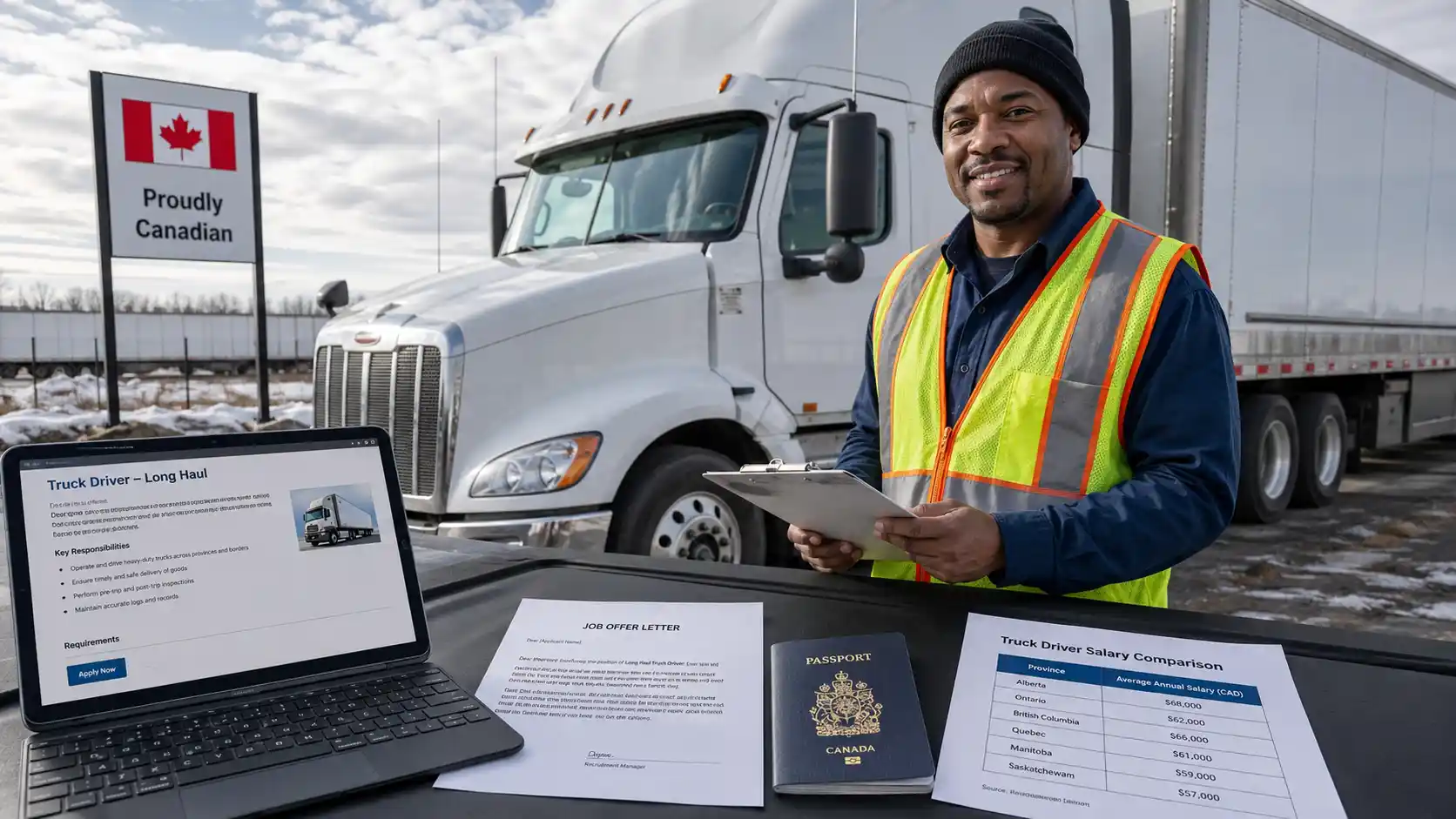
In Ontario, long-haul truck drivers typically earn in the range of CAD 50,000 to CAD 75,000 annually, with experienced drivers on dedicated routes sometimes earning more.
In Alberta, pay tends to run somewhat higher, often CAD 55,000 to CAD 80,000 annually, partly reflecting the province’s resource and industrial sectors, which generate significant freight demand.
In British Columbia, salaries are generally comparable to Alberta, often CAD 52,000 to CAD 78,000 annually, though the higher cost of living in cities like Vancouver affects how far this stretches.
In Manitoba and Saskatchewan, salaries tend to be somewhat lower in nominal terms, often CAD 45,000 to CAD 68,000 annually, but the cost of living is also generally lower than in Ontario or British Columbia.
In Quebec, pay is broadly comparable to Ontario, typically CAD 48,000 to CAD 72,000 annually, though French language ability is a genuine practical advantage for day-to-day work in much of the province.
These figures represent general ranges drawn from typical market patterns rather than fixed guarantees, and actual pay depends heavily on the specific employer, route type, and your own experience and qualifications. Always check current wage data through Statistics Canada’s Job Bank wage reports for the most accurate, up-to-date figures by region.
How Pay Varies by Vehicle Type and Experience
Beyond province, the type of driving work significantly affects earnings.
Long-haul drivers, who spend extended periods away from home covering interprovincial or cross-border routes, generally earn more than local or regional drivers, often because compensation is partly structured around mileage or load volume rather than a flat hourly rate.
Local and regional drivers, who typically return home daily or every few days, generally earn somewhat less than long-haul drivers but benefit from a more predictable schedule and lifestyle.
Drivers operating specialized vehicles, such as tanker trucks, flatbeds for oversized loads, or vehicles requiring additional certifications (such as transporting dangerous goods), often command higher pay due to the additional training, certification, and responsibility involved.
Experience matters considerably. A newly licensed driver entering the Canadian market typically starts toward the lower end of these ranges, while drivers with several years of clean driving record and route experience can negotiate toward the higher end, particularly with larger, established carriers.
The NOC Code for Truck Drivers and Why It Matters
Canada’s immigration system classifies occupations using the National Occupational Classification (NOC) system, and truck drivers fall under a specific NOC code within this framework. This matters because eligibility for various immigration programs, including targeted Express Entry draws and certain provincial nominee streams, is tied directly to the correct NOC code for your role.
If you are researching immigration pathways, make sure any job offer or work experience documentation accurately reflects this specific occupational classification, since mismatched or incorrect NOC coding can create real problems at the application stage. Always verify the current NOC code and its associated requirements directly through the official IRCC and Job Bank resources, since classification systems are periodically updated.
Work Permit Routes: LMIA and the Temporary Foreign Worker Program
For most foreign truck drivers without existing Canadian status, the most common entry point is a temporary work permit supported by a Labour Market Impact Assessment.
How the LMIA Process Works
A Canadian employer who wants to hire a foreign truck driver generally needs to demonstrate, through the LMIA process, that there are not enough qualified Canadian citizens or permanent residents available to fill the position, and that hiring a foreign worker will not negatively affect the Canadian labour market. This involves the employer advertising the position domestically for a specified period and documenting the results before applying for a positive LMIA.
What a Positive LMIA Means for You
Once an employer receives a positive LMIA, you can use it to apply for a temporary work permit. This permit is generally tied to that specific employer, meaning changing jobs typically requires a new LMIA-supported application unless you later qualify for an open work permit through another pathway.
Processing Realities
LMIA processing times vary and depend on current government processing volumes, the completeness of the employer’s application, and the specific occupation category. Genuine driver shortage occupations have, at times, benefited from somewhat more streamlined processing, but this is not guaranteed and changes with policy updates. Always check current LMIA processing time estimates through Employment and Social Development Canada (ESDC).
Express Entry and the Federal Skilled Trades Program
Express Entry is Canada’s primary system for managing permanent residency applications across several economic immigration programs, and the Federal Skilled Trades Program (FSTP) is the stream most relevant to truck drivers, depending on current program parameters and how the occupation is classified at the time of your application.
Eligibility for FSTP generally requires meeting specific work experience thresholds, language proficiency requirements, and either a valid job offer or, in some cases, a certificate of qualification, depending on the occupation. Truck driving’s eligibility under skilled trades pathways has shifted over time as occupational classifications and program rules are reviewed, so this is an area where checking current IRCC guidance directly is especially important rather than relying on older information.
Targeted Express Entry draws, where IRCC issues invitations to candidates in specific occupational categories regardless of their overall ranking score, have periodically included truck driving and related transportation occupations. These targeted draws are not a permanent or guaranteed feature, but they reflect the genuine, recognized shortage in this occupation at a federal level.
Provincial Nominee Programs and Truck Driving
Several Canadian provinces have, at various points, included truck driving in their own provincial nominee program streams, recognizing regional shortages that may be more acute or differently distributed than the national picture.
Saskatchewan and Manitoba, in particular, have historically shown interest in trucking and transportation occupations through their nominee programs, given the significant agricultural and resource-related freight demand in these provinces. Alberta and British Columbia have also had relevant streams at different times.
Provincial programs typically require either a qualifying job offer from an employer in that specific province or, in some streams, sufficient connection and work experience demonstrating genuine intent to settle there. Because these programs are reviewed and adjusted by each province independently, current eligibility and stream availability should always be confirmed directly through the relevant provincial immigration website rather than assumed based on past program structures.
What a Genuine Job Offer Should Look Like
A legitimate Canadian truck driving job offer tied to a work permit or immigration pathway should come from a verifiable, registered Canadian business, ideally one with a documented history of operations rather than a company that appears to have been recently formed solely to make international offers.
The offer should specify clear terms: the wage, the type of driving work involved, the expected schedule, and which specific visa or work permit route the employer intends to pursue. If an LMIA is involved, the employer is responsible for that process and its associated costs, not you. Any request for payment from you to secure the job offer, process documentation, or “guarantee” a positive LMIA outcome is a serious warning sign and is not how this system legitimately operates.
You can verify a Canadian company’s registration through the relevant provincial corporate registry, and you can research whether the company has any history of labour market disputes or complaints through publicly available government resources.
Licensing and Certification Requirements Once You Arrive
Holding a valid work permit does not automatically authorize you to drive commercially in Canada. Provincial driving licensing is a separate requirement, and most provinces require foreign drivers to obtain a Canadian commercial driver’s licence appropriate to the province where they will be working.
This generally involves passing a knowledge test, a road test, and meeting medical fitness standards, and the specific class of licence required depends on the type of vehicle you will be driving. Some provinces offer pathways that recognize prior foreign driving experience to a degree, potentially shortening certain steps, but this varies significantly and should be researched directly through the relevant provincial transportation ministry well before you plan to start working.
Cost of Living Versus Salary: The Real Take-Home Picture
A salary figure on its own does not tell you what your actual financial situation will look like, and this is especially true when comparing provinces with significantly different living costs.
Ontario and British Columbia offer relatively higher nominal salaries in some cases but also carry a higher cost of living, particularly around major cities like Toronto and Vancouver. Manitoba and Saskatchewan offer somewhat lower nominal salaries but a meaningfully lower cost of living, which can result in comparable or better real purchasing power.
Long-haul driving income, because it is sometimes tied to mileage or load volume, can also vary month to month depending on freight availability, weather, and route assignments, meaning your actual annual income may differ from a flat advertised salary figure. Understanding this variability before you commit helps you plan realistically rather than assuming a fixed, guaranteed monthly amount.
Key Things to Know
Canadian truck driver salaries vary significantly by province, vehicle type, and experience, generally ranging from roughly CAD 45,000 to CAD 80,000 annually.
Most foreign applicants enter through an LMIA-supported work permit, which requires a Canadian employer to demonstrate genuine need before hiring internationally.
Express Entry and provincial nominee programs have, at various times, included truck driving, but eligibility and program availability change and must be verified directly through official sources.
A Canadian provincial commercial driver’s licence is required separately from your work permit or visa, and this process has its own requirements and timeline.
Legitimate employers and the LMIA process do not involve fees charged to the worker, and any such request is a serious warning sign.
Common Mistakes to Avoid
Assuming a documented national shortage means every job offer or recruiter claim is automatically legitimate. Verification of the specific employer remains essential regardless of how genuine the broader shortage is.
Treating advertised salary figures as guaranteed fixed income without understanding how mileage-based or load-based pay structures can cause real income to vary.
Overlooking the separate provincial licensing requirement and assuming a work permit alone authorizes you to drive commercially in Canada.
Paying any individual or agency a fee to secure a job offer, process an LMIA, or guarantee a visa outcome.
Relying on outdated information about which immigration programs currently include truck driving, when program eligibility and targeted draws change over time.
Practical Tips
Research current wage data for your specific target province through the Job Bank wage report tool before evaluating any job offer, since this gives you a realistic regional benchmark.
Ask any prospective employer directly which specific visa or work permit route they intend to use and at what stage their LMIA application currently stands, if applicable.
Verify the employer’s business registration through the relevant provincial corporate registry before proceeding further with any application.
Research the specific provincial commercial licensing requirements for your target province well before you expect to arrive, since this process has its own timeline separate from your immigration application.
Check current IRCC and provincial nominee program websites directly for the most up-to-date information on whether truck driving currently qualifies under any specific federal or provincial stream, since this changes periodically.
Frequently Asked Questions
1. What is a realistic salary for a truck driver in Canada?
Realistic salaries generally range from about CAD 45,000 to CAD 80,000 annually depending on province, vehicle type, route, and experience. Long-haul and specialized driving roles tend toward the higher end, while local and regional driving with less specialized requirements tends toward the lower end.
2. Do I need a job offer to apply for a Canadian truck driving work permit?
In most cases, yes. The most common route, an LMIA-supported work permit, requires a specific Canadian employer to initiate the process on your behalf. Some permanent residency pathways may not strictly require a job offer, but having one generally strengthens an application.
3. What is an LMIA and why does it matter for truck drivers?
A Labour Market Impact Assessment is a document Canadian employers must generally obtain before hiring most foreign workers, demonstrating that there is a genuine need and that hiring internationally will not negatively affect the domestic labour market. A positive LMIA is typically required before you can apply for the related work permit.
4. Can truck driving lead to permanent residency in Canada?
It can, through programs such as the Federal Skilled Trades Program under Express Entry or various provincial nominee programs, depending on current eligibility rules and whether the occupation is included in current program parameters at the time of your application.
5. Which Canadian province pays truck drivers the most?
Alberta and British Columbia generally show somewhat higher nominal salary ranges in available wage data, though Ontario and Quebec also offer competitive pay. Always check current wage data for the most accurate comparison, since figures shift over time.
6. Do I need a Canadian driving licence even if I already have a work permit?
Yes. A work permit authorizes you to work in Canada, but driving commercially requires a separate provincial commercial driver’s licence appropriate to the vehicle type and province where you will be working.
7. Is it true that Canada has special immigration draws specifically for truck drivers?
Canada has, at various points, run targeted Express Entry draws that included truck driving and related transportation occupations, reflecting the genuine documented shortage. These targeted draws are not a permanent, guaranteed feature and depend on current government priorities, so checking current IRCC announcements is important.
8. How long does the LMIA and work permit process typically take?
Processing times vary considerably depending on government processing volumes, the completeness of the application, and the specific program stream used. There is no fixed universal timeline, and current estimates should be checked through Employment and Social Development Canada and IRCC directly.
9. Should I pay a recruiter to help me find a Canadian trucking job?
Be cautious. Legitimate recruitment agencies typically charge fees to employers rather than workers for placement services, and any request for you to pay for a job offer, an LMIA, or a guaranteed visa outcome is a significant warning sign that should be investigated thoroughly before proceeding.
10. Does prior international driving experience count toward Canadian licensing requirements?
Some provinces consider documented prior driving experience when assessing applicants for a Canadian commercial licence, potentially affecting certain steps in the process, but this varies by province and is not a guarantee of automatic recognition. Check directly with the relevant provincial transportation ministry for specifics.
Conclusion
Canada’s truck driver shortage is real, and it has created genuine, structured pathways for foreign applicants through LMIA-supported work permits, targeted Express Entry draws, and provincial nominee programs. But realistic salaries, while solid, vary considerably by province and role, and the visa process involves specific verification steps, employer obligations, and separate provincial licensing requirements that take time to navigate properly.
Approaching this opportunity with accurate wage expectations, a clear understanding of which visa route actually applies to your situation, and a habit of independently verifying any employer or recruiter will put you in a far stronger position than relying on inflated promises. The opportunity is genuine for well-prepared applicants who take the process seriously and verify each step through official Canadian sources.