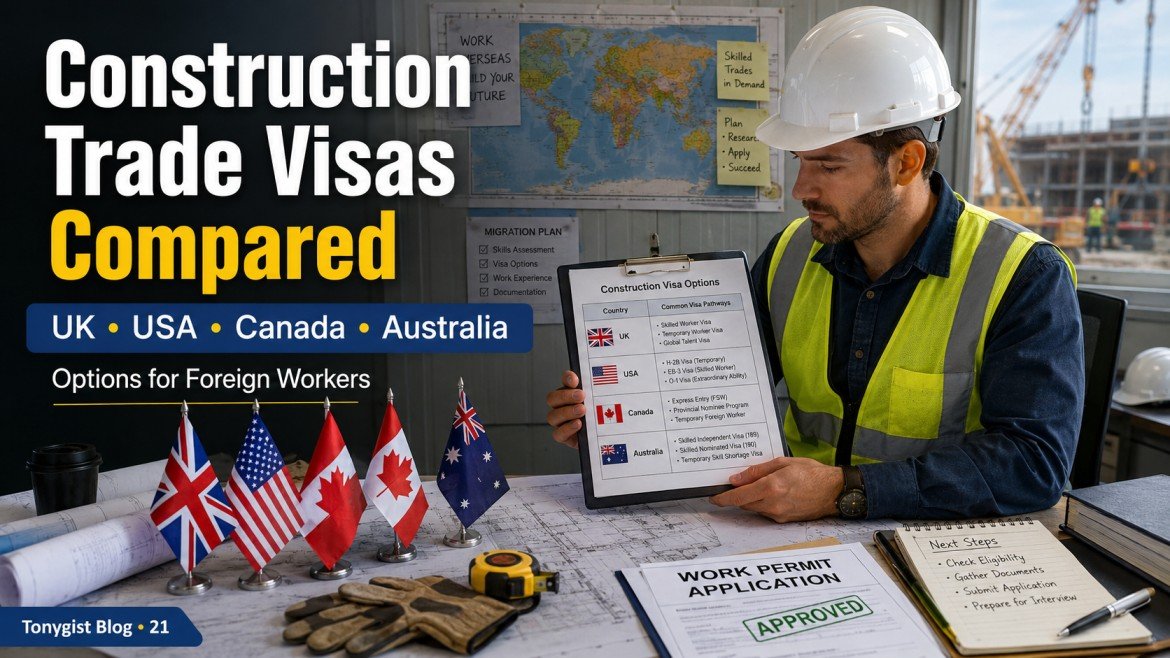
If you are a tradesperson considering working abroad, you have probably noticed that every country handles foreign construction workers differently. The UK has one process. The United States has several narrow, capped categories. Canada has its own provincial and federal systems. Australia runs a points-based model with trade-specific assessments. Trying to research all four at once usually leaves people more confused than when they started.
ADVERTISEMENT
This guide puts the four side by side so you can see the real differences clearly. It covers how each country’s visa system actually works for construction trades, what qualifications and certifications are typically required, how each country’s labor shortage translates (or does not translate) into accessible sponsorship, and what realistic timelines and pay look like in each.
None of these systems offer guaranteed outcomes, and immigration policy in all four countries changes regularly. Use this comparison to understand the landscape and to know what specific official sources to check before making decisions, rather than as a final authority on current rules.
Table of Contents
Why Comparing These Four Countries Matters
The UK: Skilled Worker Visa and Sponsor Licensing
The USA: H-2B, EB-3, and the Absence of a General Skilled Visa
Canada: Federal and Provincial Pathways for Trades
Australia: Skills Assessment and the Points-Based System
Side-by-Side Comparison of Eligibility Requirements
Side-by-Side Comparison of Processing Times
Side-by-Side Comparison of Realistic Pay
Qualification Recognition Across the Four Countries
Which Country Offers the Clearest Pathway for Which Trade
Key Things to Know
Common Mistakes to Avoid
Practical Tips
Frequently Asked Questions
Conclusion
Why Comparing These Four Countries Matters
Each of these four countries has a genuine, well-documented shortage of skilled construction workers. Each also has a completely different immigration architecture for addressing it. Understanding these differences early can save you months of effort directed at the wrong country or the wrong visa category for your specific trade and circumstances.
A welder with strong international certifications might find Canada’s system more accessible than the United States. An electrician with formal UK-style training might fit the UK’s framework more naturally than Australia’s. A civil engineer has different and generally easier options than a general tradesperson in almost all four countries, because professional, degree-requiring roles tend to have broader visa access than hands-on trades.
The UK: Skilled Worker Visa and Sponsor Licensing
The UK operates under a single primary system for most foreign workers: the Skilled Worker Visa. This requires three things to align at once: an employer holding a valid Home Office Sponsor Licence, a role that appears on the Appendix Skilled Occupations list under the correct occupational code, and a salary that meets both the general minimum threshold and the specific going rate for that occupation.
For construction, this generally means that supervisory, professional, and certain formally qualified trade roles (site managers, quantity surveyors, civil engineers, and electricians or plumbers with recognized UK-equivalent qualifications) have a realistic, if specific, pathway. General labor and entry-level roles typically fall below the salary threshold and are not commonly sponsored.
The UK does not use an annual cap or lottery system for the Skilled Worker Visa itself, which distinguishes it from the US system. The constraint in the UK is finding an employer who both holds a sponsor licence and is willing to undertake the process, since many UK construction firms are small and do not hold one.
The USA: H-2B, EB-3, and the Absence of a General Skilled Visa
The United States has no broad, general skilled worker visa comparable to the UK’s system. Instead, construction-relevant options sit in a small number of narrower categories.
H-2B covers temporary, non-agricultural labor and is the category most directly used for construction work, but it carries an annual numerical cap split across two halves of the fiscal year, and a lottery is used when demand exceeds the cap. This creates genuine unpredictability even when an employer follows the process correctly.
EB-3 offers a permanent pathway (leading to a green card) through skilled worker and “other worker” subcategories, but it requires a lengthy labor certification process through the Department of Labor and often takes well over a year, sometimes considerably longer depending on backlogs for your country of origin.
H-1B, the most internationally known US visa, generally does not apply to hands-on construction trades because it requires a role that genuinely needs a bachelor’s degree, which excludes most trade positions but can apply to civil or structural engineering roles.
Canada: Federal and Provincial Pathways for Trades
Canada’s system is built around the National Occupational Classification (NOC) and offers more dedicated trade-specific routes than the US or UK.
The Federal Skilled Trades Program, part of the Express Entry system, is specifically designed for trades occupations and requires either a valid job offer or a certificate of qualification from a Canadian provincial or territorial body, along with a minimum amount of relevant work experience.
Provincial Nominee Programs add another layer, since individual provinces can nominate workers in trades facing specific regional shortages, sometimes with more accessible criteria than the federal system alone.
The Red Seal program, Canada’s interprovincial standard for skilled trades, allows tradespeople certified in one participating province to have that certification recognized across others, which matters once you are working in Canada and considering relocation between provinces.
Australia: Skills Assessment and the Points-Based System
Australia uses a points-based skilled migration system, and for trades specifically, a mandatory skills assessment through a recognized assessing authority is required before you can apply for most relevant visa subclasses.
Trades Recognition Australia (TRA) is the primary skills assessment body for many construction trades, evaluating your qualifications and work experience against Australian standards. A positive assessment is generally a prerequisite, not a guarantee of a visa, but it is a necessary first step.
Australia’s skilled occupation lists determine which trades are eligible for which visa subclasses, and these lists are reviewed periodically. Regional visa options sometimes have lower competition than visas tied to major cities, since Australia actively encourages skilled migration to regional areas facing more acute shortages.
Side-by-Side Comparison of Eligibility Requirements
The UK requires a sponsoring employer with a valid licence and a role meeting salary thresholds, with qualification recognition handled informally through UK-specific assessment bodies depending on the trade.
The USA requires a US employer to initiate a specific visa category (H-2B or EB-3 for most trades) and separately requires state-specific trade licensing once you are working.
Canada requires either a job offer, a provincial nomination, or in some cases a certificate of qualification, combined with a formal skills and experience assessment depending on the specific program.
Australia requires a formal skills assessment from a recognized authority before visa application, combined with meeting the points threshold for the relevant visa subclass.
Side-by-Side Comparison of Processing Times
UK Skilled Worker Visa processing, once a Certificate of Sponsorship is issued, is often measured in weeks rather than months for the visa decision itself, though finding a sponsoring employer can take considerably longer.
US H-2B processing is tied to the cap and lottery cycle, meaning timing relative to the cap release dates matters enormously, and EB-3 processing often extends well beyond a year due to labor certification and backlog factors.
Canada’s Express Entry-linked programs can move relatively quickly once you have a complete profile and meet eligibility, though provincial nomination programs vary in their own processing timelines.
Australia’s skills assessment process itself can take several months before you are even in a position to apply for the relevant visa subclass, after which visa processing times add further time.
Side-by-Side Comparison of Realistic Pay
In the UK, qualified tradespeople typically earn in the range of £30,000 to £45,000 annually, with supervisory and professional roles considerably higher.
In the USA, equivalent skilled trades typically earn $45,000 to $75,000 annually depending heavily on state, union status, and specialization.
In Canada, skilled trades under the Red Seal system typically earn CAD 50,000 to CAD 80,000 annually, with regional variation, particularly higher in provinces with strong resource or construction sectors.
In Australia, skilled trades often earn AUD 60,000 to AUD 90,000 annually, reflecting both higher wage levels generally and the country’s documented shortages in several trades.
These figures are general guides only and vary by specific trade, experience, employer, and region within each country.
Qualification Recognition Across the Four Countries
The UK relies on bodies like the Joint Industry Board for electricians and NVQ-equivalent assessment for other trades, generally requiring some form of UK-specific bridging or testing for foreign-trained workers.
The USA handles trade licensing at the state level, meaning your foreign qualification is assessed (or more often, simply not recognized) according to whichever state you intend to work in, requiring you to go through that state’s specific licensing process.
Canada uses the Red Seal program as a national standard, and provincial apprenticeship authorities assess foreign qualifications and experience against Canadian benchmarks, sometimes granting credit toward the Red Seal exam based on documented experience.
Australia’s Trades Recognition Australia conducts a structured comparison of your qualifications and experience against Australian standards, producing a formal outcome that either supports your visa application or identifies gaps you would need to address.
Which Country Offers the Clearest Pathway for Which Trade
For electricians and plumbers with strong, well-documented qualifications, Canada’s Red Seal recognition process and Australia’s TRA assessment tend to offer clearer, more structured pathways than the more fragmented US state-by-state licensing system.
For welders, particularly those with internationally recognized certifications (AWS, ASME, ISO standards), all four countries offer reasonably accessible recognition, since welding certification standards are more globally aligned than other trades.
For civil and structural engineers, the UK’s Skilled Worker Visa and the US H-1B (despite its lottery) both become realistic options because these roles meet the degree-level and salary requirements that hands-on trades often do not.
For general construction labor without formal trade qualification, none of the four countries offer a particularly accessible sponsored pathway, since entry-level wages in all four typically fall below relevant thresholds or fail to justify the sponsorship process from an employer’s perspective.
Key Things to Know
The UK and Canada generally offer more structured, predictable pathways for qualified trades than the USA, where lottery-based caps create more uncertainty.
Australia’s mandatory skills assessment adds an extra upfront step but provides clarity about where you stand before you invest further time and money.
No country offers a general, simple visa route for unqualified general labor.
State, provincial, and trade-specific licensing requirements exist on top of the visa itself in all four countries and are frequently underestimated.
Engineering and professional construction roles generally have broader and faster visa access than hands-on trades across all four countries.
Common Mistakes to Avoid
Assuming that because all four countries have labor shortages, sponsorship is equally accessible everywhere. The structures differ significantly, and some are considerably more restrictive than others.
Researching only the visa and overlooking trade licensing requirements at the state or provincial level, which can add significant additional time and cost.
Treating the US H-1B as relevant to general construction trades when it is almost exclusively used for degree-requiring engineering roles.
Underestimating how long the Australian skills assessment process takes before you can even apply for a relevant visa.
Believing online content that promises guaranteed outcomes in any of these systems, when all four involve real uncertainty, caps, or assessment outcomes that are not predetermined.
Practical Tips
Identify your specific trade and qualification level first, then research which country’s recognition process most closely matches what you already hold, rather than starting from “which country is easiest” in the abstract.
If you are a welder with internationally recognized certification, prioritize researching all four countries, since this trade transfers more easily than most others.
If you are an engineer, focus your research on the UK Skilled Worker Visa and US H-1B before considering trade-specific pathways in Canada or Australia, since your degree changes which categories are realistically available.
Begin any required skills assessment (Australia’s TRA, Canada’s provincial assessment) as early as possible, since these processes take time and clarify your realistic options before you commit further.
Always verify current cap numbers, processing times, and eligibility criteria directly through each country’s official immigration website, since all four systems are reviewed and adjusted periodically.
Frequently Asked Questions
1. Which country has the most straightforward visa process for construction trades?
The UK and Canada generally offer more structured and predictable processes than the USA, mainly because the US relies on capped, lottery-based categories for most construction trade work. Australia’s process is structured but requires a mandatory skills assessment as an additional upfront step.
2. Do any of these countries offer permanent residency for construction trades?
Canada’s Federal Skilled Trades Program and Provincial Nominee Programs can lead to permanent residency. The US EB-3 category also leads to a green card, though with a longer timeline. The UK Skilled Worker Visa can lead to settlement after a qualifying period. Australia’s skilled migration visas can similarly lead to permanent residency depending on the subclass.
3. Which country is best for welders specifically?
Welders with internationally recognized certifications (AWS, ASME, ISO) tend to find relatively accessible recognition across all four countries, since welding standards are more globally aligned than electrical or plumbing codes, which vary more by country.
4. Is it harder to get a US construction visa than a UK one?
Generally, yes, for most trades, because the US system relies on capped categories with lottery allocation (H-2B) or lengthy permanent pathways (EB-3), while the UK’s Skilled Worker Visa has no cap, making the constraint primarily about finding a licensed sponsoring employer.
5. Does Australia require a specific test before applying for a trade visa?
Yes, in most cases. A skills assessment through a recognized authority such as Trades Recognition Australia is generally required before you can apply for the relevant skilled migration visa subclass.
6. Can general laborers get sponsored in any of these four countries?
It is uncommon across all four. General labor roles typically pay below relevant salary or wage thresholds and are not commonly prioritized by employers for the sponsorship process, regardless of country.
7. How does Canada’s Red Seal program help foreign tradespeople?
The Red Seal program provides a national standard for trade certification that is recognized across participating provinces. Foreign-trained tradespeople can have their experience assessed against this standard, sometimes receiving credit toward the certification exam.
8. Are civil engineers treated differently from tradespeople in these visa systems?
Yes, significantly. Civil and structural engineers, due to their degree requirements, qualify for visa categories like the UK Skilled Worker Visa and US H-1B that are generally not available to hands-on trades without a bachelor’s degree.
9. How long does the Australian TRA skills assessment take?
Processing times vary, but the assessment process often takes several months, and you generally cannot proceed with your visa application until you receive the outcome. Check current processing time estimates directly through TRA.
10. Which country has the highest pay for skilled trades?
Based on general wage ranges, Australia and the USA tend to offer higher nominal pay for skilled trades compared to the UK, though cost of living, taxation, and regional variation within each country significantly affect real purchasing power.
Conclusion
The UK, USA, Canada, and Australia each take a genuinely different approach to bringing foreign construction workers into their labor markets, and none of them offer a simple, universal solution. The UK and Canada generally provide more structured and predictable pathways for qualified tradespeople, the USA’s system is narrower and shaped by annual caps and lottery allocation, and Australia requires a formal skills assessment as a clear upfront gate before visa application.
The right country for you depends heavily on your specific trade, your existing qualifications, and how much time and uncertainty you are prepared to work through. Researching the specific official requirements for your trade in each country, rather than relying on general assumptions about which country is “easiest,” will give you a far more realistic picture of where your effort is most likely to lead somewhere.